 Add to Chrome
 Add to Firefox
 Add to Edge
Causal Reinforcement Learning for Complex Card Games: A Magic The Gathering Benchmark
May 07, 2026
Causal reinforcement learning (RL) lacks benchmarks for complex systems that combine sequential decision making, hidden information, large masked action spaces, and explicit causal structure. We introduce MTG-Causal-RL, a Gymnasium benchmark built on Magic: The Gathering with a 3,077-dimensional partial observation, a 478-action masked discrete action space, five competitive Standard archetypes, three reward schemes, and a hand-specified Structural Causal Model (SCM) over strategic variables. Every episode exposes causal variables, SCM-predicted intervention effects, and per-factor credit traces, making causal credit assignment, leave-one-out cross-archetype transfer, and policy auditability first-class metrics. We adapt a panel of reference baselines: random, heuristic, masked PPO, a causal-world-model PPO variant, and an architecture-matched scalar control. We propose Causal Graph-Factored Advantage PPO (CGFA-PPO) as a reference causal agent that uses SCM parents of win probability as factor-aligned critic targets with an intervention-calibration loss. All comparisons use paired seeds, paired-bootstrap confidence intervals, and Holm-Bonferroni correction within pre-registered families. Masked PPO and CGFA-PPO reach competitive in-distribution win rates and exceed the random baseline; per-factor calibration trajectories and leave-one-out transfer gaps expose diagnostic structure that scalar win rate alone cannot. We release the benchmark, reference-baseline results, and full evaluation protocol openly. By coupling a strategically rich, partially observed domain with an explicit causal interface and statistical protocol, MTG-Causal-RL gives causal-RL, world-model, and LLM-agent research a shared testbed for questions current benchmarks cannot pose together: causal credit assignment under masked action spaces, structural transfer across archetypes, and SCM-grounded policy auditability.

Unifying Causal Reinforcement Learning: Survey, Taxonomy, Algorithms and Applications
Dec 19, 2025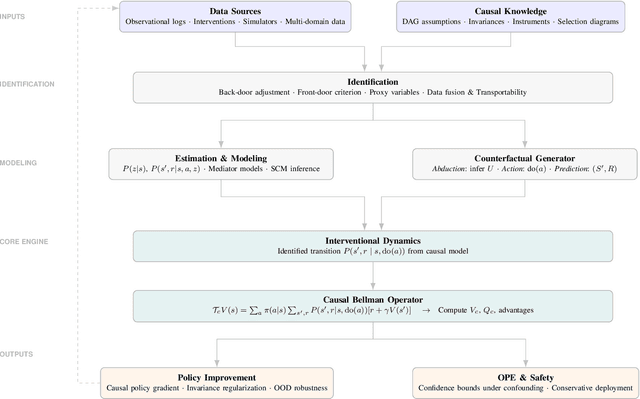
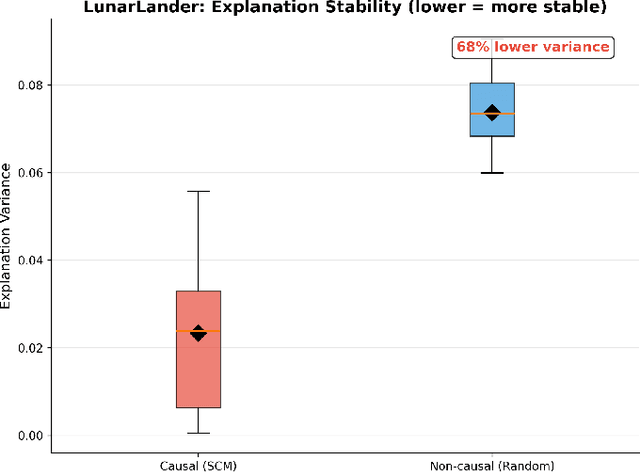
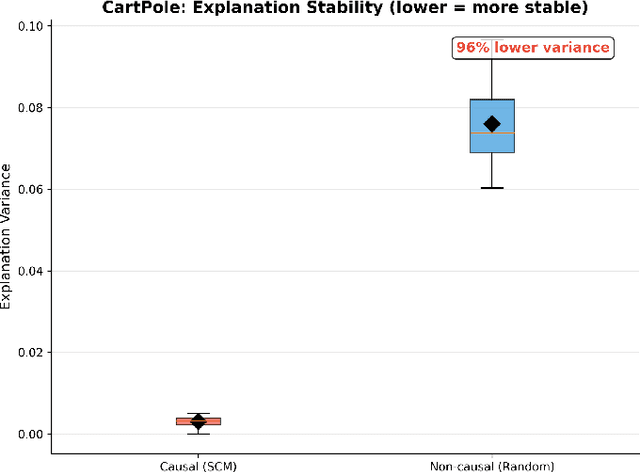
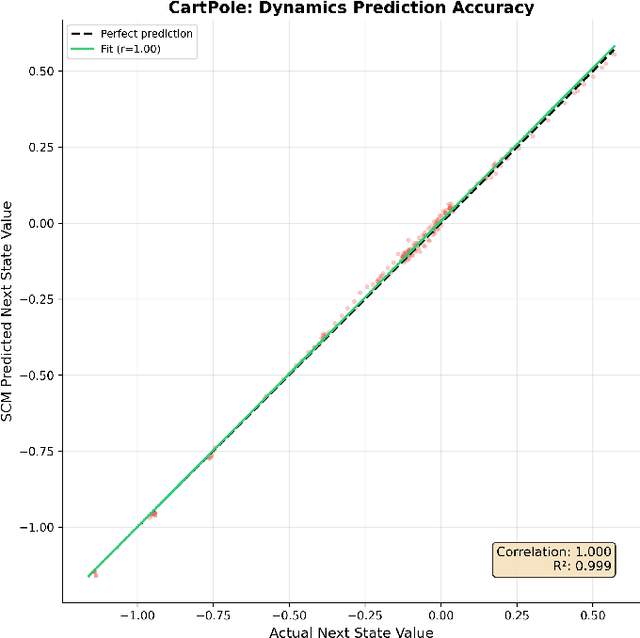
Integrating causal inference (CI) with reinforcement learning (RL) has emerged as a powerful paradigm to address critical limitations in classical RL, including low explainability, lack of robustness and generalization failures. Traditional RL techniques, which typically rely on correlation-driven decision-making, struggle when faced with distribution shifts, confounding variables, and dynamic environments. Causal reinforcement learning (CRL), leveraging the foundational principles of causal inference, offers promising solutions to these challenges by explicitly modeling cause-and-effect relationships. In this survey, we systematically review recent advancements at the intersection of causal inference and RL. We categorize existing approaches into causal representation learning, counterfactual policy optimization, offline causal RL, causal transfer learning, and causal explainability. Through this structured analysis, we identify prevailing challenges, highlight empirical successes in practical applications, and discuss open problems. Finally, we provide future research directions, underscoring the potential of CRL for developing robust, generalizable, and interpretable artificial intelligence systems.