 Add to Chrome
 Add to Firefox
 Add to Edge
Low-Rank-Modulated Functa: Exploring the Latent Space of Implicit Neural Representations for Interpretable Ultrasound Video Analysis
Mar 26, 2026
Implicit neural representations (INRs) have emerged as a powerful framework for continuous image representation learning. In Functa-based approaches, each image is encoded as a latent modulation vector that conditions a shared INR, enabling strong reconstruction performance. However, the structure and interpretability of the corresponding latent spaces remain largely unexplored. In this work, we investigate the latent space of Functa-based models for ultrasound videos and propose Low-Rank-Modulated Functa (LRM-Functa), a novel architecture that enforces a low-rank adaptation of modulation vectors in the time-resolved latent space. When applied to cardiac ultrasound, the resulting latent space exhibits clearly structured periodic trajectories, facilitating visualization and interpretability of temporal patterns. The latent space can be traversed to sample novel frames, revealing smooth transitions along the cardiac cycle, and enabling direct readout of end-diastolic (ED) and end-systolic (ES) frames without additional model training. We show that LRM-Functa outperforms prior methods in unsupervised ED and ES frame detection, while compressing each video frame to as low as rank k=2 without sacrificing competitive downstream performance on ejection fraction prediction. Evaluations on out-of-distribution frame selection in a cardiac point-of-care dataset, as well as on lung ultrasound for B-line classification, demonstrate the generalizability of our approach. Overall, LRM-Functa provides a compact, interpretable, and generalizable framework for ultrasound video analysis. The code is available at https://github.com/JuliaWolleb/LRM_Functa.

Ultrasound Image Synthesis Using Generative AI for Lung Ultrasound Detection
Jan 10, 2025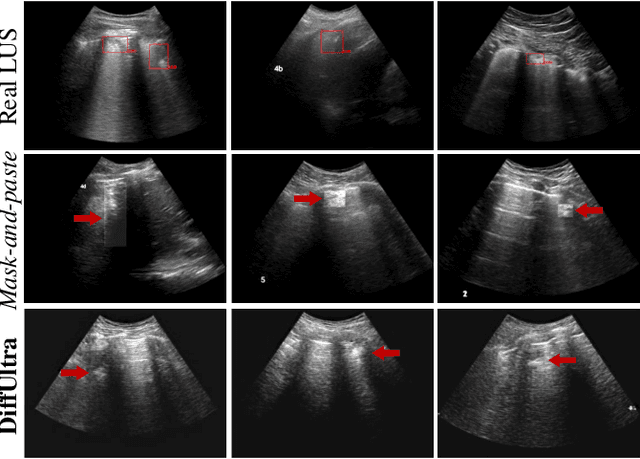


Developing reliable healthcare AI models requires training with representative and diverse data. In imbalanced datasets, model performance tends to plateau on the more prevalent classes while remaining low on less common cases. To overcome this limitation, we propose DiffUltra, the first generative AI technique capable of synthesizing realistic Lung Ultrasound (LUS) images with extensive lesion variability. Specifically, we condition the generative AI by the introduced Lesion-anatomy Bank, which captures the lesion's structural and positional properties from real patient data to guide the image synthesis.We demonstrate that DiffUltra improves consolidation detection by 5.6% in AP compared to the models trained solely on real patient data. More importantly, DiffUltra increases data diversity and prevalence of rare cases, leading to a 25% AP improvement in detecting rare instances such as large lung consolidations, which make up only 10% of the dataset.