 Add to Chrome
 Add to Firefox
 Add to Edge
Unsupervised 4D Flow MRI Velocity Enhancement and Unwrapping Using Divergence-Free Neural Networks
Mar 31, 2026
This work introduces an unsupervised Divergence and Aliasing-Free neural network (DAF-FlowNet) for 4D Flow Magnetic Resonance Imaging (4D Flow MRI) that jointly enhances noisy velocity fields and corrects phase wrapping artifacts. DAF-FlowNet parameterizes velocities as the curl of a vector potential, enforcing mass conservation by construction and avoiding explicit divergence-penalty tuning. A cosine data-consistency loss enables simultaneous denoising and unwrapping from wrapped phase images. On synthetic aortic 4D Flow MRI generated from computational fluid dynamics, DAF-FlowNet achieved lower errors than existing techniques (up to 11% lower velocity normalized root mean square error, 11% lower directional error, and 44% lower divergence relative to the best-performing alternative across noise levels), with robustness to moderate segmentation perturbations. For unwrapping, at peak velocity/velocity-encoding ratios of 1.4 and 2.1, DAF-FlowNet achieved 0.18% and 5.2% residual wrapped voxels, representing reductions of 72% and 18% relative to the best alternative method, respectively. In scenarios with both noise and aliasing, the proposed single-stage formulation outperformed a state-of-the-art sequential pipeline (up to 15% lower velocity normalized root mean square error, 11% lower directional error, and 28% lower divergence). Across 10 hypertrophic cardiomyopathy patient datasets, DAF-FlowNet preserved fine-scale flow features, corrected aliased regions, and improved internal flow consistency, as indicated by reduced inter-plane flow bias in aortic and pulmonary mass-conservation analyses recommended by the 4D Flow MRI consensus guidelines. These results support DAF-FlowNet as a framework that unifies velocity enhancement and phase unwrapping to improve the reliability of cardiovascular 4D Flow MRI.

A Survey on Deep Learning and Explainability for Automatic Image-based Medical Report Generation
Oct 20, 2020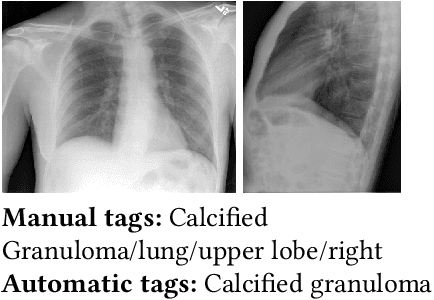
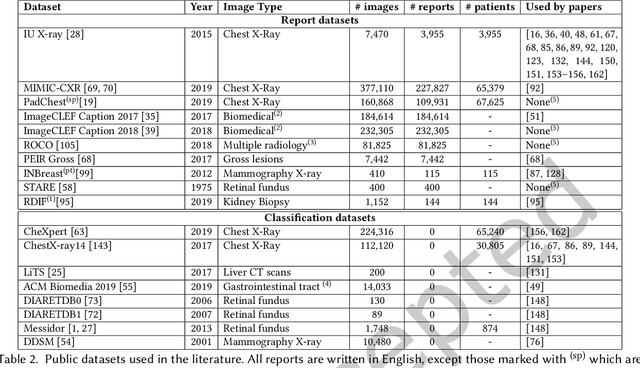
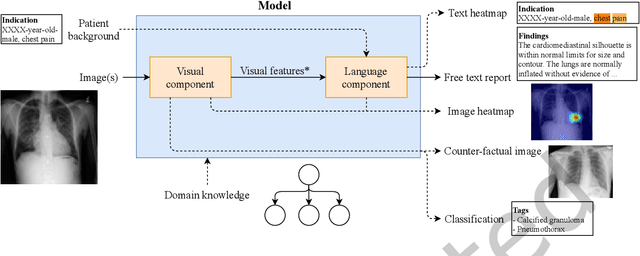
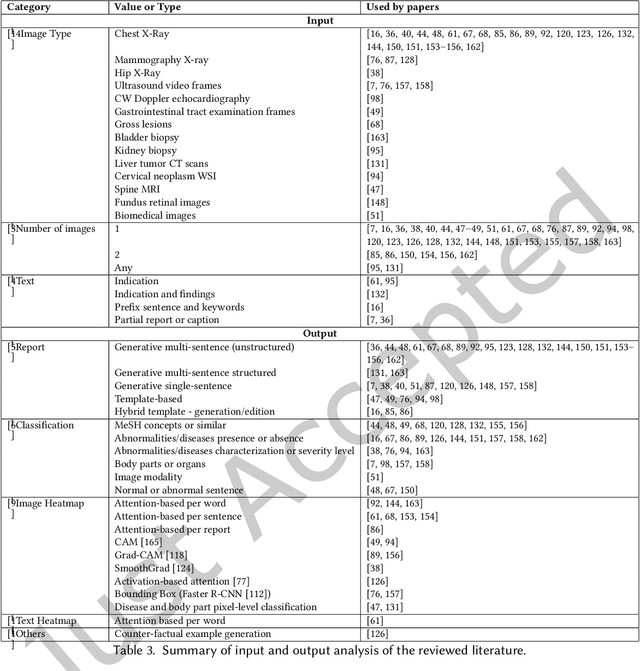
Every year physicians face an increasing demand of image-based diagnosis from patients, a problem that can be addressed with recent artificial intelligence methods. In this context, we survey works in the area of automatic report generation from medical images, with emphasis on methods using deep neural networks, with respect to: (1) Datasets, (2) Architecture Design, (3) Explainability and (4) Evaluation Metrics. Our survey identifies interesting developments, but also remaining challenges. Among them, the current evaluation of generated reports is especially weak, since it mostly relies on traditional Natural Language Processing (NLP) metrics, which do not accurately capture medical correctness.