 Add to Chrome
 Add to Firefox
 Add to Edge
Bridging MRI and PET physiology: Untangling complementarity through orthogonal representations
Apr 08, 2026
Multimodal imaging analysis often relies on joint latent representations, yet these approaches rarely define what information is shared versus modality-specific. Clarifying this distinction is clinically relevant, as it delineates the irreducible contribution of each modality and informs rational acquisition strategies. We propose a subspace decomposition framework that reframes multimodal fusion as a problem of orthogonal subspace separation rather than translation. We decompose Prostate-Specific Membrane Antigen (PSMA) PET uptake into an MRI-explainable physiological envelope and an orthogonal residual reflecting signal components not expressible within the MRI feature manifold. Using multiparametric MRI, we train an intensity-based, non-spatial implicit neural representation (INR) to map MRI feature vectors to PET uptake. We introduce a projection-based regularization using singular value decomposition to penalize residual components lying within the span of the MRI feature manifold. This enforces mathematical orthogonality between tissue-level physiological properties (structure, diffusion, perfusion) and intracellular PSMA expression. Tested on 13 prostate cancer patients, the model demonstrates that residual components spanned by MRI features are absorbed into the learned envelope, while the orthogonal residual is largest in tumour regions. This indicates that PSMA PET contains signal components not recoverable from MRI-derived physiological descriptors. The resulting decomposition provides a structured characterization of modality complementarity grounded in representation geometry rather than image translation.

Developing a PET/CT Foundation Model for Cross-Modal Anatomical and Functional Imaging
Mar 04, 2025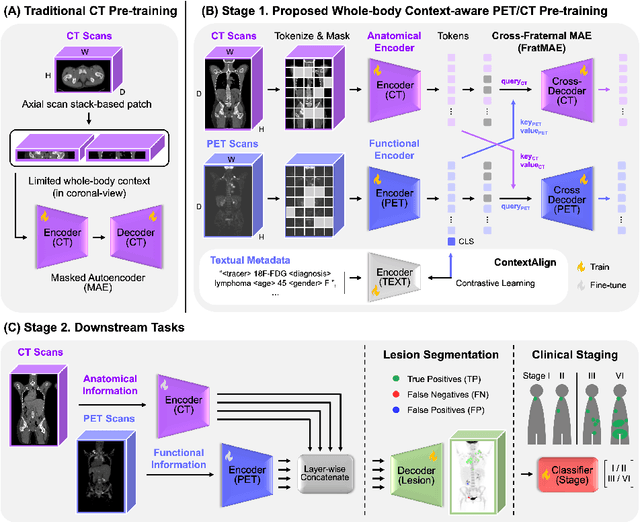
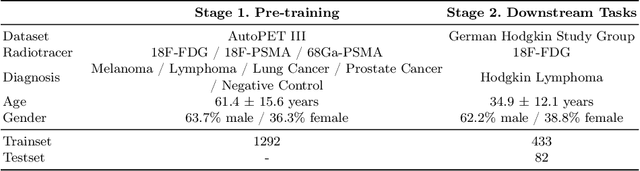

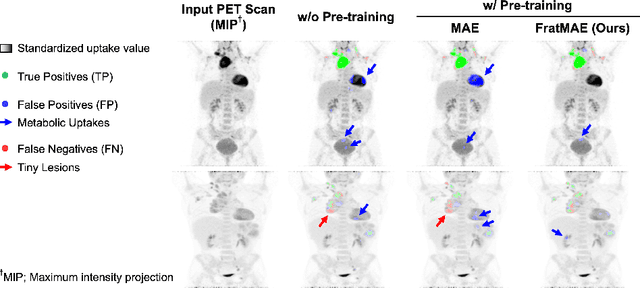
In oncology, Positron Emission Tomography-Computed Tomography (PET/CT) is widely used in cancer diagnosis, staging, and treatment monitoring, as it combines anatomical details from CT with functional metabolic activity and molecular marker expression information from PET. However, existing artificial intelligence-driven PET/CT analyses rely predominantly on task-specific models trained from scratch or on limited datasets, limiting their generalizability and robustness. To address this, we propose a foundation model approach specifically designed for multimodal PET/CT imaging. We introduce the Cross-Fraternal Twin Masked Autoencoder (FratMAE), a novel framework that effectively integrates whole-body anatomical and functional or molecular information. FratMAE employs separate Vision Transformer (ViT) encoders for PET and CT scans, along with cross-attention decoders that enable synergistic interactions between modalities during masked autoencoder training. Additionally, it incorporates textual metadata to enhance PET representation learning. By pre-training on PET/CT datasets, FratMAE captures intricate cross-modal relationships and global uptake patterns, achieving superior performance on downstream tasks and demonstrating its potential as a generalizable foundation model.