 Add to Chrome
 Add to Firefox
 Add to Edge
Pathologist Attention-Aligned Report Generation for Prostate Histopathology
Jul 21, 2026
The allocation of visual attention by pathologists during cancer diagnosis is a highly selective process that critically shapes the information extracted from whole-slide images (WSIs). Human attention helps medical imaging tasks such as classification and segmentation, and becomes a strong semantic cue for identifying diagnostically informative regions for report generation. In this paper, we introduce human attention into the training of pathologist report generation models. To this end, we collected a multimodal human-attention dataset of 121 prostate WSIs annotated with pathologists' multi-scale viewport trajectories synchronized with the pathologists' verbal descriptions and cursor movements for five clinically relevant components (e.g., Gleason patterns). Using this dataset, we finetune two report generation models with an attention-alignment loss that regularizes the model attention over image patches to match the distribution of pathologist attention. We evaluate our approach on prostate cancer report generation and visual question answering using two models with different internal attention mechanisms (i.e., how image tokens are integrated into the language decoder). Experiments show average gains of 10.9% on NLP-based metrics and 19.3% in accuracy across five clinically relevant report components. Further, model attention maps extracted at inference time, with minimal computational overhead, align more closely with pathologist attention, providing stronger visual support for the generated reports by highlighting the regions that most influence the output.

Decoding the visual attention of pathologists to reveal their level of expertise
Mar 25, 2024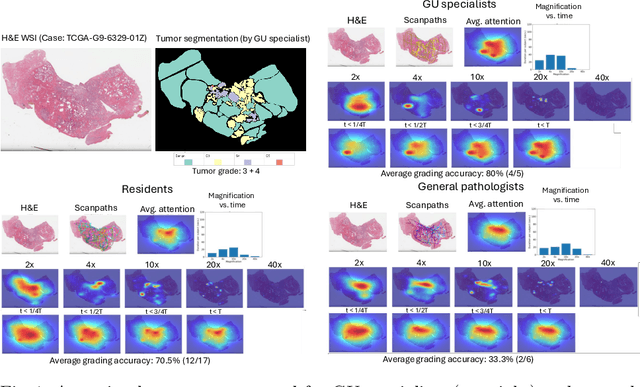
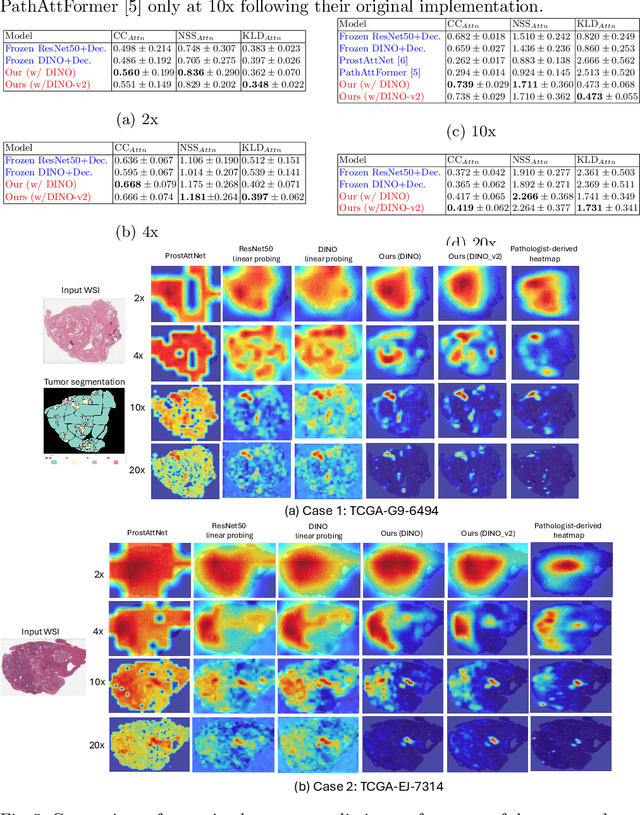
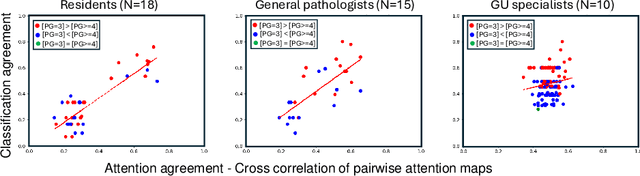
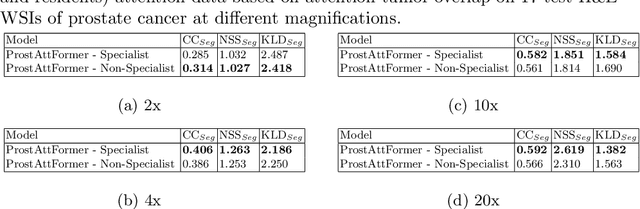
We present a method for classifying the expertise of a pathologist based on how they allocated their attention during a cancer reading. We engage this decoding task by developing a novel method for predicting the attention of pathologists as they read whole-slide Images (WSIs) of prostate and make cancer grade classifications. Our ground truth measure of a pathologists' attention is the x, y and z (magnification) movement of their viewport as they navigated through WSIs during readings, and to date we have the attention behavior of 43 pathologists reading 123 WSIs. These data revealed that specialists have higher agreement in both their attention and cancer grades compared to general pathologists and residents, suggesting that sufficient information may exist in their attention behavior to classify their expertise level. To attempt this, we trained a transformer-based model to predict the visual attention heatmaps of resident, general, and specialist (GU) pathologists during Gleason grading. Based solely on a pathologist's attention during a reading, our model was able to predict their level of expertise with 75.3%, 56.1%, and 77.2% accuracy, respectively, better than chance and baseline models. Our model therefore enables a pathologist's expertise level to be easily and objectively evaluated, important for pathology training and competency assessment. Tools developed from our model could also be used to help pathology trainees learn how to read WSIs like an expert.