 Add to Chrome
 Add to Firefox
 Add to Edge
SemanticXR: Low Power and Real-time Queryable Semantic Mapping with an Object-Level Device-Cloud Architecture
Jun 11, 2026
Semantic mapping is a core service that enables grounded interactions in emerging Extended Reality (XR) applications such as AI assistants and spatial object search. Deploying this capability on mobile XR devices requires a system that is open-vocabulary, real-time, and low-power. Existing approaches are compute-intensive and assume server-class resources. Cloud offloading offers a practical path, but no existing system splits semantic mapping across the device-cloud boundary or manages its communication, execution, and memory footprint. We present SemanticXR, the first device-cloud system for real-time, open-vocabulary semantic mapping and querying under XR power, bandwidth, and memory constraints. Our key insight is to elevate semantically identifiable objects to first-class units of communication, execution, and memory across the device and server. On the server, object-level parallelism and geometry downsampling improve mapping latency, while object-level depth-mapping co-design reduces upstream bandwidth. On the device, an object-level sparse local map with incremental updates and update prioritization enables network-robust querying with bounded memory and downstream bandwidth. Object-level configurable resource usage vs. quality trade-offs let applications and the system adapt mapping to application requirements and operating conditions, respectively. Against a device-cloud baseline with the same perception models, object-level organization improves server-side mapping latency by 2.2X at equal semantic quality. Depth-mapping co-design maintains upstream bandwidth under 2.5 Mbps. On the device, SemanticXR sustains sub-100 ms query latency for up to 10,000 objects even under network drops, supports tens of thousands of objects within 500 MB, and scales downstream bandwidth with map changes, not total scene size. The system adds only 2% device power during normal operation.

Isaac Lab: A GPU-Accelerated Simulation Framework for Multi-Modal Robot Learning
Nov 06, 2025
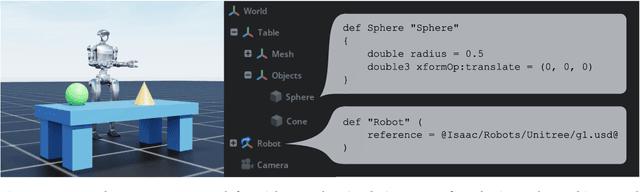
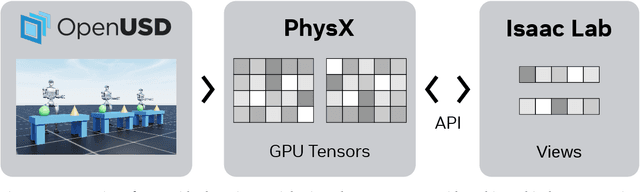

We present Isaac Lab, the natural successor to Isaac Gym, which extends the paradigm of GPU-native robotics simulation into the era of large-scale multi-modal learning. Isaac Lab combines high-fidelity GPU parallel physics, photorealistic rendering, and a modular, composable architecture for designing environments and training robot policies. Beyond physics and rendering, the framework integrates actuator models, multi-frequency sensor simulation, data collection pipelines, and domain randomization tools, unifying best practices for reinforcement and imitation learning at scale within a single extensible platform. We highlight its application to a diverse set of challenges, including whole-body control, cross-embodiment mobility, contact-rich and dexterous manipulation, and the integration of human demonstrations for skill acquisition. Finally, we discuss upcoming integration with the differentiable, GPU-accelerated Newton physics engine, which promises new opportunities for scalable, data-efficient, and gradient-based approaches to robot learning. We believe Isaac Lab's combination of advanced simulation capabilities, rich sensing, and data-center scale execution will help unlock the next generation of breakthroughs in robotics research.
Stability Selection via Variable Decorrelation
May 27, 2025The Lasso is a prominent algorithm for variable selection. However, its instability in the presence of correlated variables in the high-dimensional setting is well-documented. Although previous research has attempted to address this issue by modifying the Lasso loss function, this paper introduces an approach that simplifies the data processed by Lasso. We propose that decorrelating variables before applying the Lasso improves the stability of variable selection regardless of the direction of correlation among predictors. Furthermore, we highlight that the irrepresentable condition, which ensures consistency for the Lasso, is satisfied after variable decorrelation under two assumptions. In addition, by noting that the instability of the Lasso is not limited to high-dimensional settings, we demonstrate the effectiveness of the proposed approach for low-dimensional data. Finally, we present empirical results that indicate the efficacy of the proposed method across different variable selection techniques, highlighting its potential for broader application. The DVS R package is developed to facilitate the implementation of the methodology proposed in this paper.