 Add to Chrome
 Add to Firefox
 Add to Edge
When May I Help You? On The Effect of Proactivity on Group Human-Robot Collaboration
Jun 26, 2026
Robot initiative is a central challenge in multi-party human-robot collaboration. A robot that contributes without being addressed may provide timely support, but it may also disrupt coordination, divide attention, or interrupt turn-taking; a robot that waits to be addressed may preserve human control, but it may also miss opportunities to assist. We investigate this design challenge in a collaborative escape room in which pairs of participants work with a humanoid robot under either a reactive interaction model, where the robot responds only when addressed, or a proactive model, where it listens continuously, contributes autonomously, and periodically re-initiates interaction. We evaluate both models using puzzle-solving performance, interaction frequency, and participant ratings on the Godspeed and RoSAS scales. The proactive model substantially increases interaction frequency, whereas the reactive model shows a descriptively higher overall success rate (92.86% vs. 71.42%). The strongest differences emerge when prior experience and personality are taken into account: participants with LLM experience solve the early puzzles faster in the reactive condition, and participants with prior robot experience show modified evaluations of proactive and reactive interaction as do introverted participants. These findings demonstrate that the effects of robot initiative are simultaneously shaped by users' prior experience, personality traits and more generally by the needs of the group.

Keypoint-based Diffusion for Robotic Motion Planning on the NICOL Robot
Sep 04, 2025We propose a novel diffusion-based action model for robotic motion planning. Commonly, established numerical planning approaches are used to solve general motion planning problems, but have significant runtime requirements. By leveraging the power of deep learning, we are able to achieve good results in a much smaller runtime by learning from a dataset generated by these planners. While our initial model uses point cloud embeddings in the input to predict keypoint-based joint sequences in its output, we observed in our ablation study that it remained challenging to condition the network on the point cloud embeddings. We identified some biases in our dataset and refined it, which improved the model's performance. Our model, even without the use of the point cloud encodings, outperforms numerical models by an order of magnitude regarding the runtime, while reaching a success rate of up to 90% of collision free solutions on the test set.
Inverse Kinematics for Neuro-Robotic Grasping with Humanoid Embodied Agents
Apr 12, 2024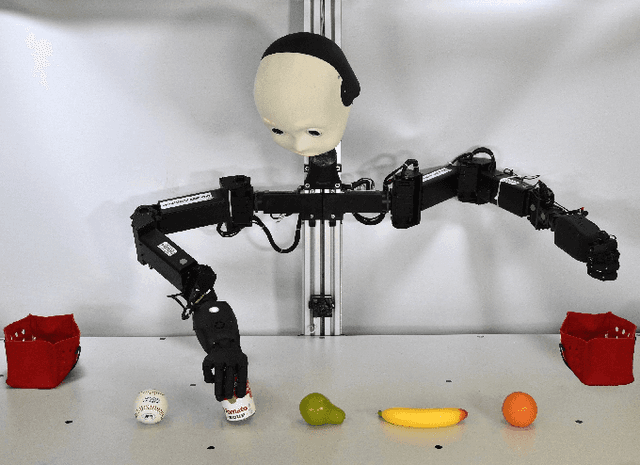
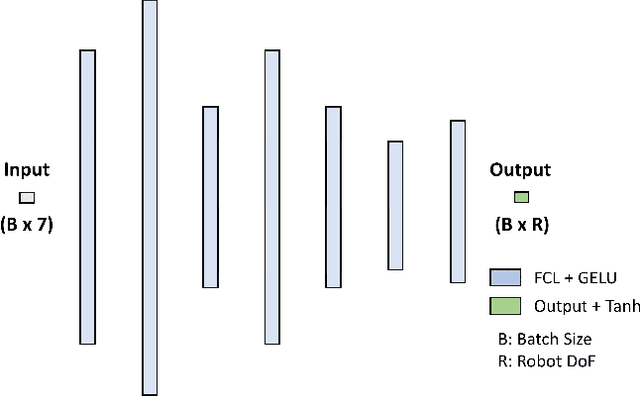
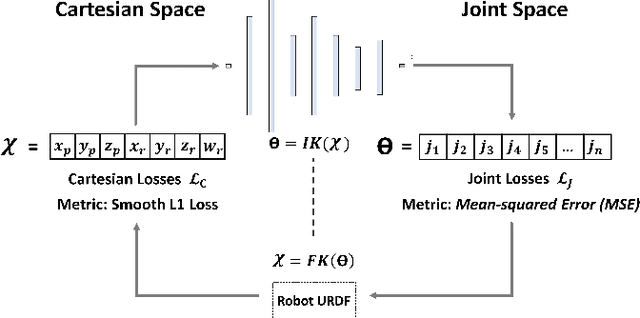
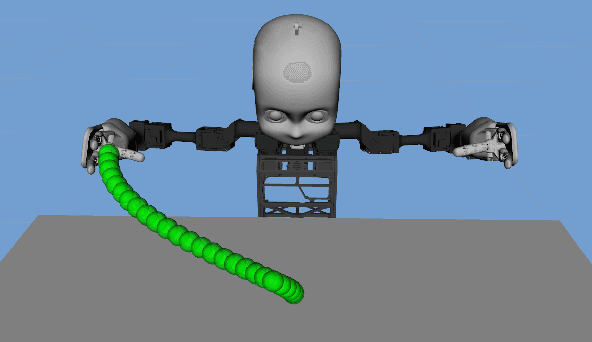
This paper introduces a novel zero-shot motion planning method that allows users to quickly design smooth robot motions in Cartesian space. A B\'ezier curve-based Cartesian plan is transformed into a joint space trajectory by our neuro-inspired inverse kinematics (IK) method CycleIK, for which we enable platform independence by scaling it to arbitrary robot designs. The motion planner is evaluated on the physical hardware of the two humanoid robots NICO and NICOL in a human-in-the-loop grasping scenario. Our method is deployed with an embodied agent that is a large language model (LLM) at its core. We generalize the embodied agent, that was introduced for NICOL, to also be embodied by NICO. The agent can execute a discrete set of physical actions and allows the user to verbally instruct various different robots. We contribute a grasping primitive to its action space that allows for precise manipulation of household objects. The new CycleIK method is compared to popular numerical IK solvers and state-of-the-art neural IK methods in simulation and is shown to be competitive with or outperform all evaluated methods when the algorithm runtime is very short. The grasping primitive is evaluated on both NICOL and NICO robots with a reported grasp success of 72% to 82% for each robot, respectively.