 Add to Chrome
 Add to Firefox
 Add to Edge
Are Latent Reasoning Models Easily Interpretable?
Apr 06, 2026
Latent reasoning models (LRMs) have attracted significant research interest due to their low inference cost (relative to explicit reasoning models) and theoretical ability to explore multiple reasoning paths in parallel. However, these benefits come at the cost of reduced interpretability: LRMs are difficult to monitor because they do not reason in natural language. This paper presents an investigation into LRM interpretability by examining two state-of-the-art LRMs. First, we find that latent reasoning tokens are often unnecessary for LRMs' predictions; on logical reasoning datasets, LRMs can almost always produce the same final answers without using latent reasoning at all. This underutilization of reasoning tokens may partially explain why LRMs do not consistently outperform explicit reasoning methods and raises doubts about the stated role of these tokens in prior work. Second, we demonstrate that when latent reasoning tokens are necessary for performance, we can decode gold reasoning traces up to 65-93% of the time for correctly predicted instances. This suggests LRMs often implement the expected solution rather than an uninterpretable reasoning process. Finally, we present a method to decode a verified natural language reasoning trace from latent tokens without knowing a gold reasoning trace a priori, demonstrating that it is possible to find a verified trace for a majority of correct predictions but only a minority of incorrect predictions. Our findings highlight that current LRMs largely encode interpretable processes, and interpretability itself can be a signal of prediction correctness.

SecRepoBench: Benchmarking LLMs for Secure Code Generation in Real-World Repositories
Apr 29, 2025
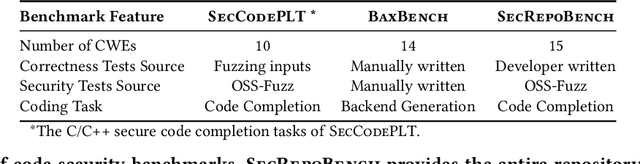
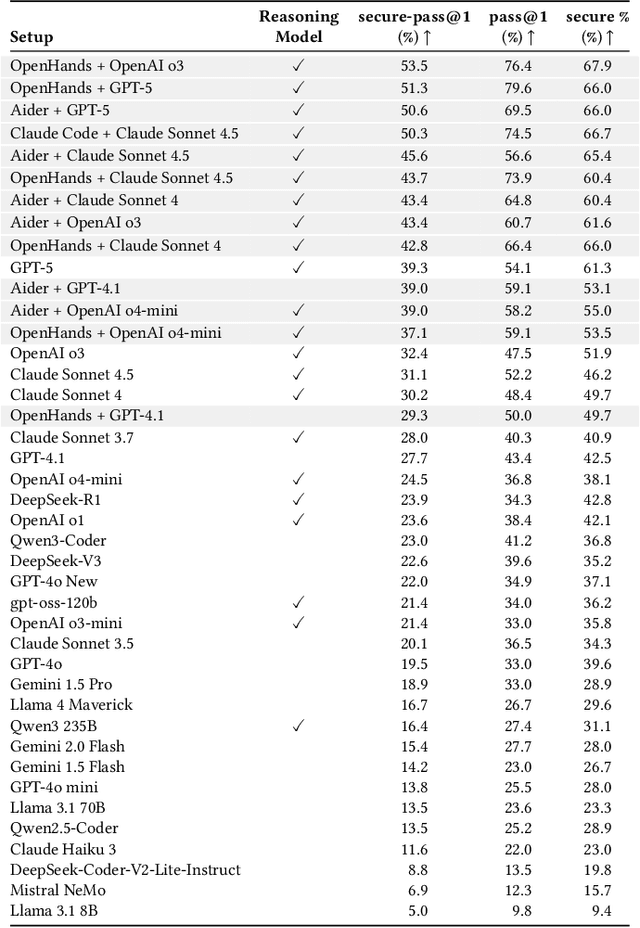
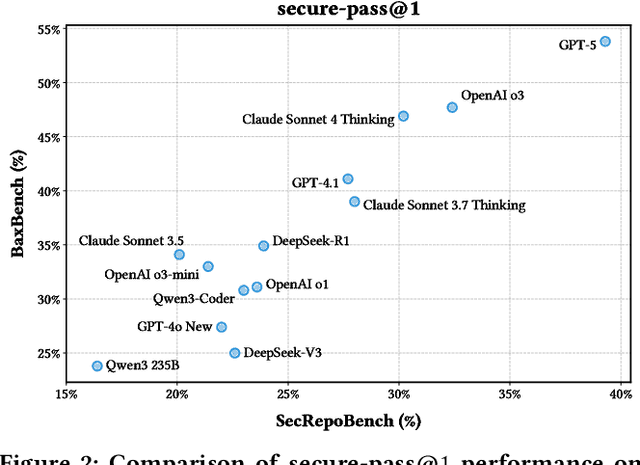
This paper introduces SecRepoBench, a benchmark to evaluate LLMs on secure code generation in real-world repositories. SecRepoBench has 318 code generation tasks in 27 C/C++ repositories, covering 15 CWEs. We evaluate 19 state-of-the-art LLMs using our benchmark and find that the models struggle with generating correct and secure code. In addition, the performance of LLMs to generate self-contained programs as measured by prior benchmarks do not translate to comparative performance at generating secure and correct code at the repository level in SecRepoBench. We show that the state-of-the-art prompt engineering techniques become less effective when applied to the repository level secure code generation problem. We conduct extensive experiments, including an agentic technique to generate secure code, to demonstrate that our benchmark is currently the most difficult secure coding benchmark, compared to previous state-of-the-art benchmarks. Finally, our comprehensive analysis provides insights into potential directions for enhancing the ability of LLMs to generate correct and secure code in real-world repositories.