 Add to Chrome
 Add to Firefox
 Add to Edge
Approaches to Analysing Historical Newspapers Using LLMs
Mar 27, 2026
This study presents a computational analysis of the Slovene historical newspapers \textit{Slovenec} and \textit{Slovenski narod} from the sPeriodika corpus, combining topic modelling, large language model (LLM)-based aspect-level sentiment analysis, entity-graph visualisation, and qualitative discourse analysis to examine how collective identities, political orientations, and national belonging were represented in public discourse at the turn of the twentieth century. Using BERTopic, we identify major thematic patterns and show both shared concerns and clear ideological differences between the two newspapers, reflecting their conservative-Catholic and liberal-progressive orientations. We further evaluate four instruction-following LLMs for targeted sentiment classification in OCR-degraded historical Slovene and select the Slovene-adapted GaMS3-12B-Instruct model as the most suitable for large-scale application, while also documenting important limitations, particularly its stronger performance on neutral sentiment than on positive or negative sentiment. Applied at dataset scale, the model reveals meaningful variation in the portrayal of collective identities, with some groups appearing predominantly in neutral descriptive contexts and others more often in evaluative or conflict-related discourse. We then create NER graphs to explore the relationships between collective identities and places. We apply a mixed methods approach to analyse the named entity graphs, combining quantitative network analysis with critical discourse analysis. The investigation focuses on the emergence and development of intertwined historical political and socionomic identities. Overall, the study demonstrates the value of combining scalable computational methods with critical interpretation to support digital humanities research on noisy historical newspaper data.

Dr. KID: Direct Remeshing and K-set Isometric Decomposition for Scalable Physicalization of Organic Shapes
Apr 06, 2023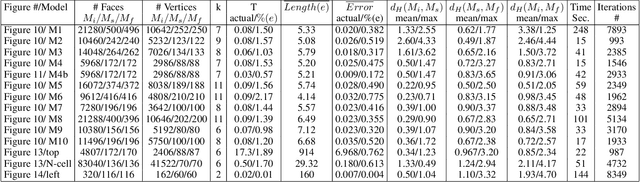
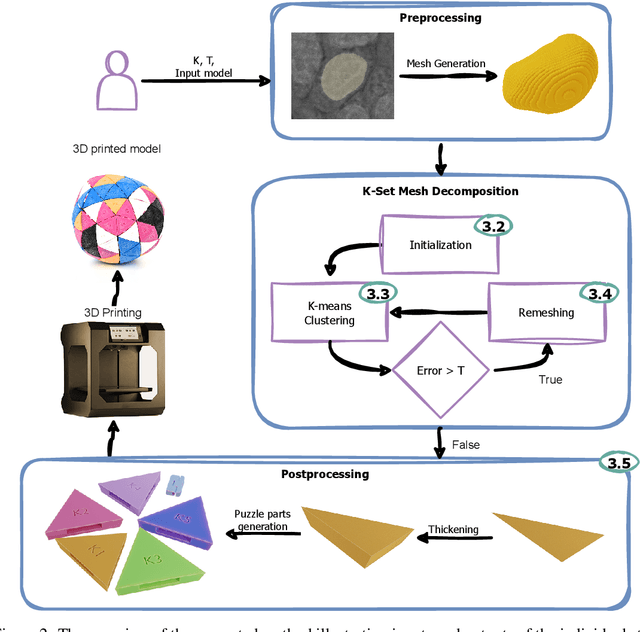
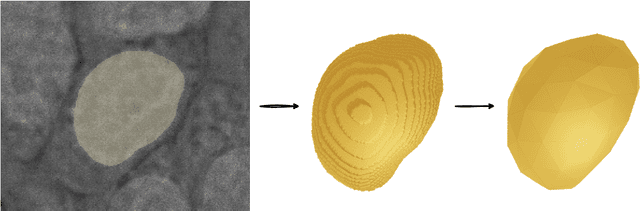
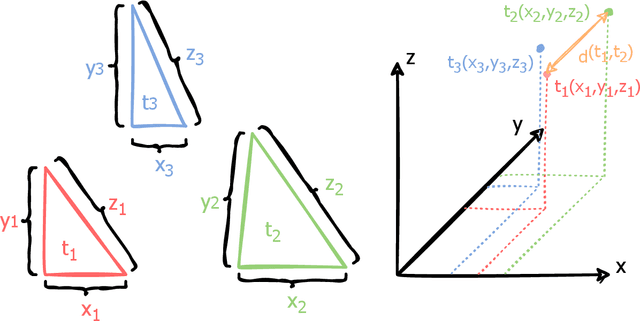
Dr. KID is an algorithm that uses isometric decomposition for the physicalization of potato-shaped organic models in a puzzle fashion. The algorithm begins with creating a simple, regular triangular surface mesh of organic shapes, followed by iterative k-means clustering and remeshing. For clustering, we need similarity between triangles (segments) which is defined as a distance function. The distance function maps each triangle's shape to a single point in the virtual 3D space. Thus, the distance between the triangles indicates their degree of dissimilarity. K-means clustering uses this distance and sorts of segments into k classes. After this, remeshing is applied to minimize the distance between triangles within the same cluster by making their shapes identical. Clustering and remeshing are repeated until the distance between triangles in the same cluster reaches an acceptable threshold. We adopt a curvature-aware strategy to determine the surface thickness and finalize puzzle pieces for 3D printing. Identical hinges and holes are created for assembling the puzzle components. For smoother outcomes, we use triangle subdivision along with curvature-aware clustering, generating curved triangular patches for 3D printing. Our algorithm was evaluated using various models, and the 3D-printed results were analyzed. Findings indicate that our algorithm performs reliably on target organic shapes with minimal loss of input geometry.
Differentiable Electron Microscopy Simulation: Methods and Applications for Visualization
May 08, 2022
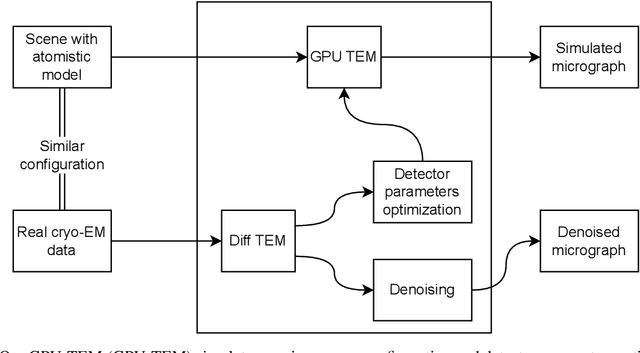
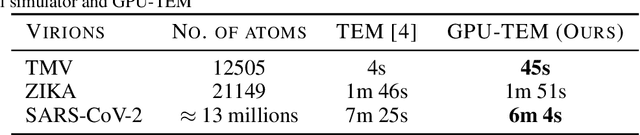
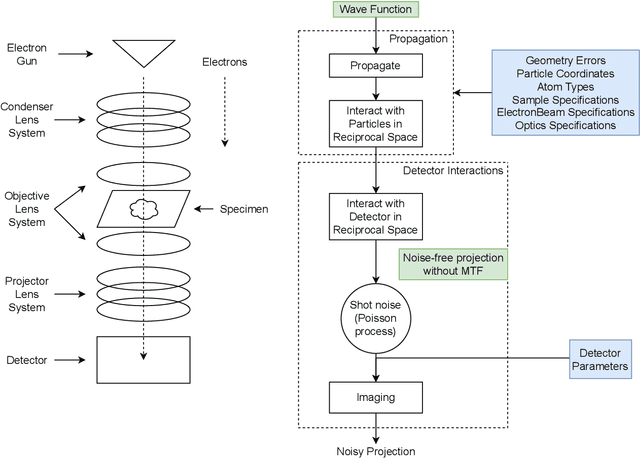
We propose a new microscopy simulation system that can depict atomistic models in a micrograph visual style, similar to results of physical electron microscopy imaging. This system is scalable, able to represent simulation of electron microscopy of tens of viral particles and synthesizes the image faster than previous methods. On top of that, the simulator is differentiable, both its deterministic as well as stochastic stages that form signal and noise representations in the micrograph. This notable property has the capability for solving inverse problems by means of optimization and thus allows for generation of microscopy simulations using the parameter settings estimated from real data. We demonstrate this learning capability through two applications: (1) estimating the parameters of the modulation transfer function defining the detector properties of the simulated and real micrographs, and (2) denoising the real data based on parameters trained from the simulated examples. While current simulators do not support any parameter estimation due to their forward design, we show that the results obtained using estimated parameters are very similar to the results of real micrographs. Additionally, we evaluate the denoising capabilities of our approach and show that the results showed an improvement over state-of-the-art methods. Denoised micrographs exhibit less noise in the tilt-series tomography reconstructions, ultimately reducing the visual dominance of noise in direct volume rendering of microscopy tomograms.