 Add to Chrome
 Add to Firefox
 Add to Edge
Looped Diffusion Language Models
May 25, 2026
Masked diffusion models (MDMs) have emerged as a promising alternative to autoregressive models for language modeling, yet the effective design of transformer architectures for MDMs remains underexplored. In this paper, we show that selectively looping the early-middle transformer layers significantly improves both training efficiency and model performance in MDMs. We call this approach LoopMDM(Looped Masked Diffusion Model), which brings two key benefits: looping layers at training-time yields a depth-scaling effect without adding parameters, while varying the number of loops at inference-time enables flexible compute scaling. Despite the simplicity, the results are striking: across multiple pre-training corpora, LoopMDM matches the performance of same-size MDMs with up to 3.3 fewer training FLOPs, while its final performance outperforms them on various reasoning benchmarks, including up to 8.5 points on GSM8K. It even surpasses deeper non-looped MDMs trained with comparable per-step compute, indicating that selective looping is more effective than naive depth scaling. Furthermore, LoopMDM can scale inference-time compute by increasing the number of loops. Adaptively adjusting the number of loops throughout the sampling process further yields additional gains in compute efficiency while maintaining performance. Lastly, with attention analysis, we provide evidence that looping is effective in MDMs by promoting interactions among masked positions. Our code and weights will be publicly released.

Understanding and Accelerating the Training of Masked Diffusion Language Models
May 13, 2026Masked diffusion models (MDMs) have emerged as a promising alternative to autoregressive models (ARMs) for language modeling. However, MDMs are known to learn substantially more slowly than ARMs, which may become problematic when scaling MDMs to larger models. Therefore, we ask the following question: how can we accelerate standard MDM training while maintaining its final performance? To this end, we first provide a detailed analysis of why MDM training is slow. We find that the main factor is the locality bias of language: the predictive information for a token is concentrated in nearby positions. We further investigate how this bias slows learning and suggest a simple yet effective remedy: bell-shaped time sampling as a training strategy. Notably, MDMs trained with our training recipe reach the same validation negative log-likelihood (NLL) up to $\sim4\times$ faster than standard training on One Billion Word Benchmark (LM1B). We also show faster improvements in generative perplexity, zero-shot perplexity, and downstream task performance on various benchmarks.
Unifying Masked Diffusion Models with Various Generation Orders and Beyond
Feb 02, 2026Masked diffusion models (MDMs) are a potential alternative to autoregressive models (ARMs) for language generation, but generation quality depends critically on the generation order. Prior work either hard-codes an ordering (e.g., blockwise left-to-right) or learns an ordering policy for a pretrained MDM, which incurs extra cost and can yield suboptimal solutions due to the two-stage optimization. Motivated by this, we propose order-expressive masked diffusion model (OeMDM) for a broad class of diffusion generative processes with various generation orders, enabling the interpretation of MDM, ARM, and block diffusion in a single framework. Furthermore, building on OeMDM, we introduce learnable-order masked diffusion model (LoMDM), which jointly learns the generation ordering and diffusion backbone through a single objective from scratch, enabling the diffusion model to generate text in context-dependent ordering. Empirically, we confirm that LoMDM outperforms various discrete diffusion models across multiple language modeling benchmarks.
MemBench: Memorized Image Trigger Prompt Dataset for Diffusion Models
Jul 24, 2024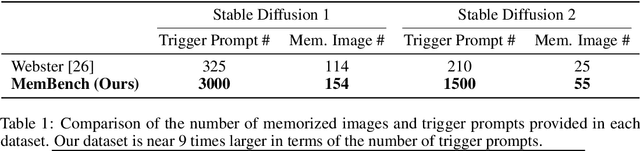


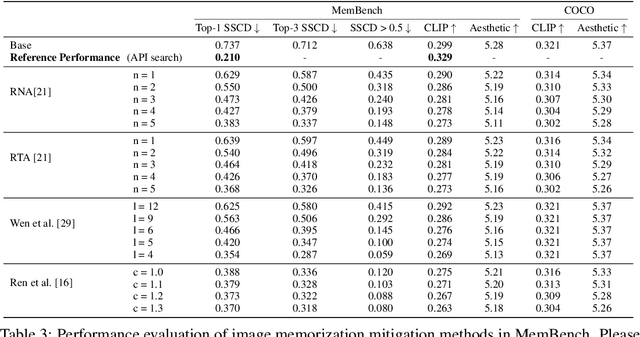
Diffusion models have achieved remarkable success in Text-to-Image generation tasks, leading to the development of many commercial models. However, recent studies have reported that diffusion models often generate replicated images in train data when triggered by specific prompts, potentially raising social issues ranging from copyright to privacy concerns. To sidestep the memorization, there have been recent studies for developing memorization mitigation methods for diffusion models. Nevertheless, the lack of benchmarks impedes the assessment of the true effectiveness of these methods. In this work, we present MemBench, the first benchmark for evaluating image memorization mitigation methods. Our benchmark includes a large number of memorized image trigger prompts in Stable Diffusion, the most popularly used model nowadays. Furthermore, in contrast to the prior work evaluating mitigation performance only on trigger prompts, we present metrics evaluating on both trigger prompts and general prompts, so that we can see whether mitigation methods address the memorization issue while maintaining performance for general prompts. This is an important development considering the practical applications which previous works have overlooked. Through evaluation on MemBench, we verify that the performance of existing image memorization mitigation methods is still insufficient for application to diffusion models.