 Add to Chrome
 Add to Firefox
 Add to Edge
VOID: Defeating Unauthorized Mimicry in Latent Diffusion Models
Jun 11, 2026
While Latent Diffusion Models (LDMs) have revolutionized visual synthesis, they are increasingly exploited for unauthorized mimicry of individuals. Existing defenses inject deceptive perturbations to steer the generated images toward irrelevant targets. However, this approach hinges on an ungrounded assumption: subtle perturbations can maintain their deceptive efficacy throughout an LDM's extensive generation process. In reality, the model's innate restoration mechanism will remove such perturbations and cause individual identities to re-emerge in the images generated. We propose VOID, a defense framework that overcomes this conundrum by manipulating an LDM's intrinsic stochasticity. VOID perturbs the diffusion pipeline in two novel ways: 1) amplifying the latent encoding errors to shatter an image's semantic structure, and 2) counteracting the target guidance signals to suppress the model's restoration capabilities. This results in a semantic corruption that thwarts any unauthorized mimicry. Notably, the security gain does not come at the price of visual utility, as VOID simultaneously manages to confine perturbations to human-imperceptible regions of protected images. Our comprehensive evaluation of 24 state-of-the-art defenses against 10 mimicry attacks on 5 datasets demonstrates VOID's unprecedented protection power: it increases the average Frechet Inception Distance (FID) from 113 to 365, a 223% improvement over the strongest defense to date.

Enhancing Adversarial Transferability Through Neighborhood Conditional Sampling
May 25, 2024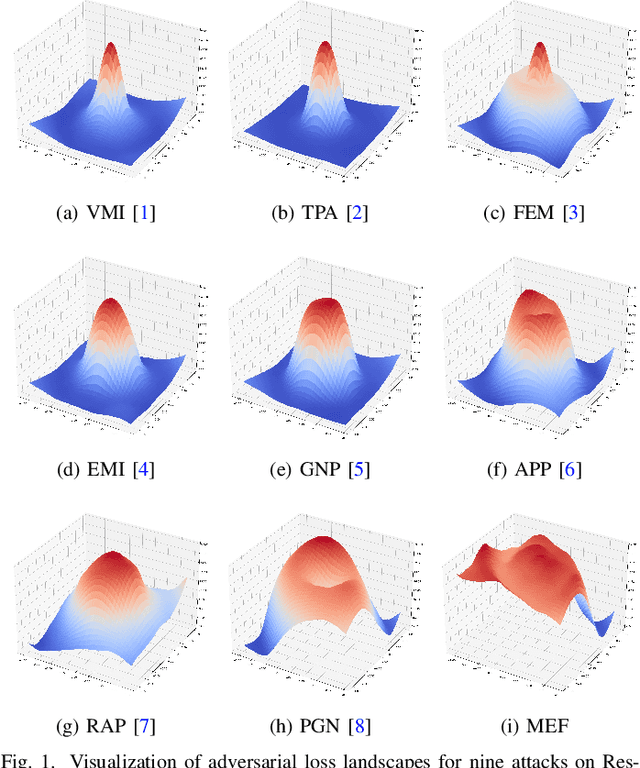
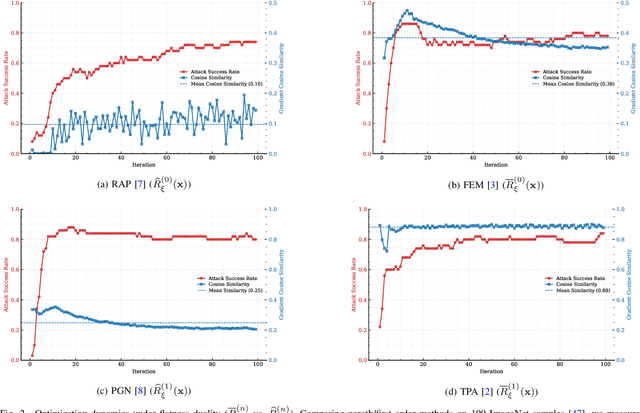
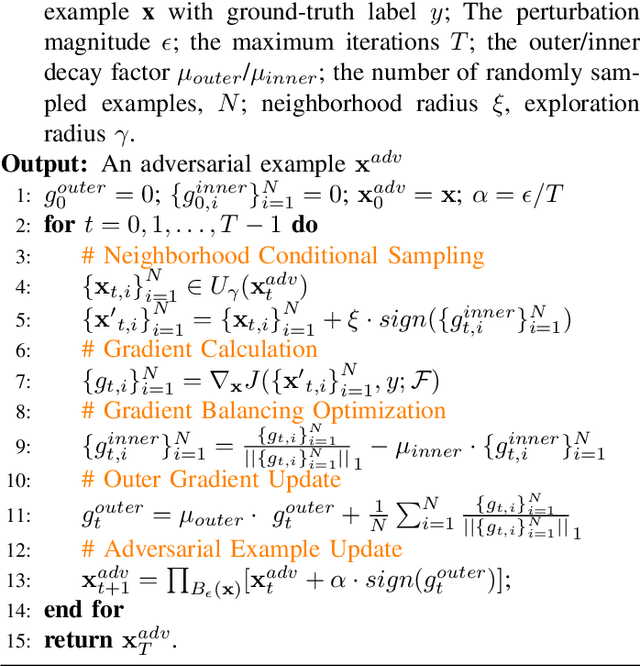
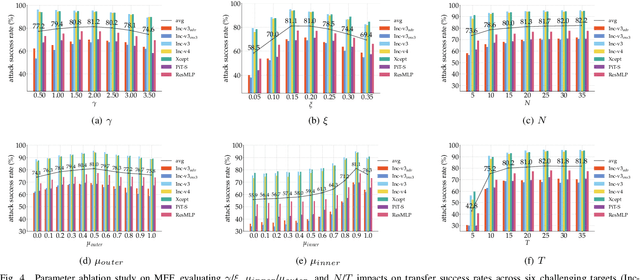
Transfer-based attacks craft adversarial examples utilizing a white-box surrogate model to compromise various black-box target models, posing significant threats to many real-world applications. However, existing transfer attacks suffer from either weak transferability or expensive computation. To bridge the gap, we propose a novel sample-based attack, named neighborhood conditional sampling (NCS), which enjoys high transferability with lightweight computation. Inspired by the observation that flat maxima result in better transferability, NCS is formulated as a max-min bi-level optimization problem to seek adversarial regions with high expected adversarial loss and small standard deviations. Specifically, due to the inner minimization problem being computationally intensive to resolve, and affecting the overall transferability, we propose a momentum-based previous gradient inversion approximation (PGIA) method to effectively solve the inner problem without any computation cost. In addition, we prove that two newly proposed attacks, which achieve flat maxima for better transferability, are actually specific cases of NCS under particular conditions. Extensive experiments demonstrate that NCS efficiently generates highly transferable adversarial examples, surpassing the current best method in transferability while requiring only 50% of the computational cost. Additionally, NCS can be seamlessly integrated with other methods to further enhance transferability.