 Add to Chrome
 Add to Firefox
 Add to Edge
Does Forgetting Transfer Across Modalities? A Real-World Benchmark for Cross-Modal Knowledge Unlearning Evaluation
Aug 04, 2026
Vision-Language Models (VLMs), like Large Language Models (LLMs), may memorize sensitive, copyrighted, or harmful knowledge from their pretraining corpora. Removing such knowledge is essential for building trustworthy AI systems. However, existing studies primarily focus on forgetting within individual modalities. Although recent work has begun to explore cross-modal consistency in unlearning, the cross-modal transfer of real-world knowledge unlearning remains insufficiently studied. To address this gap, we introduce UNLINK-VL, a real-world benchmark for cross-modal knowledge unlearning in VLMs. Under a post-hoc unlearning setting in which the original forget and retain corpora are unavailable, UNLINK-VL selects visually identifiable real-world entities as unlearning targets and associates them with corresponding images and one-hop and multi-hop facts derived from Wikidata. The benchmark comprises four complementary subsets that evaluate direct forgetting of target knowledge, the propagation of forgetting through relational knowledge, the preservation of related non-target knowledge, and robustness to semantically equivalent queries. We train models under text-only and multimodal unlearning settings and evaluate forgetting effectiveness and retained utility across textual, visual, and cross-modal scenarios. Extensive experiments reveal a pronounced asymmetry in cross-modal transfer: multimodal unlearning remains effective under textual evaluation, whereas text-only unlearning transfers poorly to visual and cross-modal scenarios. Meanwhile, the evaluated methods largely preserve the models' general capabilities. These findings demonstrate that relying solely on intra-modal evaluation, particularly text-only evaluation, may substantially overestimate the effectiveness of knowledge unlearning in VLMs, underscoring the need for cross-modal unlearning and evaluation.

SDDF: Specificity-Driven Dynamic Focusing for Open-Vocabulary Camouflaged Object Detection
Mar 27, 2026Open-vocabulary object detection (OVOD) aims to detect known and unknown objects in the open world by leveraging text prompts. Benefiting from the emergence of large-scale vision--language pre-trained models, OVOD has demonstrated strong zero-shot generalization capabilities. However, when dealing with camouflaged objects, the detector often fails to distinguish and localize objects because the visual features of the objects and the background are highly similar. To bridge this gap, we construct a benchmark named OVCOD-D by augmenting carefully selected camouflaged object images with fine-grained textual descriptions. Due to the limited scale of available camouflaged object datasets, we adopt detectors pre-trained on large-scale object detection datasets as our baseline methods, as they possess stronger zero-shot generalization ability. In the specificity-aware sub-descriptions generated by multimodal large models, there still exist confusing and overly decorative modifiers. To mitigate such interference, we design a sub-description principal component contrastive fusion strategy that reduces noisy textual components. Furthermore, to address the challenge that the visual features of camouflaged objects are highly similar to those of their surrounding environment, we propose a specificity-guided regional weak alignment and dynamic focusing method, which aims to strengthen the detector's ability to discriminate camouflaged objects from background. Under the open-set evaluation setting, the proposed method achieves an AP of 56.4 on the OVCOD-D benchmark.
Towards Building a Food Knowledge Graph for Internet of Food
Jul 13, 2021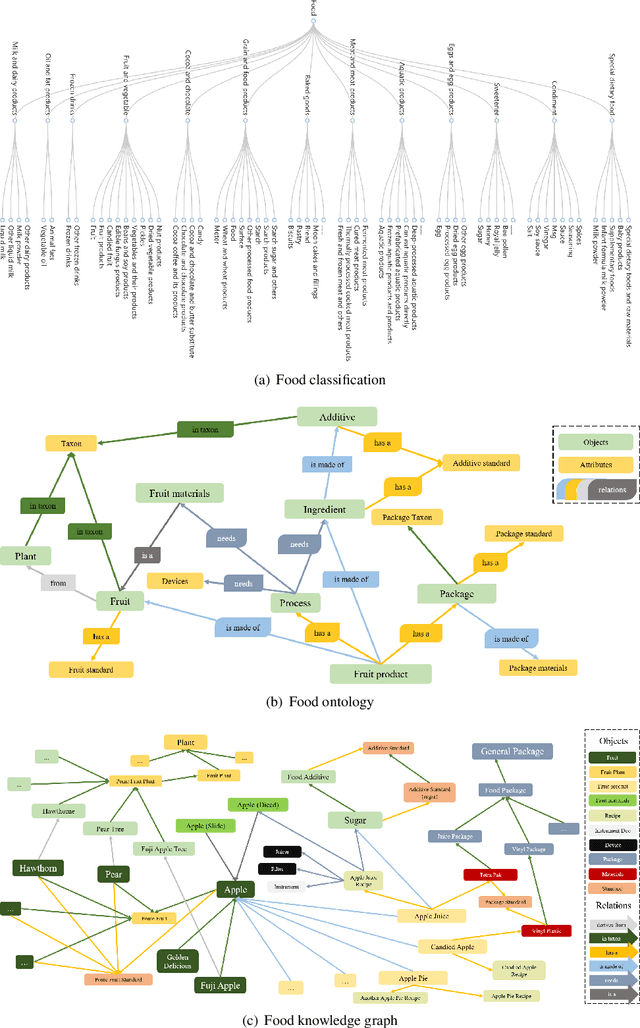
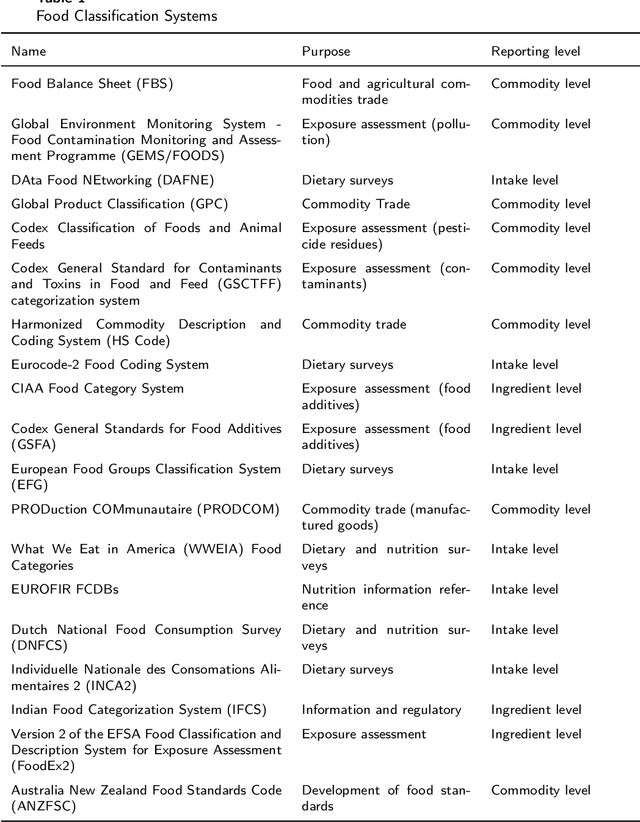
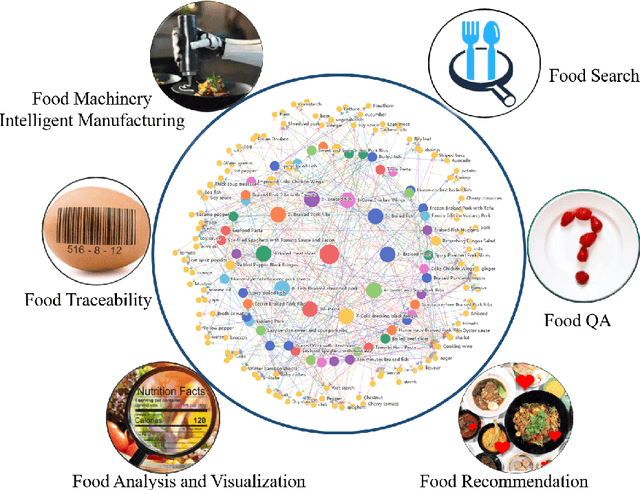
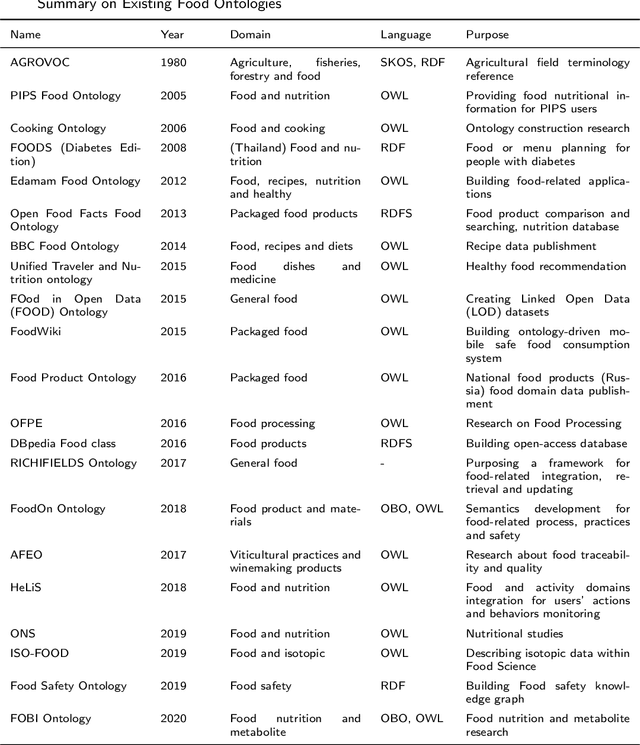
Background: The deployment of various networks (e.g., Internet of Things (IoT) and mobile networks) and databases (e.g., nutrition tables and food compositional databases) in the food system generates massive information silos due to the well-known data harmonization problem. The food knowledge graph provides a unified and standardized conceptual terminology and their relationships in a structured form and thus can transform these information silos across the whole food system to a more reusable globally digitally connected Internet of Food, enabling every stage of the food system from farm-to-fork. Scope and approach: We review the evolution of food knowledge organization, from food classification, food ontology to food knowledge graphs. We then discuss the progress in food knowledge graphs from several representative applications. We finally discuss the main challenges and future directions. Key findings and conclusions: Our comprehensive summary of current research on food knowledge graphs shows that food knowledge graphs play an important role in food-oriented applications, including food search and Question Answering (QA), personalized dietary recommendation, food analysis and visualization, food traceability, and food machinery intelligent manufacturing. Future directions for food knowledge graphs cover several fields such as multimodal food knowledge graphs and food intelligence.