 Add to Chrome
 Add to Firefox
 Add to Edge
SCoOP: Semantic Consistent Opinion Pooling for Uncertainty Quantification in Multiple Vision-Language Model Systems
Mar 25, 2026
Combining multiple Vision-Language Models (VLMs) can enhance multimodal reasoning and robustness, but aggregating heterogeneous models' outputs amplifies uncertainty and increases the risk of hallucinations. We propose SCoOP (Semantic-Consistent Opinion Pooling), a training-free uncertainty quantification (UQ) framework multi-VLM systems through uncertainty-weighted linear opinion pooling. Unlike prior UQ methods designed for single models, SCoOP explicitly measures collective, system-level uncertainty across multiple VLMs, enabling effective hallucination detection and abstention for highly uncertain samples. On ScienceQA, SCoOP achieves an AUROC of 0.866 for hallucination detection, outperforming baselines (0.732-0.757) by approximately 10-13%. For abstention, it attains an AURAC of 0.907, exceeding baselines (0.818-0.840) by 7-9%. Despite these gains, SCoOP introduces only microsecond-level aggregation overhead relative to the baselines, which is trivial compared to typical VLM inference time (on the order of seconds). These results demonstrate that SCoOP provides an efficient and principled mechanism for uncertainty-aware aggregation, advancing the reliability of multimodal AI systems.

ORCA: Agentic Reasoning For Hallucination and Adversarial Robustness in Vision-Language Models
Sep 18, 2025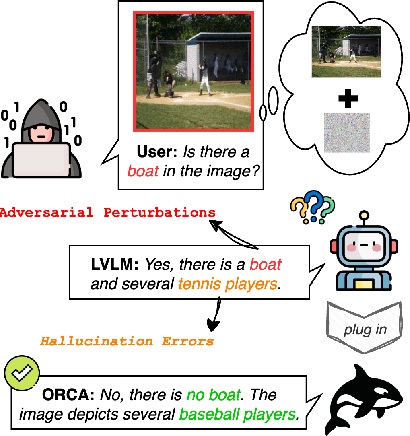
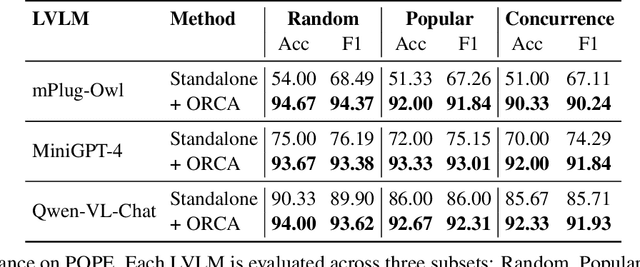
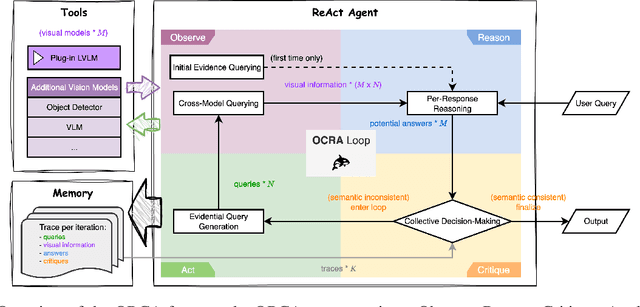
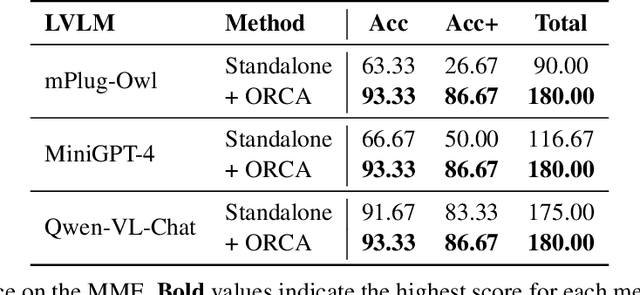
Large Vision-Language Models (LVLMs) exhibit strong multimodal capabilities but remain vulnerable to hallucinations from intrinsic errors and adversarial attacks from external exploitations, limiting their reliability in real-world applications. We present ORCA, an agentic reasoning framework that improves the factual accuracy and adversarial robustness of pretrained LVLMs through test-time structured inference reasoning with a suite of small vision models (less than 3B parameters). ORCA operates via an Observe--Reason--Critique--Act loop, querying multiple visual tools with evidential questions, validating cross-model inconsistencies, and refining predictions iteratively without access to model internals or retraining. ORCA also stores intermediate reasoning traces, which supports auditable decision-making. Though designed primarily to mitigate object-level hallucinations, ORCA also exhibits emergent adversarial robustness without requiring adversarial training or defense mechanisms. We evaluate ORCA across three settings: (1) clean images on hallucination benchmarks, (2) adversarially perturbed images without defense, and (3) adversarially perturbed images with defense applied. On the POPE hallucination benchmark, ORCA improves standalone LVLM performance by +3.64\% to +40.67\% across different subsets. Under adversarial perturbations on POPE, ORCA achieves an average accuracy gain of +20.11\% across LVLMs. When combined with defense techniques on adversarially perturbed AMBER images, ORCA further improves standalone LVLM performance, with gains ranging from +1.20\% to +48.00\% across evaluation metrics. These results demonstrate that ORCA offers a promising path toward building more reliable and robust multimodal systems.