 Add to Chrome
 Add to Firefox
 Add to Edge
PanoAir: A Panoramic Visual-Inertial SLAM with Cross-Time Real-World UAV Dataset
Apr 01, 2026
Accurate pose estimation is fundamental for unmanned aerial vehicle (UAV) applications, where Visual-Inertial SLAM (VI-SLAM) provides a cost-effective solution for localization and mapping. However, existing VI-SLAM methods mainly rely on sensors with limited fields of view (FoV), which can lead to drift and even failure in complex UAV scenarios. Although panoramic cameras provide omnidirectional perception to improve robustness, panoramic VI-SLAM and corresponding real-world datasets for UAVs remain underexplored. To address this limitation, we first construct a real-world panoramic visual-inertial dataset covering diverse flight conditions, including varying illumination, altitudes, trajectory lengths, and motion dynamics. To achieve accurate and robust pose estimation under such challenging UAV scenarios, we propose a panoramic VI-SLAM framework that exploits the omnidirectional FoV via the proposed panoramic feature extraction and panoramic loop closure, enhancing feature constraints and ensuring global consistency. Extensive experiments on both the proposed dataset and public benchmarks demonstrate that our method achieves superior accuracy, robustness, and consistency compared to existing approaches. Moreover, deployment on embedded platform validates its practical applicability, achieving comparable computational efficiency to PC implementations. The source code and dataset are publicly available at https://drive.google.com/file/d/1lG1Upn6yi-N6tYpEHAt6dfR1uhzNtWbT/view

Causal Graphs Meet Thoughts: Enhancing Complex Reasoning in Graph-Augmented LLMs
Jan 24, 2025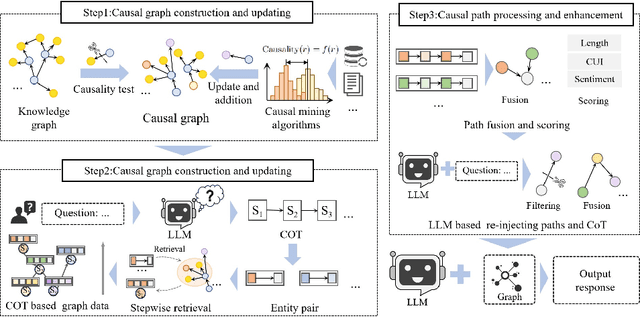
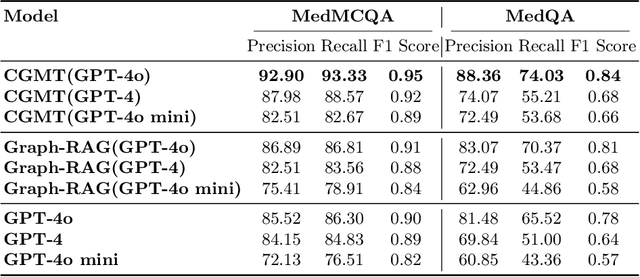
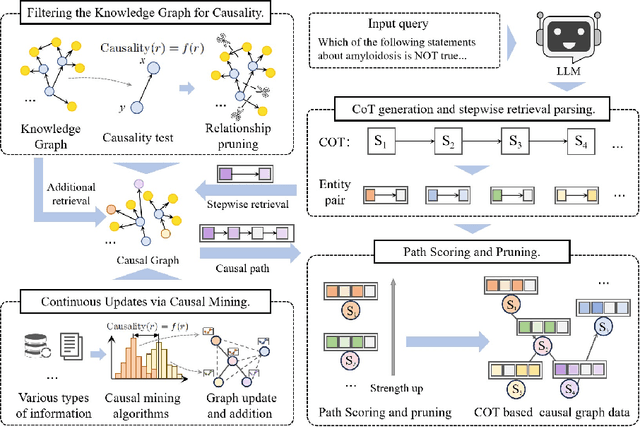
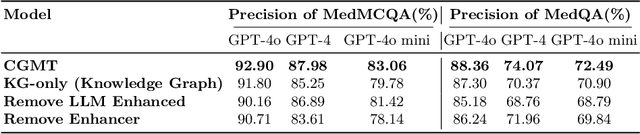
In knowledge-intensive tasks, especially in high-stakes domains like medicine and law, it is critical not only to retrieve relevant information but also to provide causal reasoning and explainability. Large language models (LLMs) have achieved remarkable performance in natural language understanding and generation tasks. However, they often suffer from limitations such as difficulty in incorporating new knowledge, generating hallucinations, and explaining their reasoning process. To address these challenges, integrating knowledge graphs with Graph Retrieval-Augmented Generation (Graph RAG) has emerged as an effective solution. Traditional Graph RAG methods often rely on simple graph traversal or semantic similarity, which do not capture causal relationships or align well with the model's internal reasoning steps. This paper proposes a novel pipeline that filters large knowledge graphs to emphasize cause-effect edges, aligns the retrieval process with the model's chain-of-thought (CoT), and enhances reasoning through multi-stage path improvements. Experiments on medical question-answering tasks show consistent gains, with up to a 10\% absolute improvement across multiple large language models (LLMs). This approach demonstrates the value of combining causal reasoning with stepwise retrieval, leading to more interpretable and logically grounded solutions for complex queries.