 Add to Chrome
 Add to Firefox
 Add to Edge
Predict-then-Optimize for Seaport Power-Logistics Scheduling: Generalization across Varying Tasks Stream
Nov 13, 2025
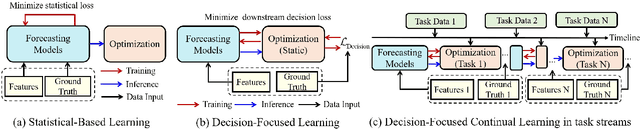
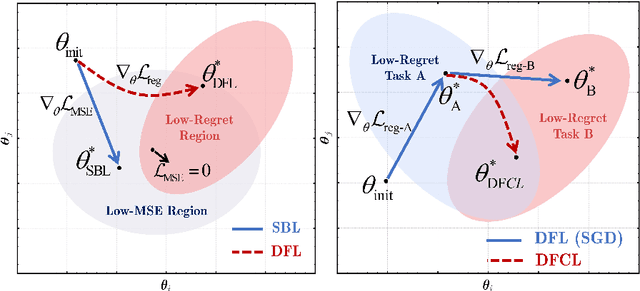
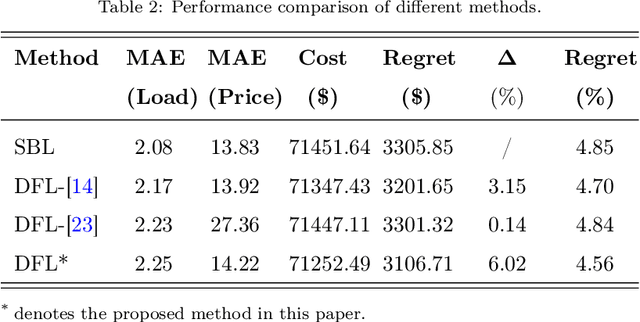
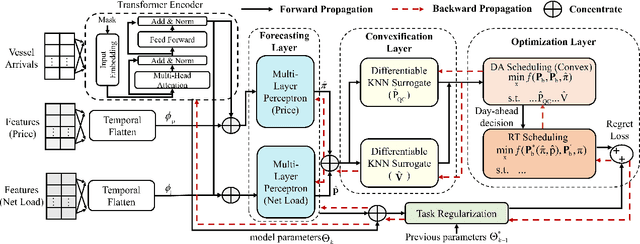
Power-logistics scheduling in modern seaports typically follow a predict-then-optimize pipeline. To enhance the decision quality of forecasts, decision-focused learning has been proposed, which aligns the training of forecasting models with downstream decision outcomes. However, this end-to-end design inherently restricts the value of forecasting models to only a specific task structure, and thus generalize poorly to evolving tasks induced by varying seaport vessel arrivals. We address this gap with a decision-focused continual learning framework that adapts online to a stream of scheduling tasks. Specifically, we introduce Fisher information based regularization to enhance cross-task generalization by preserving parameters critical to prior tasks. A differentiable convex surrogate is also developed to stabilize gradient backpropagation. The proposed approach enables learning a decision-aligned forecasting model across a varying tasks stream with a sustainable long-term computational burden. Experiments calibrated to the Jurong Port demonstrate superior decision performance and generalization over existing methods with reduced computational cost.

A Hybrid Strategy for Aggregated Probabilistic Forecasting and Energy Trading in HEFTCom2024
May 15, 2025Obtaining accurate probabilistic energy forecasts and making effective decisions amid diverse uncertainties are routine challenges in future energy systems. This paper presents the solution of team GEB, which ranked 3rd in trading, 4th in forecasting, and 1st among student teams in the IEEE Hybrid Energy Forecasting and Trading Competition 2024 (HEFTCom2024). The solution provides accurate probabilistic forecasts for a wind-solar hybrid system, and achieves substantial trading revenue in the day-ahead electricity market. Key components include: (1) a stacking-based approach combining sister forecasts from various Numerical Weather Predictions (NWPs) to provide wind power forecasts, (2) an online solar post-processing model to address the distribution shift in the online test set caused by increased solar capacity, (3) a probabilistic aggregation method for accurate quantile forecasts of hybrid generation, and (4) a stochastic trading strategy to maximize expected trading revenue considering uncertainties in electricity prices. This paper also explores the potential of end-to-end learning to further enhance the trading revenue by adjusting the distribution of forecast errors. Detailed case studies are provided to validate the effectiveness of these proposed methods. Code for all mentioned methods is available for reproduction and further research in both industry and academia.