 Add to Chrome
 Add to Firefox
 Add to Edge
CMT-Aware Channel Modeling and Transmit-Power Minimization for Pinching-Antenna Systems
Aug 04, 2026
This letter investigates transmit-power minimization for multiuser pinching-antenna system (PAS) from a coupled-mode-theory (CMT)-aware perspective. Existing CMT-based pinching antenna (PA) studies reveal coupling-induced power exchange and radiation behavior, but these effects have not been fully embedded into system-level multi-PA channel modeling and beamforming design. We therefore develop a directional and loss-aware channel model that captures coupling-length-dependent power extraction and the downstream guided-power reduction caused by in-waveguide attenuation and upstream extraction. The model shows that PA design should account for both directional radiation and guided-power evolution, rather than only propagation distance or maximum coupling considered in most existing works. Based on this channel model, we formulate a quality-of-service (QoS)-constrained power minimization problem for continuous PA positioning and finite-codebook activation. For each candidate coupling length, the element-wise positioning and BPSO-based activation use a closed-form zero-forcing (ZF) power metric for low-complexity configuration ranking, thereby avoiding repeated beamforming optimization while excluding rank-deficient candidates and ordering the remaining ones. The selected configuration for each coupling length is then evaluated by optimal fixed-configuration QoS beamforming. Simulation results demonstrate that CMT-aware modeling fundamentally reshapes the preferred PA configuration, maximum coupling is not always power-efficient due to suppressed downstream PA contributions, and finite-codebook activation combined with ZF-based ranking provides a balance between transmit-power performance and deployment complexity.

Transfer-based Adversarial Poisoning Attacks for Online (MIMO-)Deep Receviers
Sep 04, 2024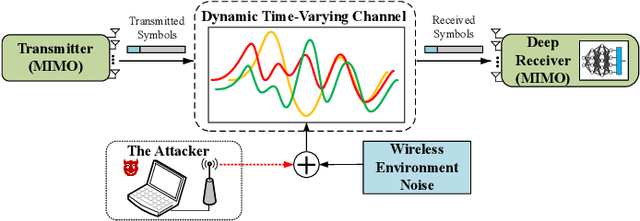
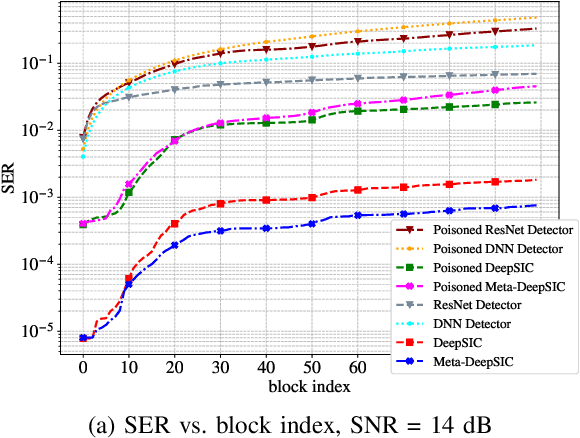
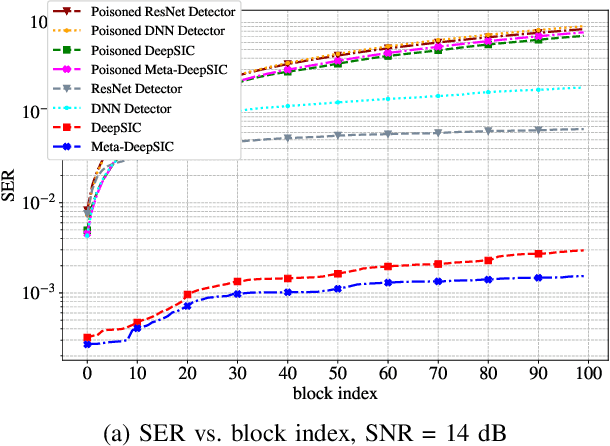
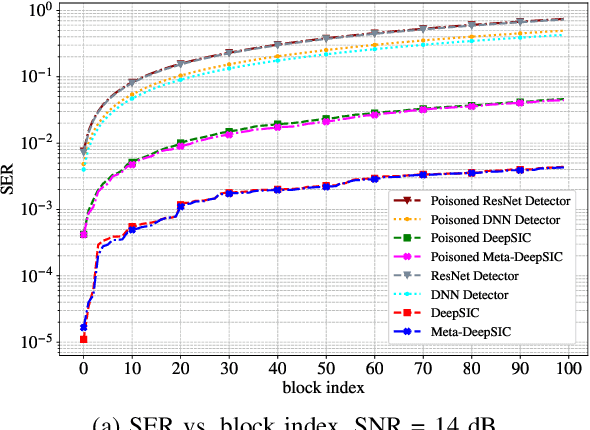
Recently, the design of wireless receivers using deep neural networks (DNNs), known as deep receivers, has attracted extensive attention for ensuring reliable communication in complex channel environments. To adapt quickly to dynamic channels, online learning has been adopted to update the weights of deep receivers with over-the-air data (e.g., pilots). However, the fragility of neural models and the openness of wireless channels expose these systems to malicious attacks. To this end, understanding these attack methods is essential for robust receiver design.In this paper, we propose a transfer-based adversarial poisoning attack method for online receivers.Without knowledge of the attack target, adversarial perturbations are injected to the pilots, poisoning the online deep receiver and impairing its ability to adapt to dynamic channels and nonlinear effects. In particular, our attack method targets Deep Soft Interference Cancellation (DeepSIC)[1] using online meta-learning.As a classical model-driven deep receiver, DeepSIC incorporates wireless domain knowledge into its architecture. This integration allows it to adapt efficiently to time-varying channels with only a small number of pilots, achieving optimal performance in a multi-input and multi-output (MIMO) scenario.The deep receiver in this scenario has a number of applications in the field of wireless communication, which motivates our study of the attack methods targeting it.Specifically, we demonstrate the effectiveness of our attack in simulations on synthetic linear, synthetic nonlinear, static, and COST 2100 channels. Simulation results indicate that the proposed poisoning attack significantly reduces the performance of online receivers in rapidly changing scenarios.