 Add to Chrome
 Add to Firefox
 Add to Edge
ABM-UDE: Developing Surrogates for Epidemic Agent-Based Models via Scientific Machine Learning
Feb 25, 2026
Agent-based epidemic models (ABMs) encode behavioral and policy heterogeneity but are too slow for nightly hospital planning. We develop county-ready surrogates that learn directly from exascale ABM trajectories using Universal Differential Equations (UDEs): mechanistic SEIR-family ODEs with a neural-parameterized contact rate $κ_φ(u,t)$ (no additive residual). Our contributions are threefold: we adapt multiple shooting and an observer-based prediction-error method (PEM) to stabilize identification of neural-augmented epidemiological dynamics across intervention-driven regime shifts; we enforce positivity and mass conservation and show the learned contact-rate parameterization yields a well-posed vector field; and we quantify accuracy, calibration, and compute against ABM ensembles and UDE baselines. On a representative ExaEpi scenario, PEM-UDE reduces mean MSE by 77% relative to single-shooting UDE (3.00 vs. 13.14) and by 20% relative to MS-UDE (3.75). Reliability improves in parallel: empirical coverage of ABM $10$-$90$% and $25$-$75$% bands rises from 0.68/0.43 (UDE) and 0.79/0.55 (MS-UDE) to 0.86/0.61 with PEM-UDE and 0.94/0.69 with MS+PEM-UDE, indicating calibrated uncertainty rather than overconfident fits. Inference runs in seconds on commodity CPUs (20-35 s per $\sim$90-day forecast), enabling nightly ''what-if'' sweeps on a laptop. Relative to a $\sim$100 CPU-hour ABM reference run, this yields $\sim10^{4}\times$ lower wall-clock per scenario. This closes the realism-cadence gap, supports threshold-aware decision-making (e.g., maintaining ICU occupancy $<75$%), preserves mechanistic interpretability, and enables calibrated, risk-aware scenario planning on standard institutional hardware. Beyond epidemics, the ABM$\to$UDE recipe provides a portable path to distill agent-based simulators into fast, trustworthy surrogates for other scientific domains.

Physics-Constrained Flow Matching: Sampling Generative Models with Hard Constraints
Jun 04, 2025Deep generative models have recently been applied to physical systems governed by partial differential equations (PDEs), offering scalable simulation and uncertainty-aware inference. However, enforcing physical constraints, such as conservation laws (linear and nonlinear) and physical consistencies, remains challenging. Existing methods often rely on soft penalties or architectural biases that fail to guarantee hard constraints. In this work, we propose Physics-Constrained Flow Matching (PCFM), a zero-shot inference framework that enforces arbitrary nonlinear constraints in pretrained flow-based generative models. PCFM continuously guides the sampling process through physics-based corrections applied to intermediate solution states, while remaining aligned with the learned flow and satisfying physical constraints. Empirically, PCFM outperforms both unconstrained and constrained baselines on a range of PDEs, including those with shocks, discontinuities, and sharp features, while ensuring exact constraint satisfaction at the final solution. Our method provides a general framework for enforcing hard constraints in both scientific and general-purpose generative models, especially in applications where constraint satisfaction is essential.
ACED: Accelerated Computational Electrochemical systems Discovery
Nov 10, 2020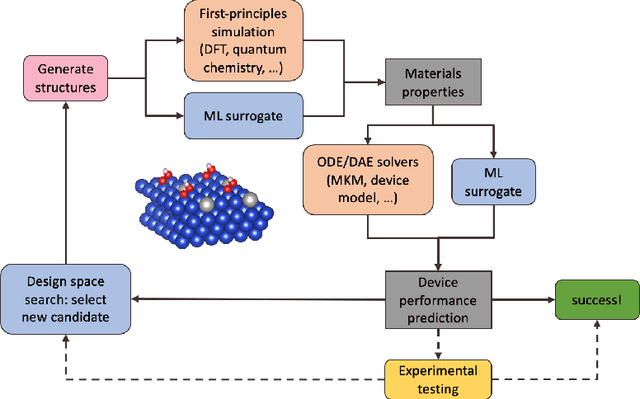
Large-scale electrification is vital to addressing the climate crisis, but many engineering challenges remain to fully electrifying both the chemical industry and transportation. In both of these areas, new electrochemical materials and systems will be critical, but developing these systems currently relies heavily on computationally expensive first-principles simulations as well as human-time-intensive experimental trial and error. We propose to develop an automated workflow that accelerates these computational steps by introducing both automated error handling in generating the first-principles training data as well as physics-informed machine learning surrogates to further reduce computational cost. It will also have the capacity to include automated experiments "in the loop" in order to dramatically accelerate the overall materials discovery pipeline.