 Add to Chrome
 Add to Firefox
 Add to Edge
Mask What Matters: Saliency-Guided Video Self-Supervised Learning for Autonomous Driving
Aug 17, 2026
Video self-supervised learning through masked spatiotemporal prediction has emerged as a promising paradigm for learning feature representations from unlabeled data. However, existing methods typically rely on random masking, which indiscriminately removes regions irrespective of their semantic or temporal relevance. In ego-centric driving videos, this can weaken the pretext signal since safety-critical cues such as pedestrians, vehicles, lane boundaries, and dynamic interactions often occupy only a small portion of the frame, yet are central to downstream perception. We introduce V-JEPA4A, a domain-specialized variant of V-JEPA for autonomous driving that is pre-trained on publicly available driving videos with a novel saliency-driven masking policy. It accounts for semantically and temporally relevant context. The proposed policy preserves and predicts context according to semantic importance and temporal relevance, yielding more informative representation learning while retaining the efficiency of masked prediction. We evaluate the resulting encoders on four driving benchmarks spanning tracking, semantic segmentation, and depth estimation. The results demonstrate that V-JEPA4A reduces identity switches on BDD100k MOT by 25% over V-JEPA with random masking, achieves 73.2 mIoU on Cityscapes, and 3.75 RMSE on KITTI-2015 depth, while incurring only ~14% additional pre-training iteration overhead.

Depth-Wise Probing and Pruning of the Planning Token in a Driving Vision-Language-Action Model
Aug 07, 2026Vision-language-action (VLA) models route driving decisions through a deep language model, but it is unclear how much of that depth the action itself requires. We study a representative driving VLA whose entire plan is carried by a single planning token that a generative planner decodes into a trajectory. Borrowing the planner as a trajectory-space logit lens, we decode the planning token from every one of the 32 decoder layers and measure two signals: the linear decodability of the navigation command and trajectory compatibility with the frozen native planner. Our diagnostic shows that semantic intent is linearly decodable early: command-probe accuracy reaches 97.7\% after the first decoder layer, compared with 16.7\% chance. In contrast, compatibility with the frozen native planner improves gradually across depth, with open-loop Avg-L2 reaching its minimum of 2.11\,m only at the final layer. Learned readouts from the first layer recover much of this gap, indicating that planning information is already present early but is not yet represented in the format expected by the deployed planner. Ranking decoder layers by the angular deviation they induce in the planning token permits removal of 8 of 32 layers within an approximately 5\% relative open-loop error increase and yields a measured 1.33$\times$ decoder speedup. At the evaluated sample size, no family-specific degradation is statistically resolved. These findings are limited to the evaluated ORION checkpoint and Bench2Drive setup.
A Point-Based Approach to Efficient LiDAR Multi-Task Perception
Apr 19, 2024Multi-task networks can potentially improve performance and computational efficiency compared to single-task networks, facilitating online deployment. However, current multi-task architectures in point cloud perception combine multiple task-specific point cloud representations, each requiring a separate feature encoder and making the network structures bulky and slow. We propose PAttFormer, an efficient multi-task architecture for joint semantic segmentation and object detection in point clouds that only relies on a point-based representation. The network builds on transformer-based feature encoders using neighborhood attention and grid-pooling and a query-based detection decoder using a novel 3D deformable-attention detection head design. Unlike other LiDAR-based multi-task architectures, our proposed PAttFormer does not require separate feature encoders for multiple task-specific point cloud representations, resulting in a network that is 3x smaller and 1.4x faster while achieving competitive performance on the nuScenes and KITTI benchmarks for autonomous driving perception. Our extensive evaluations show substantial gains from multi-task learning, improving LiDAR semantic segmentation by +1.7% in mIou and 3D object detection by +1.7% in mAP on the nuScenes benchmark compared to the single-task models.
Self-Supervised Multi-Object Tracking From Consistency Across Timescales
Apr 25, 2023
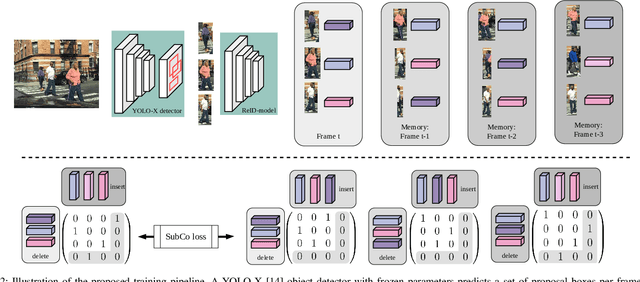
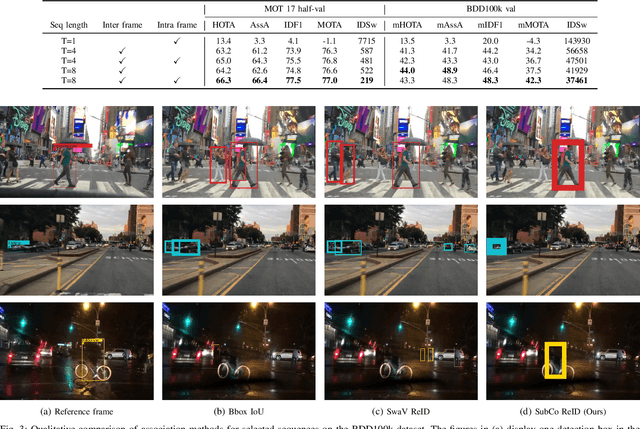

Self-supervised multi-object trackers have the potential to leverage the vast amounts of raw data recorded worldwide. However, they still fall short in re-identification accuracy compared to their supervised counterparts. We hypothesize that this deficiency results from restricting self-supervised objectives to single frames or frame pairs. Such designs lack sufficient visual appearance variations during training to learn consistent re-identification features. Therefore, we propose a training objective that learns re-identification features over a sequence of frames by enforcing consistent association scores across short and long timescales. Extensive evaluations on the BDD100K and MOT17 benchmarks demonstrate that our learned ReID features significantly reduce ID switches compared to other self-supervised methods, setting the new state of the art for self-supervised multi-object tracking and even performing on par with supervised methods on the BDD100k benchmark.
Self-Supervised Representation Learning from Temporal Ordering of Automated Driving Sequences
Feb 17, 2023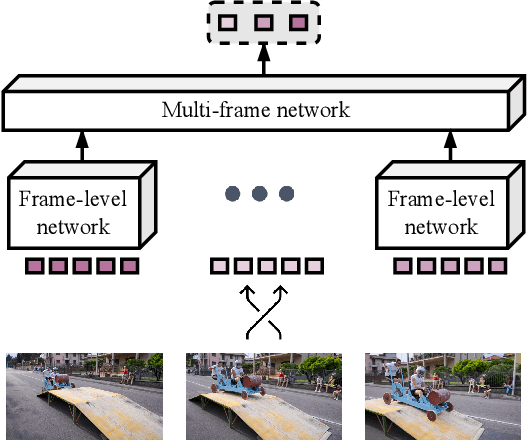
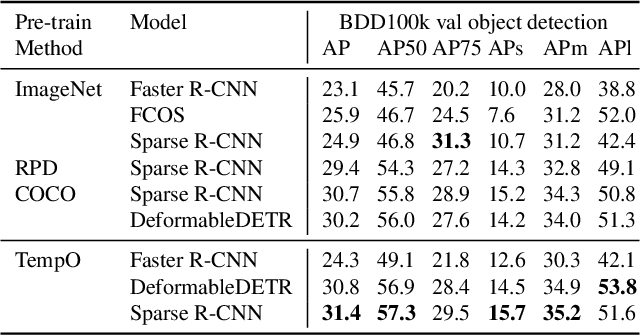
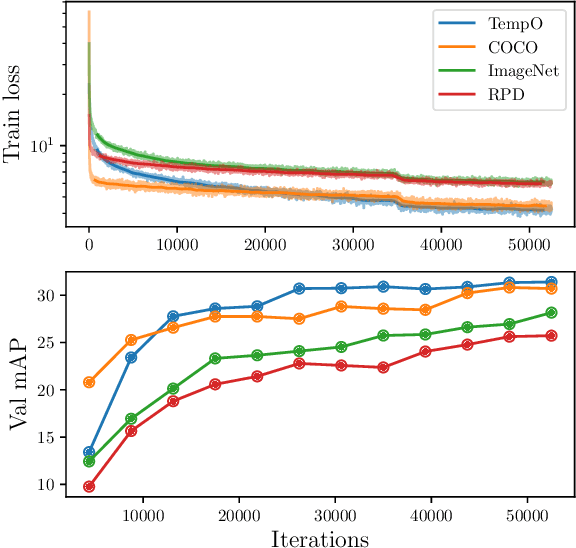
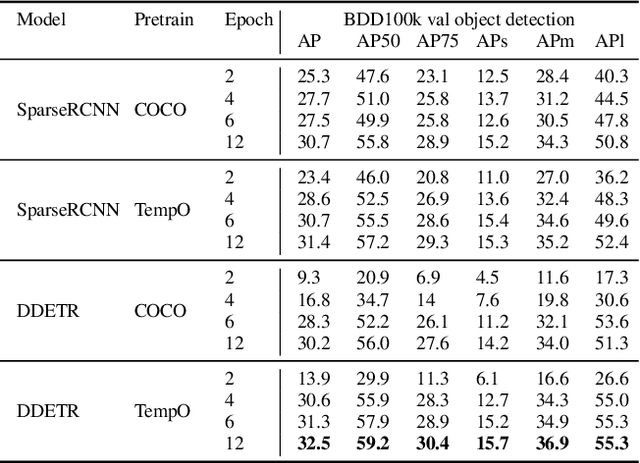
Self-supervised feature learning enables perception systems to benefit from the vast amount of raw data being recorded by vehicle fleets all over the world. However, their potential to learn dense representations from sequential data has been relatively unexplored. In this work, we propose TempO, a temporal ordering pretext task for pre-training region-level feature representations for perception tasks. We embed each frame by an unordered set of proposal feature vectors, a representation that is natural for instance-level perception architectures, and formulate the sequential ordering prediction by comparing similarities between sets of feature vectors in a transformer-based multi-frame architecture. Extensive evaluation in automated driving domains on the BDD100K and MOT17 datasets shows that our TempO approach outperforms existing self-supervised single-frame pre-training methods as well as supervised transfer learning initialization strategies on standard object detection and multi-object tracking benchmarks.
On Hyperbolic Embeddings in 2D Object Detection
Mar 18, 2022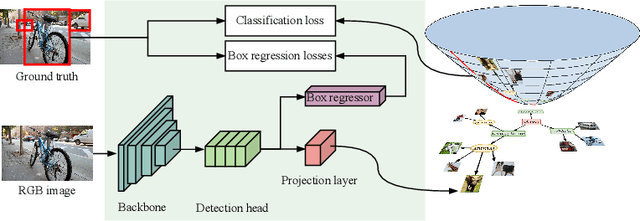
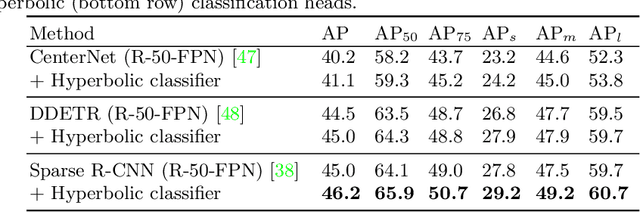


Object detection, for the most part, has been formulated in the euclidean space, where euclidean or spherical geodesic distances measure the similarity of an image region to an object class prototype. In this work, we study whether a hyperbolic geometry better matches the underlying structure of the object classification space. We incorporate a hyperbolic classifier in two-stage, keypoint-based, and transformer-based object detection architectures and evaluate them on large-scale, long-tailed, and zero-shot object detection benchmarks. In our extensive experimental evaluations, we observe categorical class hierarchies emerging in the structure of the classification space, resulting in lower classification errors and boosting the overall object detection performance.
Contrastive Object Detection Using Knowledge Graph Embeddings
Dec 21, 2021


Object recognition for the most part has been approached as a one-hot problem that treats classes to be discrete and unrelated. Each image region has to be assigned to one member of a set of objects, including a background class, disregarding any similarities in the object types. In this work, we compare the error statistics of the class embeddings learned from a one-hot approach with semantically structured embeddings from natural language processing or knowledge graphs that are widely applied in open world object detection. Extensive experimental results on multiple knowledge-embeddings as well as distance metrics indicate that knowledge-based class representations result in more semantically grounded misclassifications while performing on par compared to one-hot methods on the challenging COCO and Cityscapes object detection benchmarks. We generalize our findings to multiple object detection architectures by proposing a knowledge-embedded design for keypoint-based and transformer-based object detection architectures.