 Add to Chrome
 Add to Firefox
 Add to Edge
MuellerPT: Decomposition Driven Pretraining for Dense Learning in Mueller Polarimetry
May 22, 2026
Mueller matrix imaging provides rich, physically meaningful contrast for biomedical tissue analysis, but supervised learning is hindered by scarce dense annotations and strong domain shifts across specimens and acquisition settings. We introduce MuellerPT, a physics guided pre-training approach that learns transferable dense representations by predicting Lu-Chipman decomposition maps from per-pixel 4x4 Mueller matrices. To scale pre-training, we collected a new large Multispectral Animal Polarimetric Organ dataset (MAP-Org). The pre-trained encoder is adapted with a segmentation head for grey vs. white matter segmentation in lamb brain. A classification head is used for colorectal cancer vs. non-cancer classification. Both segmentation and classification are evaluated across few-shot learning scenarios. In segmentation, MuellerPT improves label efficiency and cross specimen transfer compared to models without pre-training, achieving an absolute DICE gain of over 20% compared to the baseline trained from scratch when using 5% of the training data. In classification, MuellerPT also enhances label efficiency, improving overall accuracy by 8% compared to the baseline when using 1% of the training data. We demonstrate MuellerPT's robustness to domain shift with a qualitative evaluation of its predicted Lu-Chipman maps on an ex vivo human oesophagus sample. These results suggest that predicting Lu-Chipman decomposition is an effective and practical pretext task for robust biomedical inference from Mueller polarimetry and can pave the way for future work on label efficient Mueller imaging.

Automatic Robotic-Assisted Diffuse Reflectance Spectroscopy Scanning System
Mar 11, 2025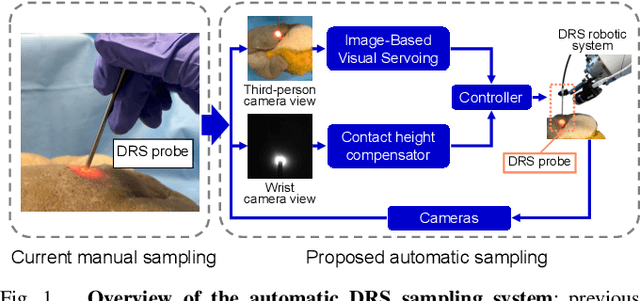
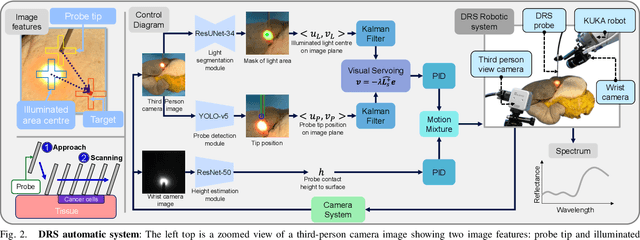
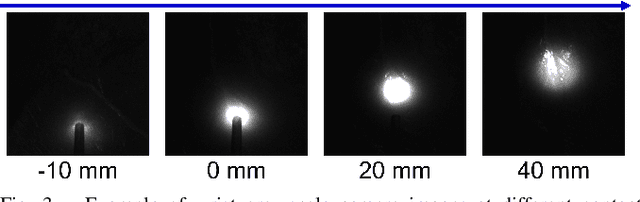
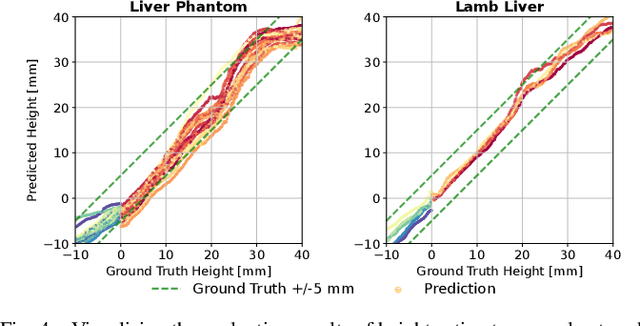
Diffuse Reflectance Spectroscopy (DRS) is a well-established optical technique for tissue composition assessment which has been clinically evaluated for tumour detection to ensure the complete removal of cancerous tissue. While point-wise assessment has many potential applications, incorporating automated large-area scanning would enable holistic tissue sampling with higher consistency. We propose a robotic system to facilitate autonomous DRS scanning with hybrid visual servoing control. A specially designed height compensation module enables precise contact condition control. The evaluation results show that the system can accurately execute the scanning command and acquire consistent DRS spectra with comparable results to the manual collection, which is the current gold standard protocol. Integrating the proposed system into surgery lays the groundwork for autonomous intra-operative DRS tissue assessment with high reliability and repeatability. This could reduce the need for manual scanning by the surgeon while ensuring complete tumor removal in clinical practice.