 Add to Chrome
 Add to Firefox
 Add to Edge
Distilling 3D Spatial Reasoning into a Lightweight Vision-Language Model with CoT
May 10, 2026
Large-scale 3D vision-language models (VLMs) like LLaVA-3D offer strong spatial reasoning but are difficult to deploy due to high computational costs. We propose a knowledge distillation framework that transfers spatial reasoning from a 7B teacher to a 2.29B student model. Our approach achieves 8.7x lower inference latency and a 3x reduction in model size while retaining 54-72% of the teacher's performance. The framework utilizes VGGT as the vision encoder and a multi-task distillation pipeline with uncertainty-aware loss weighting. To improve reasoning without chain-of-thought (CoT) data, we introduce "Hidden CoT": learnable latent tokens that serve as an internal scratchpad before answer generation. This is the first use of latent scratchpad reasoning in distilled 3D VLMs. The student model jointly performs spatial description, depth estimation, and object detection. Experiments on ScanNet and 3D-FRONT show strong spatial understanding, reaching 68-72% accuracy on proximity and contact tasks. Our framework enables efficient 3D scene QA on resource-constrained platforms.

On the Real-Time Semantic Segmentation of Aphid Clusters in the Wild
Jul 17, 2023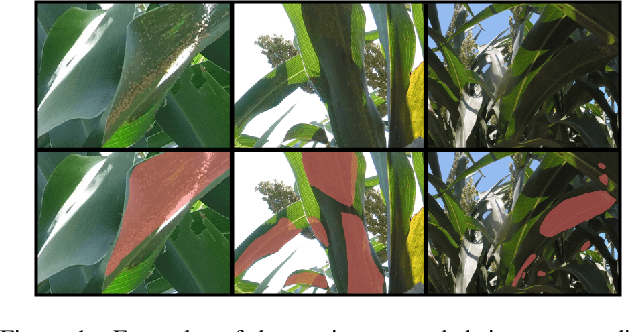
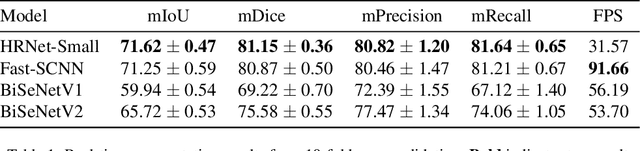
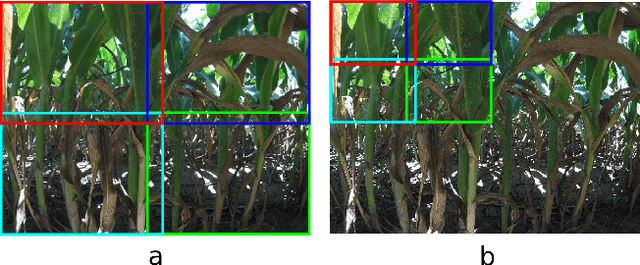
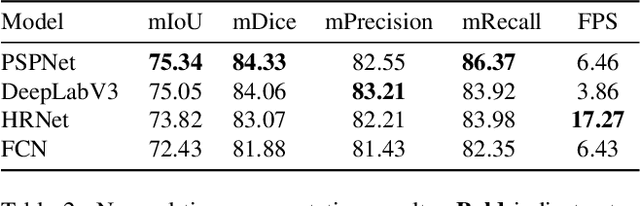
Aphid infestations can cause extensive damage to wheat and sorghum fields and spread plant viruses, resulting in significant yield losses in agriculture. To address this issue, farmers often rely on chemical pesticides, which are inefficiently applied over large areas of fields. As a result, a considerable amount of pesticide is wasted on areas without pests, while inadequate amounts are applied to areas with severe infestations. The paper focuses on the urgent need for an intelligent autonomous system that can locate and spray infestations within complex crop canopies, reducing pesticide use and environmental impact. We have collected and labeled a large aphid image dataset in the field, and propose the use of real-time semantic segmentation models to segment clusters of aphids. A multiscale dataset is generated to allow for learning the clusters at different scales. We compare the segmentation speeds and accuracy of four state-of-the-art real-time semantic segmentation models on the aphid cluster dataset, benchmarking them against nonreal-time models. The study results show the effectiveness of a real-time solution, which can reduce inefficient pesticide use and increase crop yields, paving the way towards an autonomous pest detection system.