 Add to Chrome
 Add to Firefox
 Add to Edge
Computational Turing Test Reveals Systematic Differences Between Human and AI Language
Nov 06, 2025
Large language models (LLMs) are increasingly used in the social sciences to simulate human behavior, based on the assumption that they can generate realistic, human-like text. Yet this assumption remains largely untested. Existing validation efforts rely heavily on human-judgment-based evaluations -- testing whether humans can distinguish AI from human output -- despite evidence that such judgments are blunt and unreliable. As a result, the field lacks robust tools for assessing the realism of LLM-generated text or for calibrating models to real-world data. This paper makes two contributions. First, we introduce a computational Turing test: a validation framework that integrates aggregate metrics (BERT-based detectability and semantic similarity) with interpretable linguistic features (stylistic markers and topical patterns) to assess how closely LLMs approximate human language within a given dataset. Second, we systematically compare nine open-weight LLMs across five calibration strategies -- including fine-tuning, stylistic prompting, and context retrieval -- benchmarking their ability to reproduce user interactions on X (formerly Twitter), Bluesky, and Reddit. Our findings challenge core assumptions in the literature. Even after calibration, LLM outputs remain clearly distinguishable from human text, particularly in affective tone and emotional expression. Instruction-tuned models underperform their base counterparts, and scaling up model size does not enhance human-likeness. Crucially, we identify a trade-off: optimizing for human-likeness often comes at the cost of semantic fidelity, and vice versa. These results provide a much-needed scalable framework for validation and calibration in LLM simulations -- and offer a cautionary note about their current limitations in capturing human communication.

REFORMS: Reporting Standards for Machine Learning Based Science
Aug 15, 2023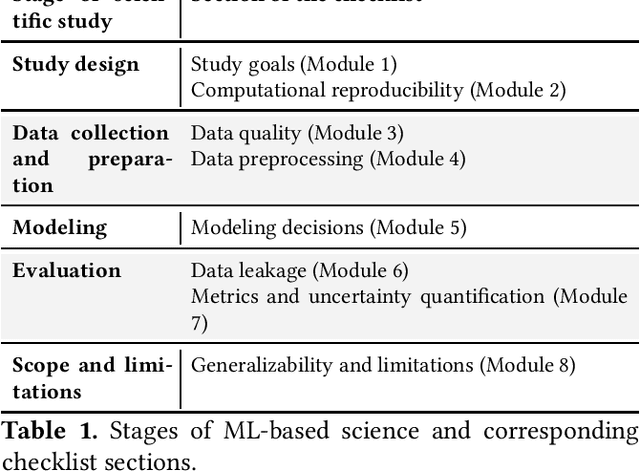
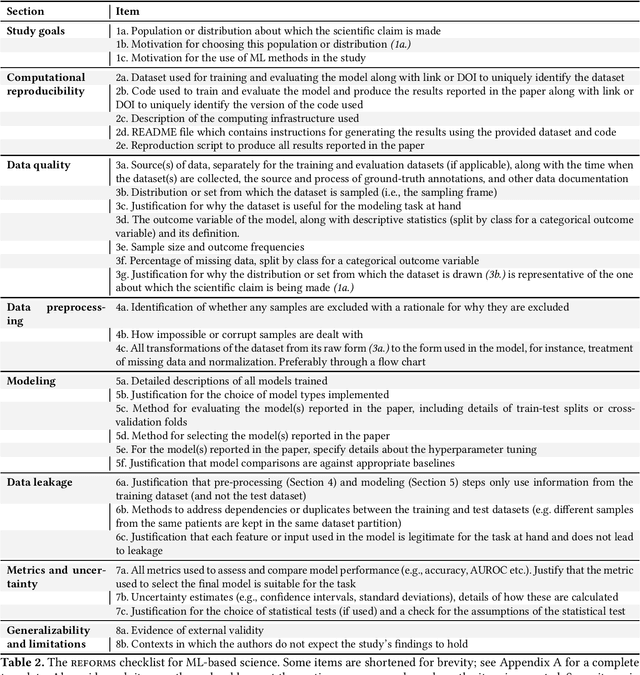
Machine learning (ML) methods are proliferating in scientific research. However, the adoption of these methods has been accompanied by failures of validity, reproducibility, and generalizability. These failures can hinder scientific progress, lead to false consensus around invalid claims, and undermine the credibility of ML-based science. ML methods are often applied and fail in similar ways across disciplines. Motivated by this observation, our goal is to provide clear reporting standards for ML-based science. Drawing from an extensive review of past literature, we present the REFORMS checklist ($\textbf{Re}$porting Standards $\textbf{For}$ $\textbf{M}$achine Learning Based $\textbf{S}$cience). It consists of 32 questions and a paired set of guidelines. REFORMS was developed based on a consensus of 19 researchers across computer science, data science, mathematics, social sciences, and biomedical sciences. REFORMS can serve as a resource for researchers when designing and implementing a study, for referees when reviewing papers, and for journals when enforcing standards for transparency and reproducibility.