 Add to Chrome
 Add to Firefox
 Add to Edge
Benchmarking Generalization in Financial Statement Fraud Detection: robust evaluation and novel tasks
Jul 21, 2026
Financial statement fraud detection (FSFD) is crucial for market integrity but faces challenges from increasingly sophisticated schemes and under-utilized textual data in financial reports. Existing methods often rely on random data splits, leading to overoptimistic performance estimates that do not reflect real-world generalization to new companies or future periods. To address this recurring problem with the state of the art, we propose a robust FSFD framework leveraging Large Language Models (LLMs) to integrate both structured financial data and unstructured textual information from financial reports. We provide a more realistic evaluation through a novel and challenging benchmark task called Company-Isolated FSFD (CI-FSFD). We construct and make publicly available a comprehensive U.S. company dataset combining financial statements, summarized MD&A text, and fraud labels. Our approach achieves the best performance on the challenging CI-FSFD task, demonstrating the critical value of textual data and robust evaluation for reliable financial fraud detection.

Large Language Models for Citation Function Classification
Jul 20, 2026Citation function classification plays a crucial role in understanding the relationships between scientific publications and advancing bibliometric analysis. This study presents one of the first comprehensive evaluations of multiple state-of-the-art (SOTA) large language models (LLMs) for citation function classification, achieving new SOTA results on the ACL-ARC dataset. We systematically compare five models (Mistral 7B, Orca 2-7B, LLaMA 3.1-8B, Falcon 7B, and SciBERT) across zero-shot, few-shot, and fine-tuning approaches. Our fine-tuned Falcon 7B model achieves a 73.3% macro F1 score on ACL-ARC, representing a significant improvement over previous methods. Additionally, we introduce AC3, a novel dataset featuring a seven-category annotation scheme that distinguishes between neutral acknowledgments and explicit evaluative stances (more opinion-oriented citations - criticizing, complimenting, contradicting). The dataset is implemented across four context extraction variants to systematically evaluate the impact of contextual scope on classification performance. We also provide detailed analysis of model performance, experimental configurations, and limitations to guide future research in this domain. To our knowledge, this is one of the first studies dedicated to comprehensive model comparison for citation function classification, addressing a gap identified in recent surveys.
GraphLit: Learning Text-Enriched Dynamic Character Network Representations for Literary Study
May 28, 2026Methods to represent literary texts as graphs or sequences of graphs mainly focus on representing character interactions, and often overlook another crucial aspect: the textual context in which characters interact. We introduce Dynamic Heterogeneous Character Networks (DHCNs), which organize long novels into temporally localized heterogeneous graphs that align characters with their textual contexts. We extract around 20,000 DHCNs from Project Gutenberg, and propose GraphLit, a self-supervised learning framework that learns rich literary representations through a masked graph autoencoder objective. Across a wide-range of 12 character-related tasks, GraphLit improves over text-only and graph-only baselines, particularly on tasks requiring contextual understanding. Finally, we demonstrate the applicability of DHCNs and GraphLit for literary analysis by studying the link between narrative non-linearity and dynamic social features.
S-VoCAL: A Dataset and Evaluation Framework for Inferring Speaking Voice Character Attributes in Literature
Mar 01, 2026With recent advances in Text-to-Speech (TTS) systems, synthetic audiobook narration has seen increased interest, reaching unprecedented levels of naturalness. However, larger gaps remain in synthetic narration systems' ability to impersonate fictional characters, and convey complex emotions or prosody. A promising direction to enhance character identification is the assignment of plausible voices to each fictional characters in a book. This step typically requires complex inference of attributes in book-length contexts, such as a character's age, gender, origin or physical health, which in turns requires dedicated benchmark datasets to evaluate extraction systems' performances. We present S-VoCAL (Speaking Voice Character Attributes in Literature), the first dataset and evaluation framework dedicated to evaluate the inference of voice-related fictional character attributes. S-VoCAL entails 8 attributes grounded in sociophonetic studies, and 952 character-book pairs derived from Project Gutenberg. Its evaluation framework addresses the particularities of each attribute, and includes a novel similarity metric based on recent Large Language Models embeddings. We demonstrate the applicability of S-VoCAL by applying a simple Retrieval-Augmented Generation (RAG) pipeline to the task of inferring character attributes. Our results suggest that the RAG pipeline reliably infers attributes such as Age or Gender, but struggles on others such as Origin or Physical Health. The dataset and evaluation code are available at https://github.com/AbigailBerthe/S-VoCAL .
Cross-lingual Matryoshka Representation Learning across Speech and Text
Feb 23, 2026Speakers of under-represented languages face both a language barrier, as most online knowledge is in a few dominant languages, and a modality barrier, since information is largely text-based while many languages are primarily oral. We address this for French-Wolof by training the first bilingual speech-text Matryoshka embedding model, enabling efficient retrieval of French text from Wolof speech queries without relying on a costly ASR-translation pipelines. We introduce large-scale data curation pipelines and new benchmarks, compare modeling strategies, and show that modality fusion within a frozen text Matryoshka model performs best. Although trained only for retrieval, the model generalizes well to other tasks, such as speech intent detection, indicating the learning of general semantic representations. Finally, we analyze cost-accuracy trade-offs across Matryoshka dimensions and ranks, showing that information is concentrated only in a few components, suggesting potential for efficiency improvements.
Ladder Up, Memory Down: Low-Cost Fine-Tuning With Side Nets
Dec 16, 2025Fine-tuning large language models (LLMs) is often limited by the memory available on commodity GPUs. Parameter-efficient fine-tuning (PEFT) methods such as QLoRA reduce the number of trainable parameters, yet still incur high memory usage induced by the backward pass in the full model. We revisit Ladder Side Tuning (LST), a rarely explored PEFT technique that adds a lightweight side network, and show that it matches QLoRA's compute scaling slope while cutting peak memory by 50\%. Across different downstream benchmarks spanning natural language understanding, mathematical and LLM-critic tasks, LST has competitive performance with QLoRA's accuracy on average while being much more memory-efficient. This efficiency enables fine-tuning of 7B-parameter models on a single 12 GB consumer GPU with 2k-token contexts, requiring no gradient checkpointing\textemdash conditions under which QLoRA exhausts memory. Beyond memory efficiency, we also establish scaling laws showing that LST scales similarly to QLoRA. We exploit Ladder's architectural flexibility by introducing xLadder, a depth-extended variant that increases effective depth via cross-connections and shortens chain-of-thought (CoT) at fixed parameter count. Ladder is strong when memory is the bottleneck; xLadder builds on this by enabling deeper reasoning without additional memory overhead.
Speech Language Models for Under-Represented Languages: Insights from Wolof
Sep 18, 2025We present our journey in training a speech language model for Wolof, an underrepresented language spoken in West Africa, and share key insights. We first emphasize the importance of collecting large-scale, spontaneous, high-quality speech data, and show that continued pretraining HuBERT on this dataset outperforms both the base model and African-centric models on ASR. We then integrate this speech encoder into a Wolof LLM to train the first Speech LLM for this language, extending its capabilities to tasks such as speech translation. Furthermore, we explore training the Speech LLM to perform multi-step Chain-of-Thought before transcribing or translating. Our results show that the Speech LLM not only improves speech recognition but also performs well in speech translation. The models and the code will be openly shared.
LibriQuote: A Speech Dataset of Fictional Character Utterances for Expressive Zero-Shot Speech Synthesis
Sep 04, 2025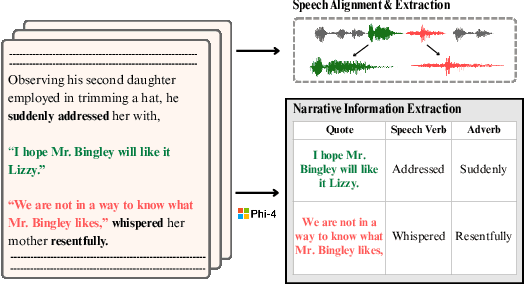
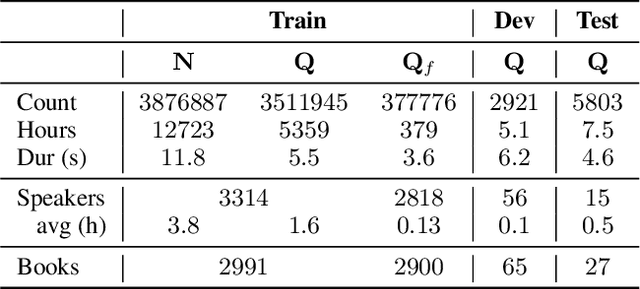
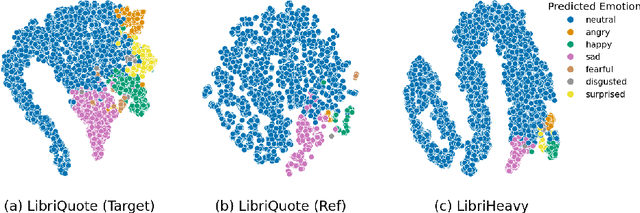
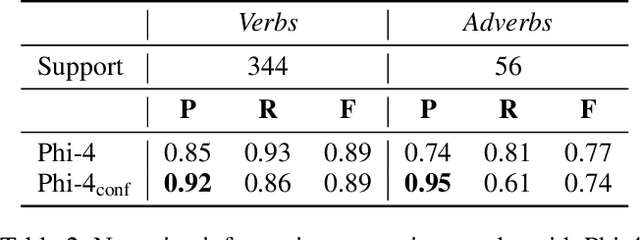
Text-to-speech (TTS) systems have recently achieved more expressive and natural speech synthesis by scaling to large speech datasets. However, the proportion of expressive speech in such large-scale corpora is often unclear. Besides, existing expressive speech corpora are typically smaller in scale and primarily used for benchmarking TTS systems. In this paper, we introduce the LibriQuote dataset, an English corpus derived from read audiobooks, designed for both fine-tuning and benchmarking expressive zero-shot TTS system. The training dataset includes 12.7K hours of read, non-expressive speech and 5.3K hours of mostly expressive speech drawn from character quotations. Each utterance in the expressive subset is supplemented with the context in which it was written, along with pseudo-labels of speech verbs and adverbs used to describe the quotation (\textit{e.g. ``he whispered softly''}). Additionally, we provide a challenging 7.5 hour test set intended for benchmarking TTS systems: given a neutral reference speech as input, we evaluate system's ability to synthesize an expressive utterance while preserving reference timbre. We validate qualitatively the test set by showing that it covers a wide range of emotions compared to non-expressive speech, along with various accents. Extensive subjective and objective evaluations show that fine-tuning a baseline TTS system on LibriQuote significantly improves its synthesized speech intelligibility, and that recent systems fail to synthesize speech as expressive and natural as the ground-truth utterances. The dataset and evaluation code are freely available. Audio samples can be found at https://libriquote.github.io/.
The Lucie-7B LLM and the Lucie Training Dataset: Open resources for multilingual language generation
Mar 15, 2025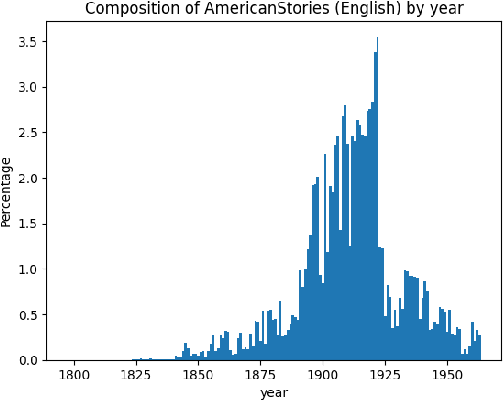
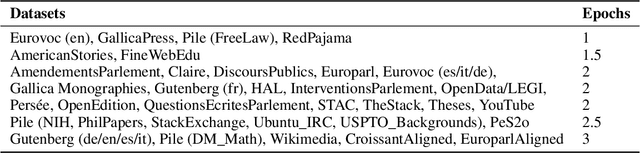
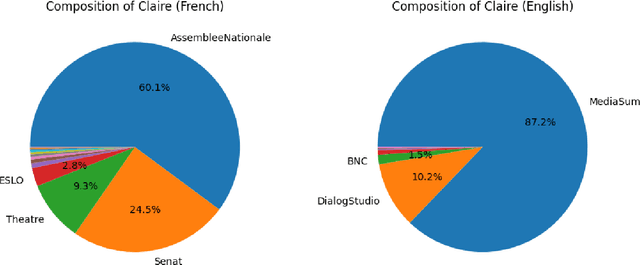
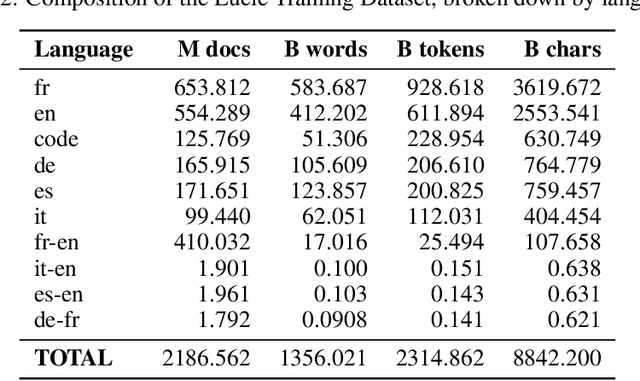
We present both the Lucie Training Dataset and the Lucie-7B foundation model. The Lucie Training Dataset is a multilingual collection of textual corpora centered around French and designed to offset anglo-centric biases found in many datasets for large language model pretraining. Its French data is pulled not only from traditional web sources, but also from French cultural heritage documents, filling an important gap in modern datasets. Beyond French, which makes up the largest share of the data, we added documents to support several other European languages, including English, Spanish, German, and Italian. Apart from its value as a resource for French language and culture, an important feature of this dataset is that it prioritizes data rights by minimizing copyrighted material. In addition, building on the philosophy of past open projects, it is redistributed in the form used for training and its processing is described on Hugging Face and GitHub. The Lucie-7B foundation model is trained on equal amounts of data in French and English -- roughly 33% each -- in an effort to better represent cultural aspects of French-speaking communities. We also describe two instruction fine-tuned models, Lucie-7B-Instruct-v1.1 and Lucie-7B-Instruct-human-data, which we release as demonstrations of Lucie-7B in use. These models achieve promising results compared to state-of-the-art models, demonstrating that an open approach prioritizing data rights can still deliver strong performance. We see these models as an initial step toward developing more performant, aligned models in the near future. Model weights for Lucie-7B and the Lucie instruct models, along with intermediate checkpoints for the former, are published on Hugging Face, while model training and data preparation code is available on GitHub. This makes Lucie-7B one of the first OSI compliant language models according to the new OSI definition.
Lillama: Large Language Models Compression via Low-Rank Feature Distillation
Dec 28, 2024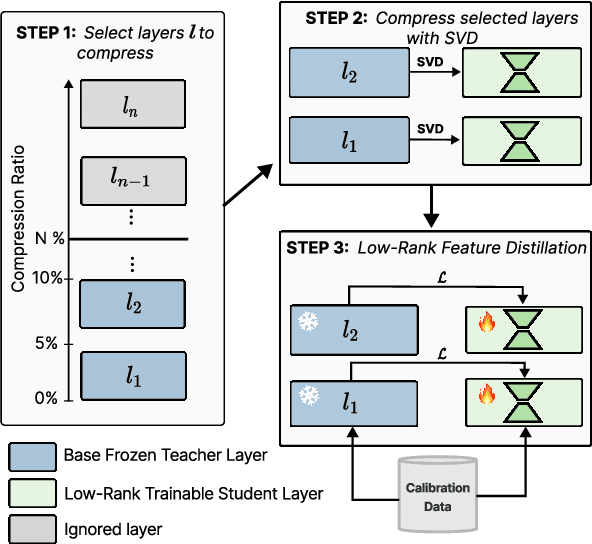
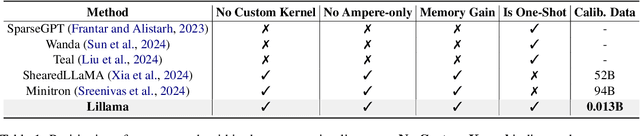
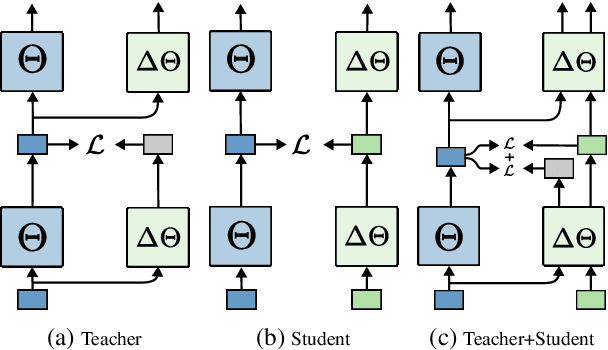
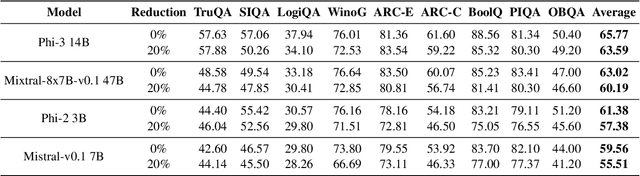
Current LLM structured pruning methods typically involve two steps: (1) compression with calibration data and (2) costly continued pretraining on billions of tokens to recover lost performance. This second step is necessary as the first significantly impacts model accuracy. Prior research suggests pretrained Transformer weights aren't inherently low-rank, unlike their activations, which may explain this drop. Based on this observation, we propose Lillama, a compression method that locally distills activations with low-rank weights. Using SVD for initialization and a joint loss combining teacher and student activations, we accelerate convergence and reduce memory use with local gradient updates. Lillama compresses Mixtral-8x7B within minutes on a single A100 GPU, removing 10 billion parameters while retaining over 95% of its original performance. Phi-2 3B can be compressed by 40% with just 13 million calibration tokens, resulting in a small model that competes with recent models of similar size. The method generalizes well to non-transformer architectures, compressing Mamba-3B by 20% while maintaining 99% performance.