 Add to Chrome
 Add to Firefox
 Add to Edge
SAMSEM -- A Generic and Scalable Approach for IC Metal Line Segmentation
Mar 17, 2026
In light of globalized hardware supply chains, the assurance of hardware components has gained significant interest, particularly in cryptographic applications and high-stakes scenarios. Identifying metal lines on scanning electron microscope (SEM) images of integrated circuits (ICs) is one essential step in verifying the absence of malicious circuitry in chips manufactured in untrusted environments. Due to varying manufacturing processes and technologies, such verification usually requires tuning parameters and algorithms for each target IC. Often, a machine learning model trained on images of one IC fails to accurately detect metal lines on other ICs. To address this challenge, we create SAMSEM by adapting Meta's Segment Anything Model 2 (SAM2) to the domain of IC metal line segmentation. Specifically, we develop a multi-scale segmentation approach that can handle SEM images of varying sizes, resolutions, and magnifications. Furthermore, we deploy a topology-based loss alongside pixel-based losses to focus our segmentation on electrical connectivity rather than pixel-level accuracy. Based on a hyperparameter optimization, we then fine-tune the SAM2 model to obtain a model that generalizes across different technology nodes, manufacturing materials, sample preparation methods, and SEM imaging technologies. To this end, we leverage an unprecedented dataset of SEM images obtained from 48 metal layers across 14 different ICs. When fine-tuned on seven ICs, SAMSEM achieves an error rate as low as 0.72% when evaluated on other images from the same ICs. For the remaining seven unseen ICs, it still achieves error rates as low as 5.53%. Finally, when fine-tuned on all 14 ICs, we observe an error rate of 0.62%. Hence, SAMSEM proves to be a reliable tool that significantly advances the frontier in metal line segmentation, a key challenge in post-manufacturing IC verification.

Evil from Within: Machine Learning Backdoors through Hardware Trojans
Apr 18, 2023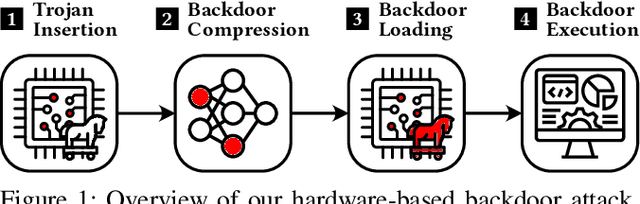
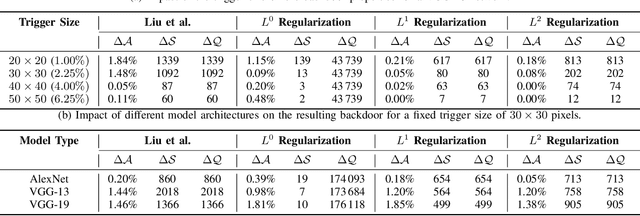
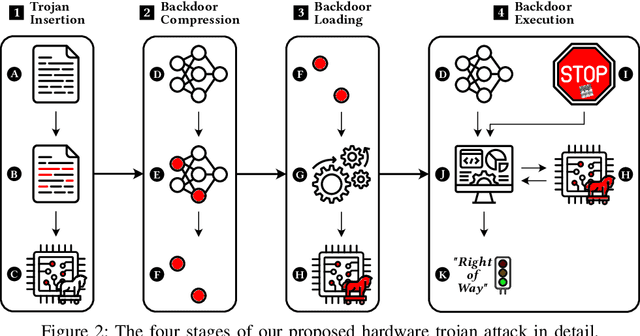
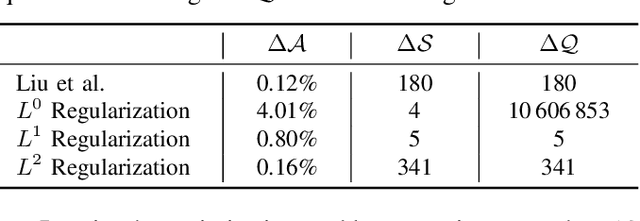
Backdoors pose a serious threat to machine learning, as they can compromise the integrity of security-critical systems, such as self-driving cars. While different defenses have been proposed to address this threat, they all rely on the assumption that the hardware on which the learning models are executed during inference is trusted. In this paper, we challenge this assumption and introduce a backdoor attack that completely resides within a common hardware accelerator for machine learning. Outside of the accelerator, neither the learning model nor the software is manipulated, so that current defenses fail. To make this attack practical, we overcome two challenges: First, as memory on a hardware accelerator is severely limited, we introduce the concept of a minimal backdoor that deviates as little as possible from the original model and is activated by replacing a few model parameters only. Second, we develop a configurable hardware trojan that can be provisioned with the backdoor and performs a replacement only when the specific target model is processed. We demonstrate the practical feasibility of our attack by implanting our hardware trojan into the Xilinx Vitis AI DPU, a commercial machine-learning accelerator. We configure the trojan with a minimal backdoor for a traffic-sign recognition system. The backdoor replaces only 30 (0.069%) model parameters, yet it reliably manipulates the recognition once the input contains a backdoor trigger. Our attack expands the hardware circuit of the accelerator by 0.24% and induces no run-time overhead, rendering a detection hardly possible. Given the complex and highly distributed manufacturing process of current hardware, our work points to a new threat in machine learning that is inaccessible to current security mechanisms and calls for hardware to be manufactured only in fully trusted environments.