 Add to Chrome
 Add to Firefox
 Add to Edge
ReverseORC: Reverse Engineering of Resizable User Interface Layouts with OR-Constraints
Feb 23, 2022
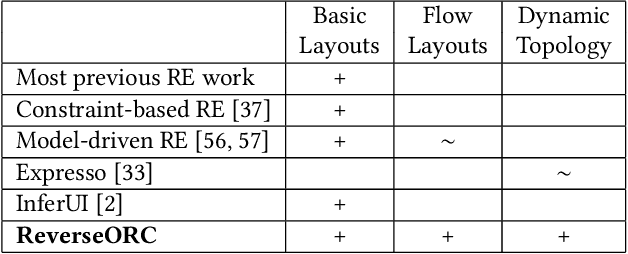
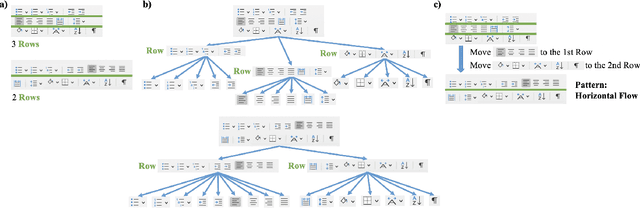
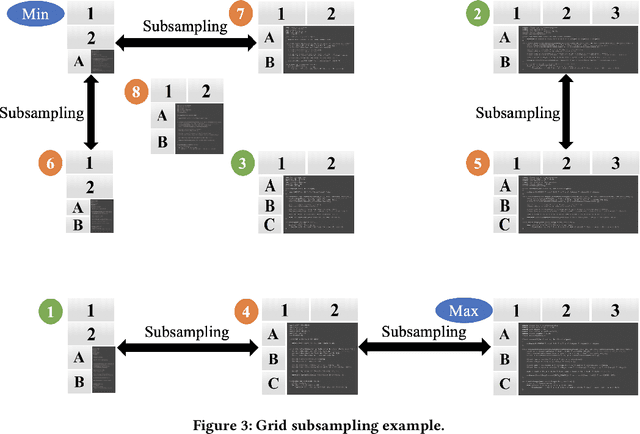

Reverse engineering (RE) of user interfaces (UIs) plays an important role in software evolution. However, the large diversity of UI technologies and the need for UIs to be resizable make this challenging. We propose ReverseORC, a novel RE approach able to discover diverse layout types and their dynamic resizing behaviours independently of their implementation, and to specify them by using OR constraints. Unlike previous RE approaches, ReverseORC infers flexible layout constraint specifications by sampling UIs at different sizes and analyzing the differences between them. It can create specifications that replicate even some non-standard layout managers with complex dynamic layout behaviours. We demonstrate that ReverseORC works across different platforms with very different layout approaches, e.g., for GUIs as well as for the Web. Furthermore, it can be used to detect and fix problems in legacy UIs, extend UIs with enhanced layout behaviours, and support the creation of flexible UI layouts.

ORCSolver: An Efficient Solver for Adaptive GUI Layout with OR-Constraints
Feb 23, 2020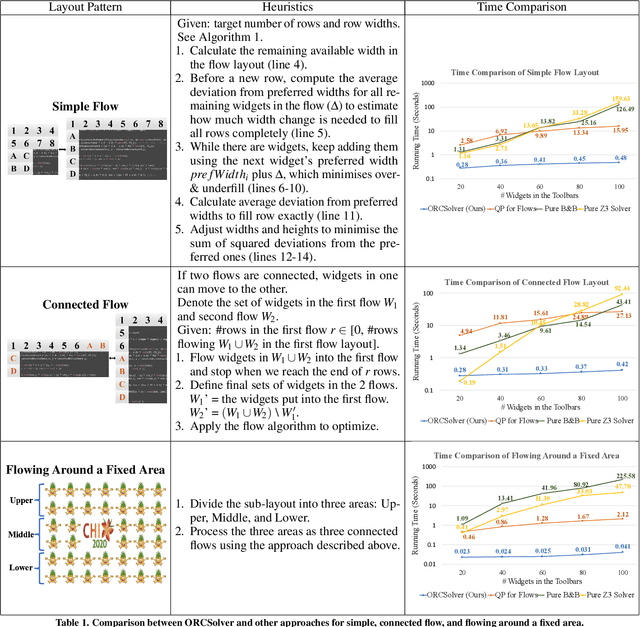
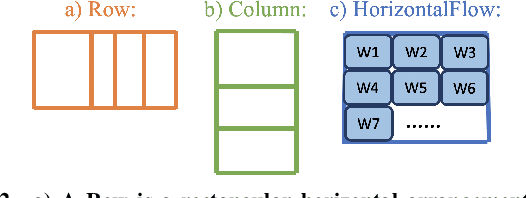
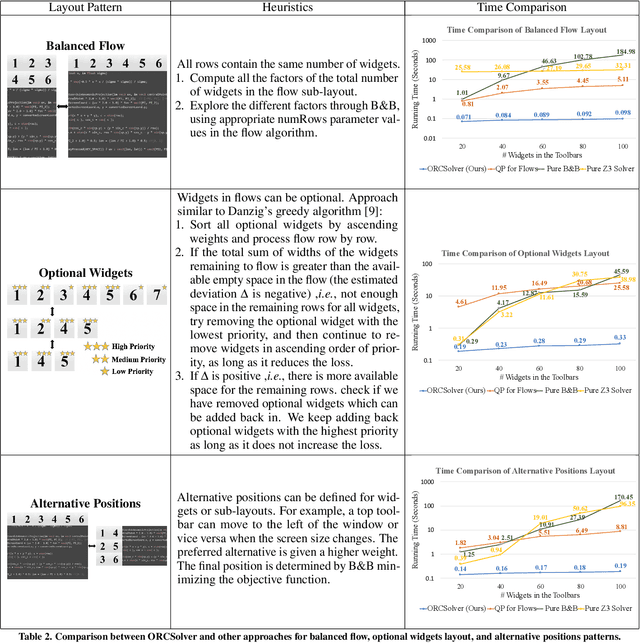
OR-constrained (ORC) graphical user interface layouts unify conventional constraint-based layouts with flow layouts, which enables the definition of flexible layouts that adapt to screens with different sizes, orientations, or aspect ratios with only a single layout specification. Unfortunately, solving ORC layouts with current solvers is time-consuming and the needed time increases exponentially with the number of widgets and constraints. To address this challenge, we propose ORCSolver, a novel solving technique for adaptive ORC layouts, based on a branch-and-bound approach with heuristic preprocessing. We demonstrate that ORCSolver simplifies ORC specifications at runtime and our approach can solve ORC layout specifications efficiently at near-interactive rates.
Speeding up SOR Solvers for Constraint-based GUIs with a Warm-Start Strategy
Jan 06, 2014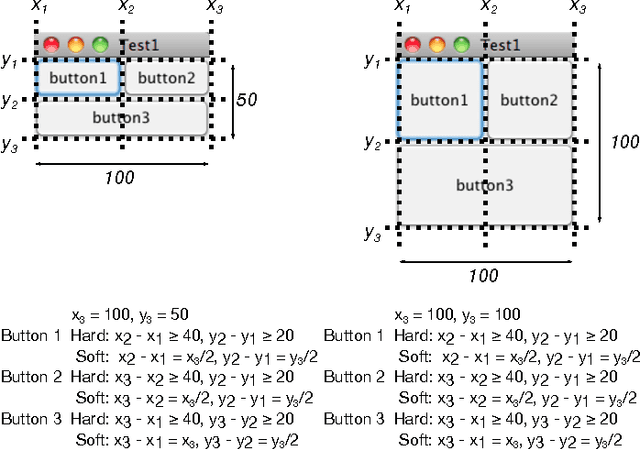
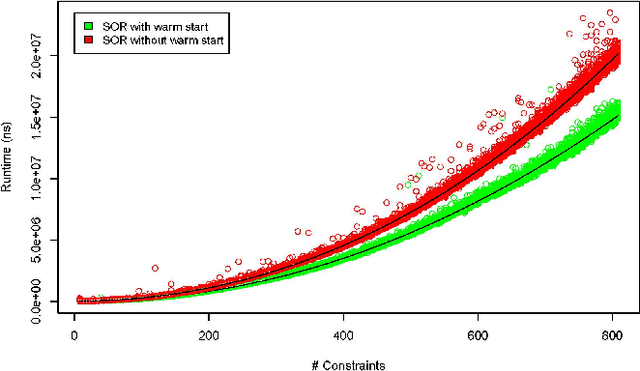
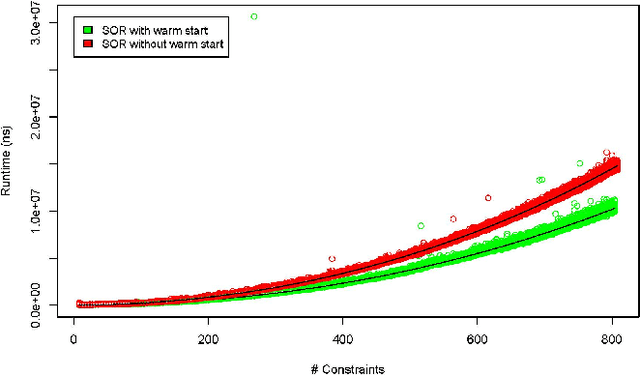
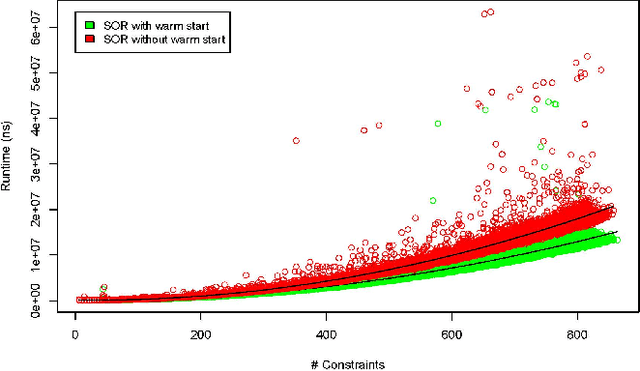
Many computer programs have graphical user interfaces (GUIs), which need good layout to make efficient use of the available screen real estate. Most GUIs do not have a fixed layout, but are resizable and able to adapt themselves. Constraints are a powerful tool for specifying adaptable GUI layouts: they are used to specify a layout in a general form, and a constraint solver is used to find a satisfying concrete layout, e.g.\ for a specific GUI size. The constraint solver has to calculate a new layout every time a GUI is resized or changed, so it needs to be efficient to ensure a good user experience. One approach for constraint solvers is based on the Gauss-Seidel algorithm and successive over-relaxation (SOR). Our observation is that a solution after resizing or changing is similar in structure to a previous solution. Thus, our hypothesis is that we can increase the computational performance of an SOR-based constraint solver if we reuse the solution of a previous layout to warm-start the solving of a new layout. In this paper we report on experiments to test this hypothesis experimentally for three common use cases: big-step resizing, small-step resizing and constraint change. In our experiments, we measured the solving time for randomly generated GUI layout specifications of various sizes. For all three cases we found that the performance is improved if an existing solution is used as a starting solution for a new layout.