 Add to Chrome
 Add to Firefox
 Add to Edge
Concept Training for Human-Aligned Language Models
Mar 31, 2026
The next-token prediction (NTP) objective trains language models to predict a single continuation token at each step. In natural language, however, a prefix can be continued in many valid ways, and even similar meanings may differ in surface form. For example, the sentence ``this website is safe to \underline{browse}'' could plausibly continue with words such as browse, search, visit, surf, or navigate. While standard NTP training treats these alternatives as mutually exclusive targets, we explore a framework that instead predicts concepts, approximated as sets of semantically related tokens. We show that models trained with concept supervision exhibit stronger alignment with human semantic similarity judgments on multiple lexical benchmarks. These gains are accompanied by lower perplexity on semantically meaningful words (definition in Section 3.1), and a modest increase in global token-level perplexity, reflecting a tradeoff between standard NTP optimization and concept-level supervision. Our results suggest that concept-level objectives can improve semantic alignment while maintaining competitive language modeling performance.

Towards EMG-to-Speech with a Necklace Form Factor
Jul 31, 2024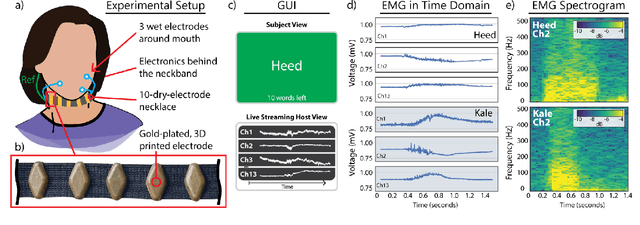
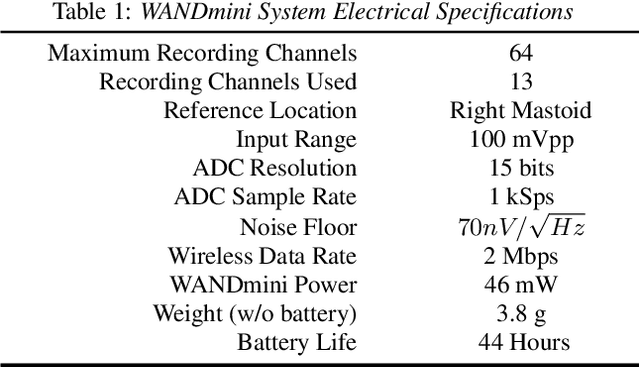
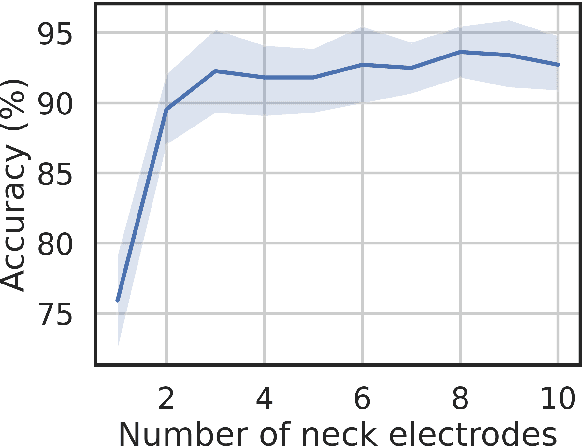
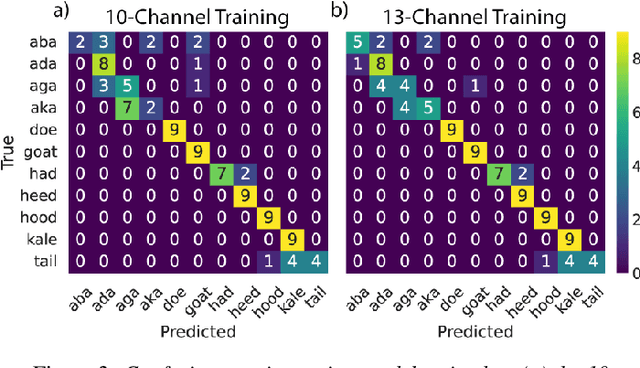
Electrodes for decoding speech from electromyography (EMG) are typically placed on the face, requiring adhesives that are inconvenient and skin-irritating if used regularly. We explore a different device form factor, where dry electrodes are placed around the neck instead. 11-word, multi-speaker voiced EMG classifiers trained on data recorded with this device achieve 92.7% accuracy. Ablation studies reveal the importance of having more than two electrodes on the neck, and phonological analyses reveal similar classification confusions between neck-only and neck-and-face form factors. Finally, speech-EMG correlation experiments demonstrate a linear relationship between many EMG spectrogram frequency bins and self-supervised speech representation dimensions.