 Add to Chrome
 Add to Firefox
 Add to Edge
Learning and Generating Mixed States Prepared by Shallow Channel Circuits
Apr 01, 2026
Learning quantum states from measurement data is a central problem in quantum information and computational complexity. In this work, we study the problem of learning to generate mixed states on a finite-dimensional lattice. Motivated by recent developments in mixed state phases of matter, we focus on arbitrary states in the trivial phase. A state belongs to the trivial phase if there exists a shallow preparation channel circuit under which local reversibility is preserved throughout the preparation. We prove that any mixed state in this class can be efficiently learned from measurement access alone. Specifically, given copies of an unknown trivial phase mixed state, our algorithm outputs a shallow local channel circuit that approximately generates this state in trace distance. The sample complexity and runtime are polynomial (or quasi-polynomial) in the number of qubits, assuming constant (or polylogarithmic) circuit depth and gate locality. Importantly, the learner is not given the original preparation circuit and relies only on its existence. Our results provide a structural foundation for quantum generative models based on shallow channel circuits. In the classical limit, our framework also inspires an efficient algorithm for classical diffusion models using only a polynomial overhead of training and generation.

Derandomized shallow shadows: Efficient Pauli learning with bounded-depth circuits
Dec 25, 2024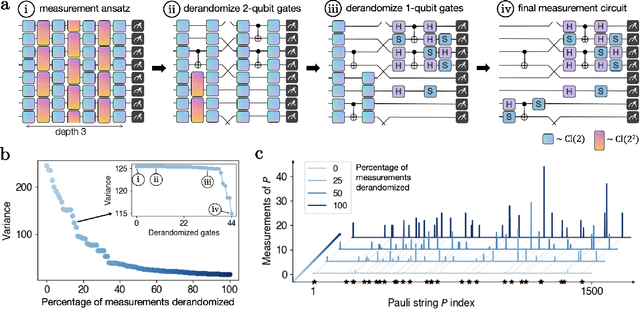
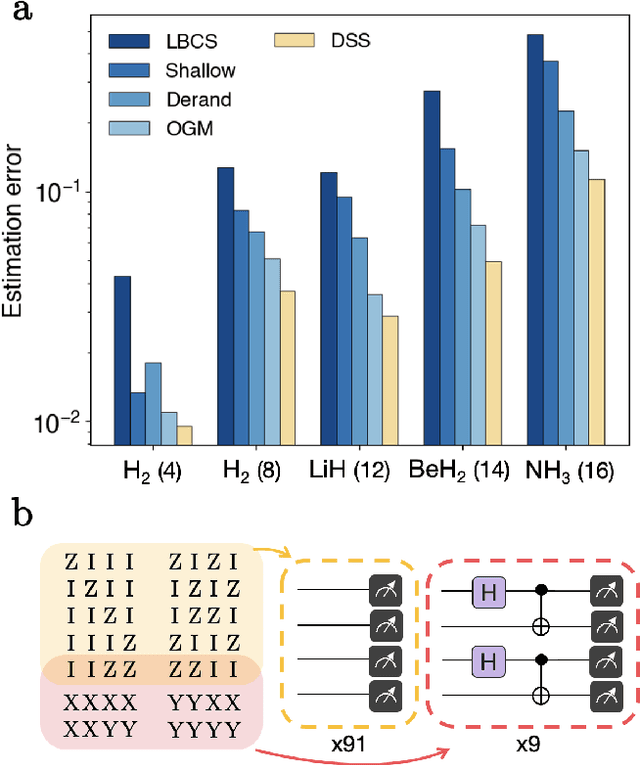
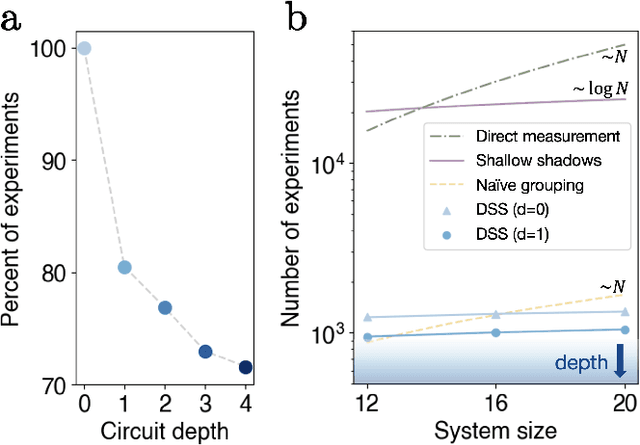

Efficiently estimating large numbers of non-commuting observables is an important subroutine of many quantum science tasks. We present the derandomized shallow shadows (DSS) algorithm for efficiently learning a large set of non-commuting observables, using shallow circuits to rotate into measurement bases. Exploiting tensor network techniques to ensure polynomial scaling of classical resources, our algorithm outputs a set of shallow measurement circuits that approximately minimizes the sample complexity of estimating a given set of Pauli strings. We numerically demonstrate systematic improvement, in comparison with state-of-the-art techniques, for energy estimation of quantum chemistry benchmarks and verification of quantum many-body systems, and we observe DSS's performance consistently improves as one allows deeper measurement circuits. These results indicate that in addition to being an efficient, low-depth, stand-alone algorithm, DSS can also benefit many larger quantum algorithms requiring estimation of multiple non-commuting observables.