 Add to Chrome
 Add to Firefox
 Add to Edge
FlowTIE: Flow-based Transport of Intensity Equation for Phase Gradient Estimation from 4D-STEM Data
Nov 10, 2025
We introduce FlowTIE, a neural-network-based framework for phase reconstruction from 4D-Scanning Transmission Electron Microscopy (STEM) data, which integrates the Transport of Intensity Equation (TIE) with a flow-based representation of the phase gradient. This formulation allows the model to bridge data-driven learning with physics-based priors, improving robustness under dynamical scattering conditions for thick specimen. The validation on simulated datasets of crystalline materials, benchmarking to classical TIE and gradient-based optimization methods are presented. The results demonstrate that FlowTIE improves phase reconstruction accuracy, fast, and can be integrated with a thick specimen model, namely multislice method.

MSLE: An ontology for Materials Science Laboratory Equipment. Large-Scale Devices for Materials Characterization
Aug 07, 2023
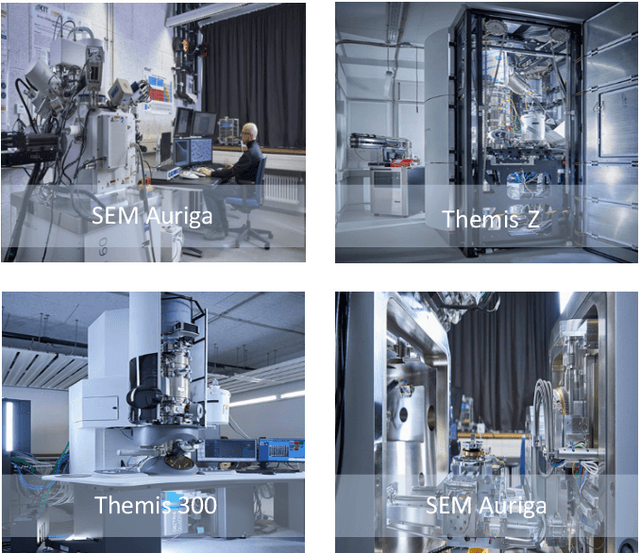
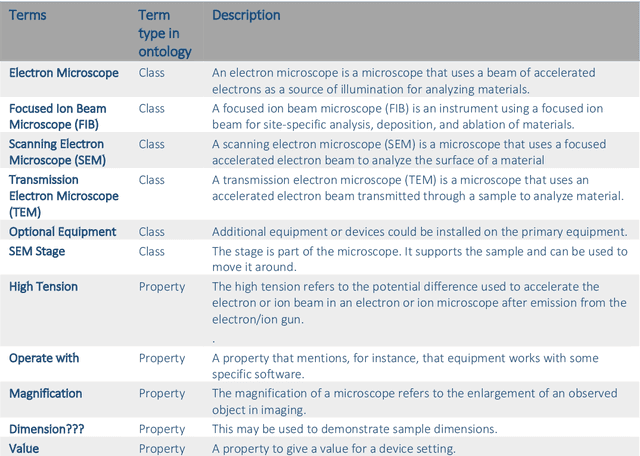
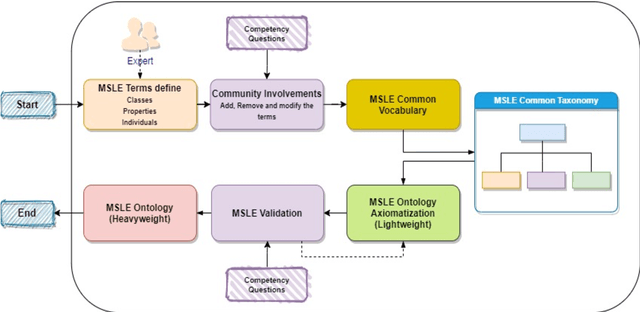
This paper introduces a new ontology for Materials Science Laboratory Equipment, termed MSLE. A fundamental issue with materials science laboratory (hereafter lab) equipment in the real world is that scientists work with various types of equipment with multiple specifications. For example, there are many electron microscopes with different parameters in chemical and physical labs. A critical development to unify the description is to build an equipment domain ontology as basic semantic knowledge and to guide the user to work with the equipment appropriately. Here, we propose to develop a consistent ontology for equipment, the MSLE ontology. In the MSLE, two main existing ontologies, the Semantic Sensor Network (SSN) and the Material Vocabulary (MatVoc), have been integrated into the MSLE core to build a coherent ontology. Since various acronyms and terms have been used for equipment, this paper proposes an approach to use a Simple Knowledge Organization System (SKOS) to represent the hierarchical structure of equipment terms. Equipment terms were collected in various languages and abbreviations and coded into the MSLE using the SKOS model. The ontology development was conducted in close collaboration with domain experts and focused on the large-scale devices for materials characterization available in our research group. Competency questions are expected to be addressed through the MSLE ontology. Constraints are modeled in the Shapes Query Language (SHACL); a prototype is shown and validated to show the value of the modeling constraints.