 Add to Chrome
 Add to Firefox
 Add to Edge
ParkDiffusion++: Ego Intention Conditioned Joint Multi-Agent Trajectory Prediction for Automated Parking using Diffusion Models
Feb 24, 2026
Automated parking is a challenging operational domain for advanced driver assistance systems, requiring robust scene understanding and interaction reasoning. The key challenge is twofold: (i) predict multiple plausible ego intentions according to context and (ii) for each intention, predict the joint responses of surrounding agents, enabling effective what-if decision-making. However, existing methods often fall short, typically treating these interdependent problems in isolation. We propose ParkDiffusion++, which jointly learns a multi-modal ego intention predictor and an ego-conditioned multi-agent joint trajectory predictor for automated parking. Our approach makes several key contributions. First, we introduce an ego intention tokenizer that predicts a small set of discrete endpoint intentions from agent histories and vectorized map polylines. Second, we perform ego-intention-conditioned joint prediction, yielding socially consistent predictions of the surrounding agents for each possible ego intention. Third, we employ a lightweight safety-guided denoiser with different constraints to refine joint scenes during training, thus improving accuracy and safety. Fourth, we propose counterfactual knowledge distillation, where an EMA teacher refined by a frozen safety-guided denoiser provides pseudo-targets that capture how agents react to alternative ego intentions. Extensive evaluations demonstrate that ParkDiffusion++ achieves state-of-the-art performance on the Dragon Lake Parking (DLP) dataset and the Intersections Drone (inD) dataset. Importantly, qualitative what-if visualizations show that other agents react appropriately to different ego intentions.

ParkDiffusion: Heterogeneous Multi-Agent Multi-Modal Trajectory Prediction for Automated Parking using Diffusion Models
May 01, 2025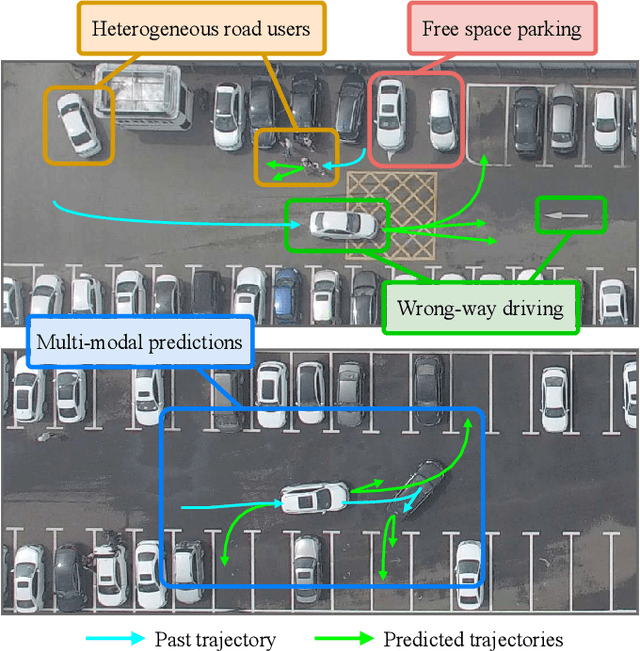
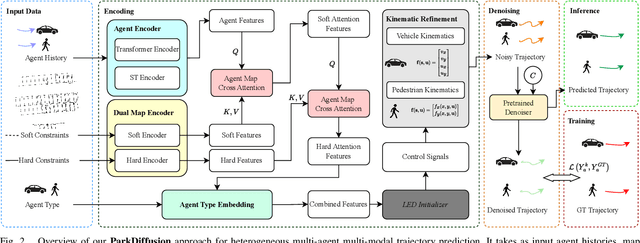
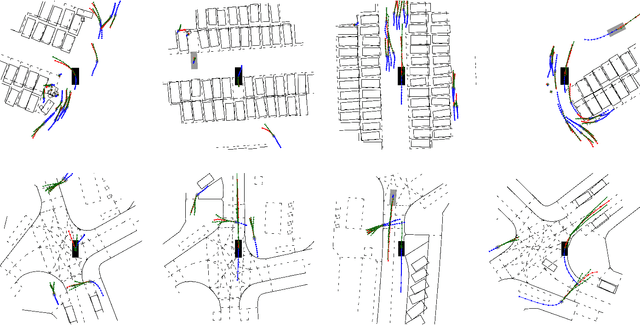
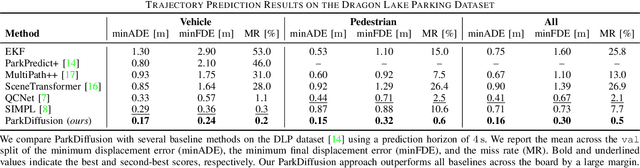
Automated parking is a critical feature of Advanced Driver Assistance Systems (ADAS), where accurate trajectory prediction is essential to bridge perception and planning modules. Despite its significance, research in this domain remains relatively limited, with most existing studies concentrating on single-modal trajectory prediction of vehicles. In this work, we propose ParkDiffusion, a novel approach that predicts the trajectories of both vehicles and pedestrians in automated parking scenarios. ParkDiffusion employs diffusion models to capture the inherent uncertainty and multi-modality of future trajectories, incorporating several key innovations. First, we propose a dual map encoder that processes soft semantic cues and hard geometric constraints using a two-step cross-attention mechanism. Second, we introduce an adaptive agent type embedding module, which dynamically conditions the prediction process on the distinct characteristics of vehicles and pedestrians. Third, to ensure kinematic feasibility, our model outputs control signals that are subsequently used within a kinematic framework to generate physically feasible trajectories. We evaluate ParkDiffusion on the Dragon Lake Parking (DLP) dataset and the Intersections Drone (inD) dataset. Our work establishes a new baseline for heterogeneous trajectory prediction in parking scenarios, outperforming existing methods by a considerable margin.