 Add to Chrome
 Add to Firefox
 Add to Edge
Benchmarking Artificial Intelligence Models for Daily Coastal Hypoxia Forecasting
Feb 05, 2026
Coastal hypoxia, especially in the northern part of Gulf of Mexico, presents a persistent ecological and economic concern. Seasonal models offer coarse forecasts that miss the fine-scale variability needed for daily, responsive ecosystem management. We present study that compares four deep learning architectures for daily hypoxia classification: Bidirectional Long Short-Term Memory (BiLSTM), Medformer (Medical Transformer), Spatio-Temporal Transformer (ST-Transformer), and Temporal Convolutional Network (TCN). We trained our models with twelve years of daily hindcast data from 2009-2020 Our training data consists of 2009-2020 hindcast data from a coupled hydrodynamic-biogeochemical model. Similarly, we use hindcast data from 2020 through 2024 as a test data. We constructed classification models incorporating water column stratification, sediment oxygen consumption, and temperature-dependent decomposition rates. We evaluated each architectures using the same data preprocessing, input/output formulation, and validation protocols. Each model achieved high classification accuracy and strong discriminative ability with ST-Transformer achieving the highest performance across all metrics and tests periods (AUC-ROC: 0.982-0.992). We also employed McNemar's method to identify statistically significant differences in model predictions. Our contribution is a reproducible framework for operational real-time hypoxia prediction that can support broader efforts in the environmental and ocean modeling systems community and in ecosystem resilience. The source code is available https://github.com/rmagesh148/hypoxia-ai/

Automatic Synthesis of Geometry Problems for an Intelligent Tutoring System
Oct 29, 2015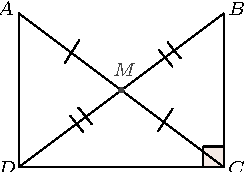
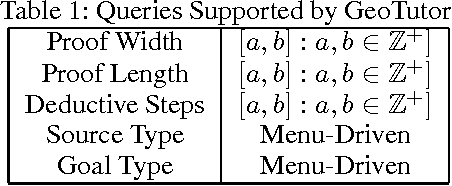
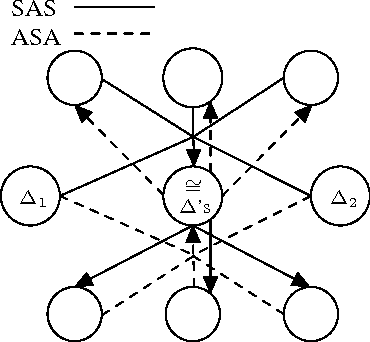
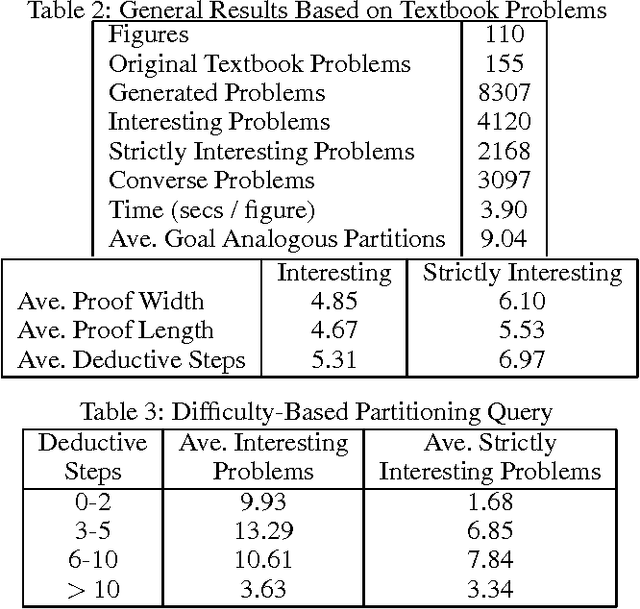
This paper presents an intelligent tutoring system, GeoTutor, for Euclidean Geometry that is automatically able to synthesize proof problems and their respective solutions given a geometric figure together with a set of properties true of it. GeoTutor can provide personalized practice problems that address student deficiencies in the subject matter.