 Add to Chrome
 Add to Firefox
 Add to Edge
ROG: Retrieval-Augmented LLM Reasoning for Complex First-Order Queries over Knowledge Graphs
Feb 02, 2026
Answering first-order logic (FOL) queries over incomplete knowledge graphs (KGs) is difficult, especially for complex query structures that compose projection, intersection, union, and negation. We propose ROG, a retrieval-augmented framework that combines query-aware neighborhood retrieval with large language model (LLM) chain-of-thought reasoning. ROG decomposes a multi-operator query into a sequence of single-operator sub-queries and grounds each step in compact, query-relevant neighborhood evidence. Intermediate answer sets are cached and reused across steps, improving consistency on deep reasoning chains. This design reduces compounding errors and yields more robust inference on complex and negation-heavy queries. Overall, ROG provides a practical alternative to embedding-based logical reasoning by replacing learned operators with retrieval-grounded, step-wise inference. Experiments on standard KG reasoning benchmarks show consistent gains over strong embedding-based baselines, with the largest improvements on high-complexity and negation-heavy query types.

A Large Language Model Based Method for Complex Logical Reasoning over Knowledge Graphs
Dec 22, 2025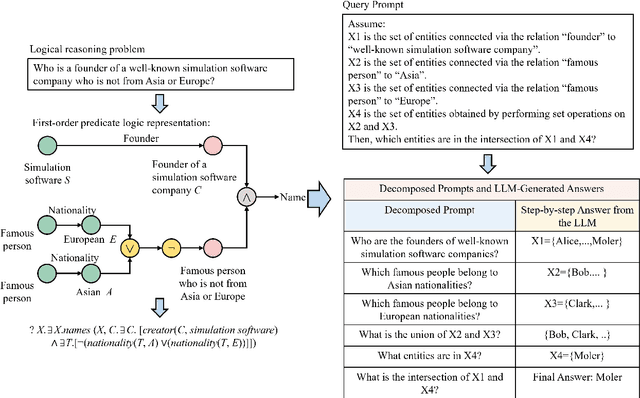
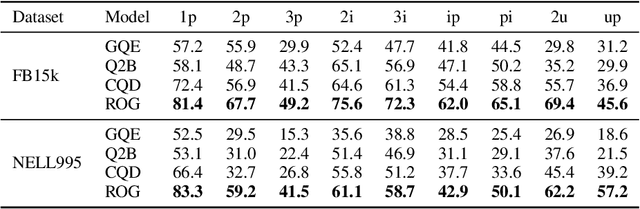
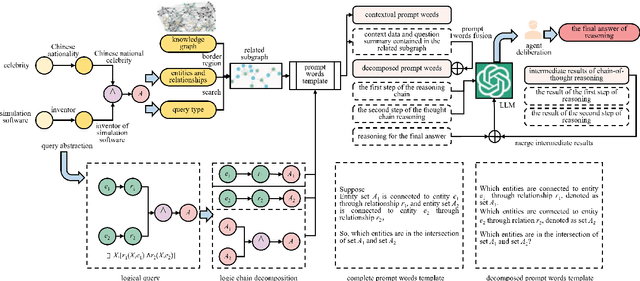
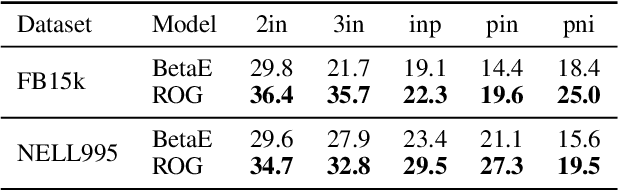
Reasoning over knowledge graphs (KGs) with first-order logic (FOL) queries is challenging due to the inherent incompleteness of real-world KGs and the compositional complexity of logical query structures. Most existing methods rely on embedding entities and relations into continuous geometric spaces and answer queries via differentiable set operations. While effective for simple query patterns, these approaches often struggle to generalize to complex queries involving multiple operators, deeper reasoning chains, or heterogeneous KG schemas. We propose ROG (Reasoning Over knowledge Graphs with large language models), an ensemble-style framework that combines query-aware KG neighborhood retrieval with large language model (LLM)-based chain-of-thought reasoning. ROG decomposes complex FOL queries into sequences of simpler sub-queries, retrieves compact, query-relevant subgraphs as contextual evidence, and performs step-by-step logical inference using an LLM, avoiding the need for task-specific embedding optimization. Experiments on standard KG reasoning benchmarks demonstrate that ROG consistently outperforms strong embedding-based baselines in terms of mean reciprocal rank (MRR), with particularly notable gains on high-complexity query types. These results suggest that integrating structured KG retrieval with LLM-driven logical reasoning offers a robust and effective alternative for complex KG reasoning tasks.
Power Transformer Fault Prediction Based on Knowledge Graphs
Feb 11, 2024In this paper, we address the challenge of learning with limited fault data for power transformers. Traditional operation and maintenance tools lack effective predictive capabilities for potential faults. The scarcity of extensive fault data makes it difficult to apply machine learning techniques effectively. To solve this problem, we propose a novel approach that leverages the knowledge graph (KG) technology in combination with gradient boosting decision trees (GBDT). This method is designed to efficiently learn from a small set of high-dimensional data, integrating various factors influencing transformer faults and historical operational data. Our approach enables accurate safe state assessments and fault analyses of power transformers despite the limited fault characteristic data. Experimental results demonstrate that this method outperforms other learning approaches in prediction accuracy, such as artificial neural networks (ANN) and logistic regression (LR). Furthermore, it offers significant improvements in progressiveness, practicality, and potential for widespread application.