 Add to Chrome
 Add to Firefox
 Add to Edge
Break-the-Beat! Controllable MIDI-to-Drum Audio Synthesis
May 14, 2026
Current methods for creating drum loop audio in digital music production, such as using one-shot samples or resampling, often demand non-trivial efforts of creators. While recent generative models achieve high fidelity and adhere to text, they lack the specific control needed for such a task. Existing symbolic-to-audio research often focuses on single, tonal instruments, leaving the challenge of polyphonic, percussive drum synthesis unaddressed. We address this gap by introducing ``Break-the-Beat!,'' a model capable of rendering a drum MIDI with the timbre of a reference audio. It is built by fine-tuning a pre-trained text-to-audio model with our proposed content encoder and a effective hybrid conditioning mechanism. To enable this, we construct a new dataset of paired target-reference drum audio from existing drum audio datasets. Experiments demonstrate that our model generates high-quality drum audio that follows high-resolution drum MIDI, achieving strong performance across metrics of audio quality, rhythmic alignment, and beat continuity. This offer producers a new, controllable tool for creative production. Demo page: https://ik4sumii.github.io/break-the-beat/

Automatic music mixing with deep learning and out-of-domain data
Aug 29, 2022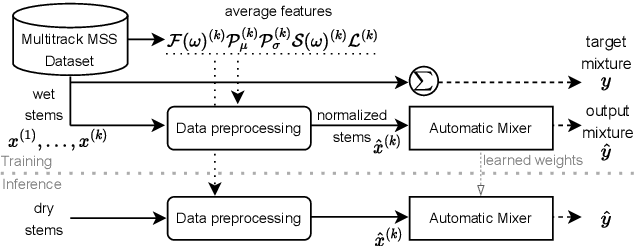
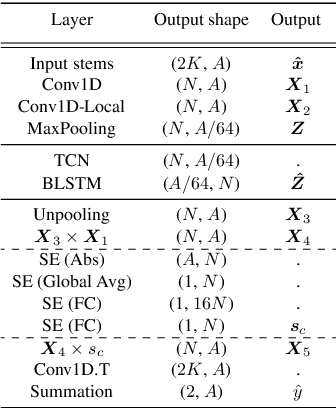

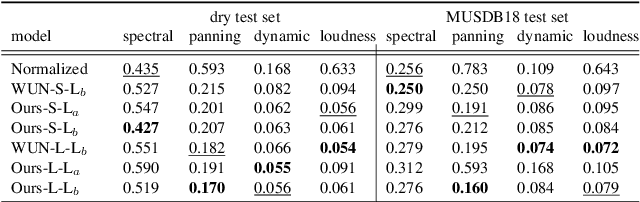
Music mixing traditionally involves recording instruments in the form of clean, individual tracks and blending them into a final mixture using audio effects and expert knowledge (e.g., a mixing engineer). The automation of music production tasks has become an emerging field in recent years, where rule-based methods and machine learning approaches have been explored. Nevertheless, the lack of dry or clean instrument recordings limits the performance of such models, which is still far from professional human-made mixes. We explore whether we can use out-of-domain data such as wet or processed multitrack music recordings and repurpose it to train supervised deep learning models that can bridge the current gap in automatic mixing quality. To achieve this we propose a novel data preprocessing method that allows the models to perform automatic music mixing. We also redesigned a listening test method for evaluating music mixing systems. We validate our results through such subjective tests using highly experienced mixing engineers as participants.