 Add to Chrome
 Add to Firefox
 Add to Edge
Gender Disambiguation in Machine Translation: Diagnostic Evaluation in Decoder-Only Architectures
Mar 18, 2026
While Large Language Models achieve state-of-the-art results across a wide range of NLP tasks, they remain prone to systematic biases. Among these, gender bias is particularly salient in MT, due to systematic differences across languages in whether and how gender is marked. As a result, translation often requires disambiguating implicit source signals into explicit gender-marked forms. In this context, standard benchmarks may capture broad disparities but fail to reflect the full complexity of gender bias in modern MT. In this paper, we extend recent frameworks on bias evaluation by: (i) introducing a novel measure coined "Prior Bias", capturing a model's default gender assumptions, and (ii) applying the framework to decoder-only MT models. Our results show that, despite their scale and state-of-the-art status, decoder-only models do not generally outperform encoder-decoder architectures on gender-specific metrics; however, post-training (e.g., instruction tuning) not only improves contextual awareness but also reduces the masculine Prior Bias.

Are We Paying Attention to Her? Investigating Gender Disambiguation and Attention in Machine Translation
May 13, 2025
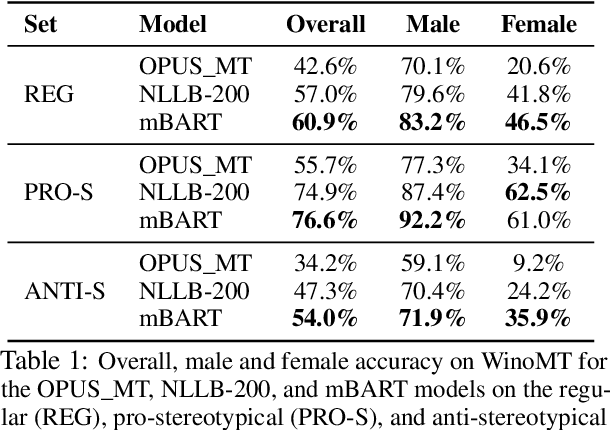
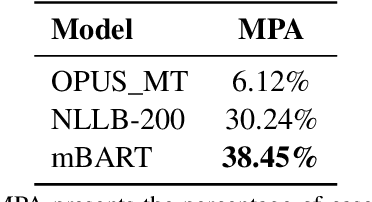
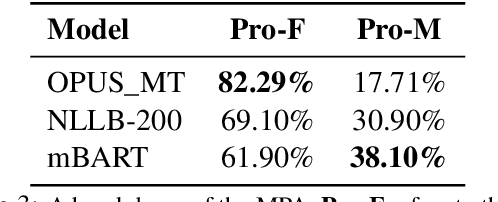
While gender bias in modern Neural Machine Translation (NMT) systems has received much attention, traditional evaluation metrics do not to fully capture the extent to which these systems integrate contextual gender cues. We propose a novel evaluation metric called Minimal Pair Accuracy (MPA), which measures the reliance of models on gender cues for gender disambiguation. MPA is designed to go beyond surface-level gender accuracy metrics by focusing on whether models adapt to gender cues in minimal pairs -- sentence pairs that differ solely in the gendered pronoun, namely the explicit indicator of the target's entity gender in the source language (EN). We evaluate a number of NMT models on the English-Italian (EN--IT) language pair using this metric, we show that they ignore available gender cues in most cases in favor of (statistical) stereotypical gender interpretation. We further show that in anti-stereotypical cases, these models tend to more consistently take masculine gender cues into account while ignoring the feminine cues. Furthermore, we analyze the attention head weights in the encoder component and show that while all models encode gender information to some extent, masculine cues elicit a more diffused response compared to the more concentrated and specialized responses to feminine gender cues.