 Add to Chrome
 Add to Firefox
 Add to Edge
Dueling DDQN-Based Adaptive Multi-Objective Handover Optimization for LEO Satellite Networks
May 04, 2026
In this paper, we propose a dueling double deep Q-network (DDQN)-based adaptive multi-objective handover framework for LEO satellite networks. The proposed method enables dynamic trade-off learning among throughput, blocking probability, and switching cost under time-varying network conditions. Simulation results demonstrate that the proposed approach consistently outperforms conventional baselines, achieving up to 10.3% throughput improvement and near-zero blocking under typical operating conditions.

Spatial-Temporal Learning-Based Distributed Routing for Dynamic LEO Satellite Networks
May 04, 2026In this paper, we propose a spatial-temporal learning-based distributed routing framework for dynamic Low Earth Orbit (LEO) satellite networks, where graph attention networks (GAT) and long short-term memory (LSTM) are integrated within a deep Q-network (DQN)-based architecture to enable distributed and adaptive routing decisions based on local observations. The routing problem is formulated as a partially observable Markov decision process (POMDP) to address partial observability under dynamic topology and time-varying traffic. Simulation results show that the proposed method significantly outperforms conventional and learning-based routing schemes in terms of throughput, packet loss, queue length, and end-to-end delay, while achieving proactive congestion avoidance with up to 23.26% queue reduction. In addition, the proposed approach maintains low computational overhead with negligible carbon emissions, demonstrating its efficiency from a Green AI perspective.
DRL-Based Beam Positioning for LEO Satellite Constellations with Weighted Least Squares
Nov 12, 2025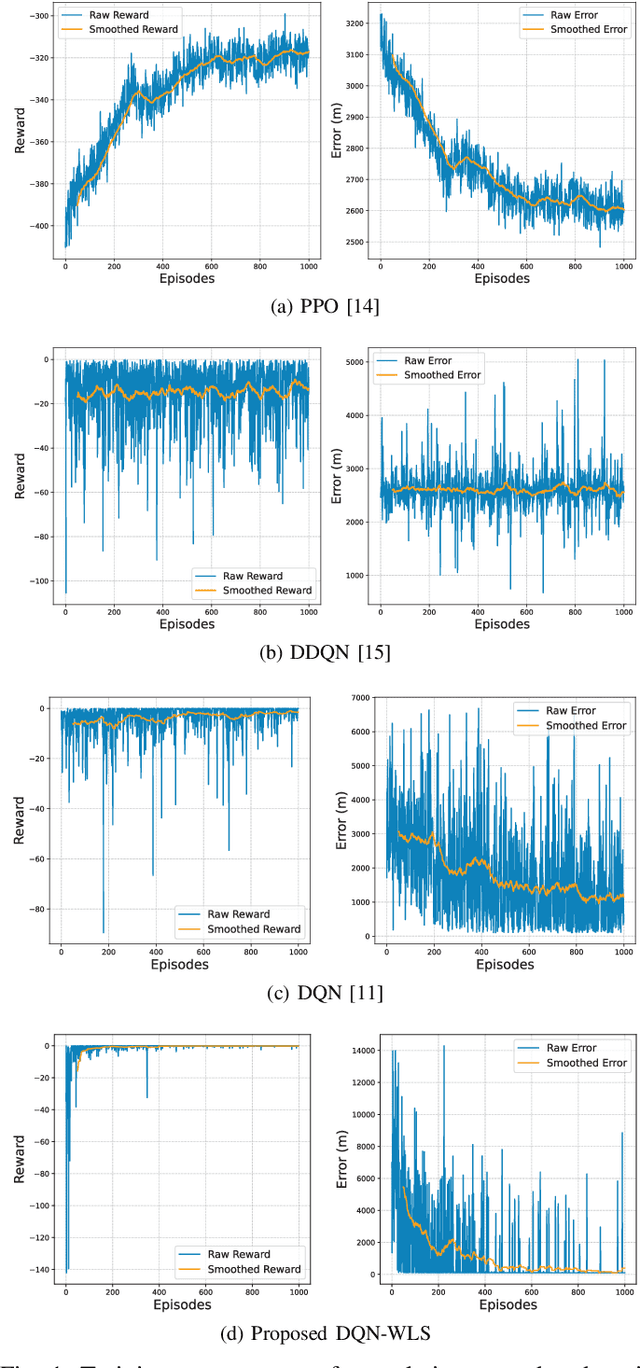
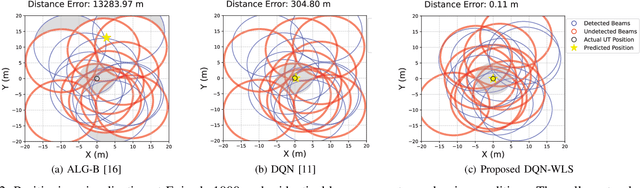
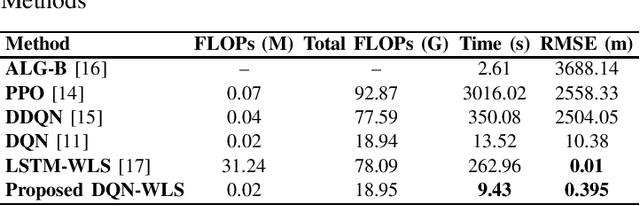
In this paper, we propose a reinforcement learning based beam weighting framework that couples a policy network with an augmented weighted least squares (WLS) estimator for accurate and low-complexity positioning in multi-beam LEO constellations. Unlike conventional geometry or CSI-dependent approaches, the policy learns directly from uplink pilot responses and geometry features, enabling robust localization without explicit CSI estimation. An augmented WLS jointly estimates position and receiver clock bias, improving numerical stability under dynamic beam geometry. Across representative scenarios, the proposed method reduces the mean positioning error by 99.3% compared with the geometry-based baseline, achieving 0.395 m RMSE with near real-time inference.