 Add to Chrome
 Add to Firefox
 Add to Edge
On the Geometric Coherence of Global Aggregation in Federated GNN
Feb 17, 2026
Federated Learning (FL) enables distributed training across multiple clients without centralized data sharing, while Graph Neural Networks (GNNs) model relational data through message passing. In federated GNN settings, client graphs often exhibit heterogeneous structural and propagation characteristics. When standard aggregation mechanisms are applied to such heterogeneous updates, the global model may converge numerically while exhibiting degraded relational behavior.Our work identifies a geometric failure mode of global aggregation in Cross- Domain Federated GNNs. Although GNN parameters are numerically represented as vectors, they encode relational transformations that govern the direction, strength, and sensitivity of information flow across graph neighborhoods. Aggregating updates originating from incompatible propagation regimes can therefore introduce destructive interference in this transformation space.This leads to loss of coherence in global message passing. Importantly, this degradation is not necessarily reflected in conventional metrics such as loss or accuracy.To address this issue, we propose GGRS (Global Geometric Reference Structure), a server-side framework that regulates client updates prior to aggregation based on geometric admissibility criteria. GGRS preserves directional consistency of relational transformations as well as maintains diversity of admissible propagation subspaces. It also stabilizes sensitivity to neighborhood interactions, without accessing client data or graph topology. Experiments on heterogeneous GNN-native, Amazon Co-purchase datasets demonstrate that GGRS preserves global message-passing coherence across training rounds by highlighting the necessity of geometry-aware regulation in federated graph learning.

DP-EMAR: A Differentially Private Framework for Autonomous Model Weight Repair in Federated IoT Systems
Dec 15, 2025Federated Learning (FL) enables decentralized model training without sharing raw data, but model weight distortion remains a major challenge in resource constrained IoT networks. In multi tier Federated IoT (Fed-IoT) systems, unstable connectivity and adversarial interference can silently alter transmitted parameters, degrading convergence. We propose DP-EMAR, a differentially private, error model based autonomous repair framework that detects and reconstructs transmission induced distortions during FL aggregation. DP-EMAR estimates corruption patterns and applies adaptive correction before privacy noise is added, enabling reliable in network repair without violating confidentiality. By integrating Differential Privacy (DP) with Secure Aggregation (SA), the framework distinguishes DP noise from genuine transmission errors. Experiments on heterogeneous IoT sensor and graph datasets show that DP-EMAR preserves convergence stability and maintains near baseline performance under communication corruption while ensuring strict (epsilon, delta)-DP guarantees. The framework enhances robustness, communication efficiency, and trust in privacy preserving Federated IoT learning.
* Accepted and presented at the AI-IoT Workshop, co-located with COMSNETS 2025
Noise-Resilient Quantum Aggregation on NISQ for Federated ADAS Learning
Dec 15, 2025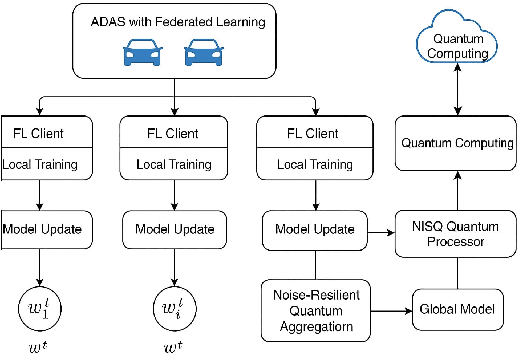
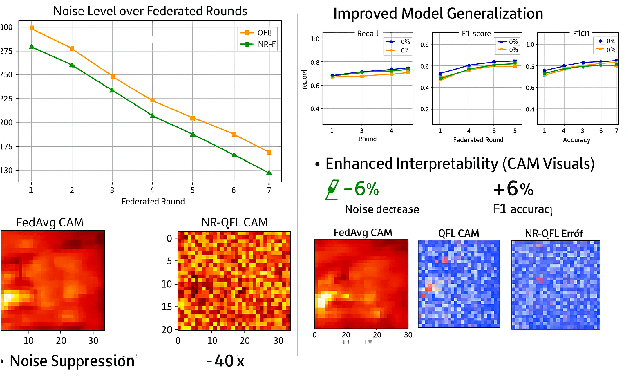
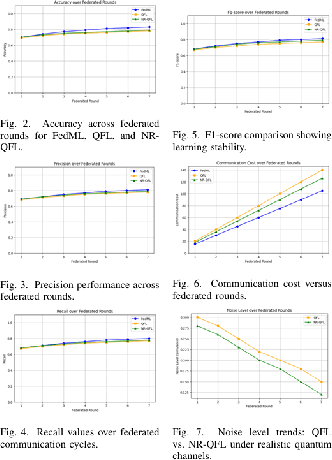
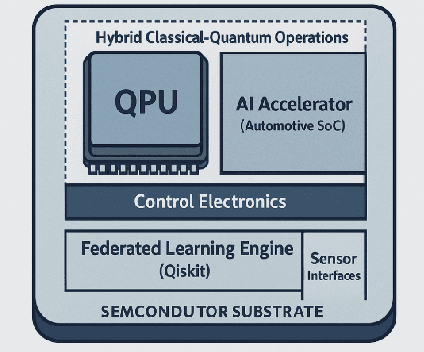
Advanced Driver Assistance Systems (ADAS) increasingly employ Federated Learning (FL) to collaboratively train models across distributed vehicular nodes while preserving data privacy. Yet, conventional FL aggregation remains susceptible to noise, latency, and security constraints inherent to real-time vehicular networks. This paper introduces Noise-Resilient Quantum Federated Learning (NR-QFL), a hybrid quantum-classical framework that enables secure, low-latency aggregation through variational quantum circuits (VQCs) operating under Noisy Intermediate-Scale Quantum (NISQ) conditions. The framework encodes model parameters as quantum states with adaptive gate reparameterization, ensuring bounded-error convergence and provable resilience under Completely Positive Trace-Preserving (CPTP) dynamics. NR-QFL employs quantum entropy-based client selection and multi-server coordination for fairness and stability. Empirical validation shows consistent convergence with reduced gradient variance, lower communication overhead, and enhanced noise tolerance under constrained edge conditions. The framework establishes a scalable foundation for quantum-enhanced federated learning, enabling secure, efficient, and dynamically stable ADAS intelligence at the vehicular edge.
* This paper was accepted and presented at WinTechCon 2025, Bangalore, India, and is published in IEEE Xplore
Visual Categorization Across Minds and Models: Cognitive Analysis of Human Labeling and Neuro-Symbolic Integration
Dec 10, 2025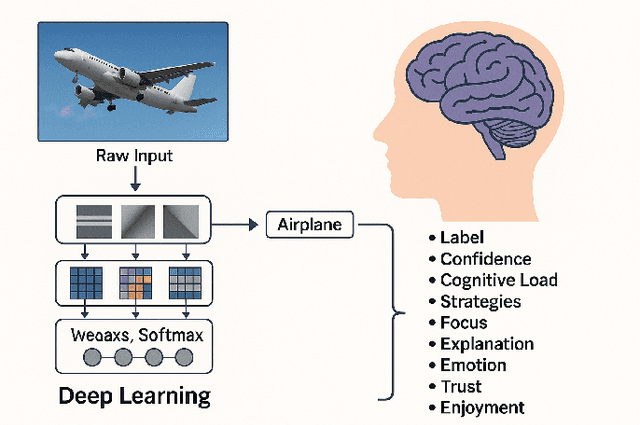
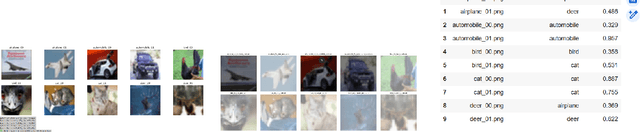
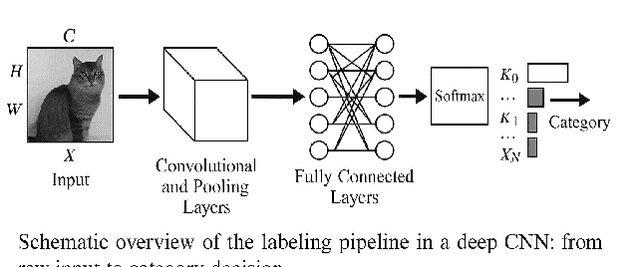
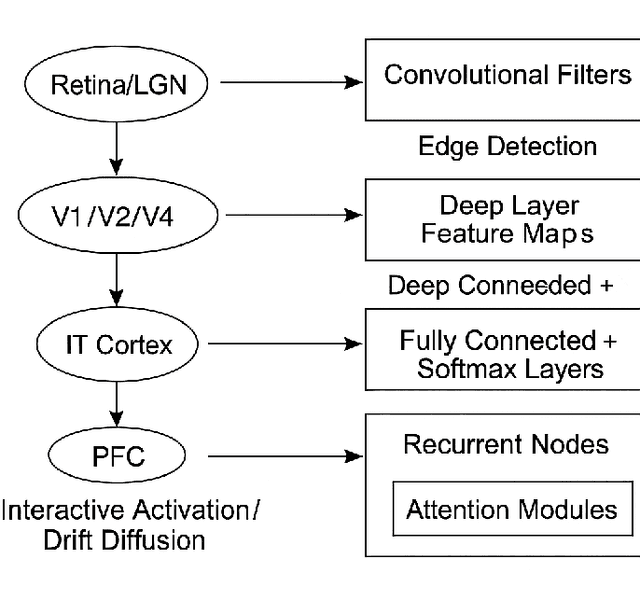
Understanding how humans and AI systems interpret ambiguous visual stimuli offers critical insight into the nature of perception, reasoning, and decision-making. This paper examines image labeling performance across human participants and deep neural networks, focusing on low-resolution, perceptually degraded stimuli. Drawing from computational cognitive science, cognitive architectures, and connectionist-symbolic hybrid models, we contrast human strategies such as analogical reasoning, shape-based recognition, and confidence modulation with AI's feature-based processing. Grounded in Marr's tri-level hypothesis, Simon's bounded rationality, and Thagard's frameworks of representation and emotion, we analyze participant responses in relation to Grad-CAM visualizations of model attention. Human behavior is further interpreted through cognitive principles modeled in ACT-R and Soar, revealing layered and heuristic decision strategies under uncertainty. Our findings highlight key parallels and divergences between biological and artificial systems in representation, inference, and confidence calibration. The analysis motivates future neuro-symbolic architectures that unify structured symbolic reasoning with connectionist representations. Such architectures, informed by principles of embodiment, explainability, and cognitive alignment, offer a path toward AI systems that are not only performant but also interpretable and cognitively grounded.