 Add to Chrome
 Add to Firefox
 Add to Edge
On the Geometric Coherence of Global Aggregation in Federated GNN
Feb 17, 2026
Federated Learning (FL) enables distributed training across multiple clients without centralized data sharing, while Graph Neural Networks (GNNs) model relational data through message passing. In federated GNN settings, client graphs often exhibit heterogeneous structural and propagation characteristics. When standard aggregation mechanisms are applied to such heterogeneous updates, the global model may converge numerically while exhibiting degraded relational behavior.Our work identifies a geometric failure mode of global aggregation in Cross- Domain Federated GNNs. Although GNN parameters are numerically represented as vectors, they encode relational transformations that govern the direction, strength, and sensitivity of information flow across graph neighborhoods. Aggregating updates originating from incompatible propagation regimes can therefore introduce destructive interference in this transformation space.This leads to loss of coherence in global message passing. Importantly, this degradation is not necessarily reflected in conventional metrics such as loss or accuracy.To address this issue, we propose GGRS (Global Geometric Reference Structure), a server-side framework that regulates client updates prior to aggregation based on geometric admissibility criteria. GGRS preserves directional consistency of relational transformations as well as maintains diversity of admissible propagation subspaces. It also stabilizes sensitivity to neighborhood interactions, without accessing client data or graph topology. Experiments on heterogeneous GNN-native, Amazon Co-purchase datasets demonstrate that GGRS preserves global message-passing coherence across training rounds by highlighting the necessity of geometry-aware regulation in federated graph learning.

From Graphs to Hypergraphs: Enhancing Aspect-Based Sentiment Analysis via Multi-Level Relational Modeling
Nov 18, 2025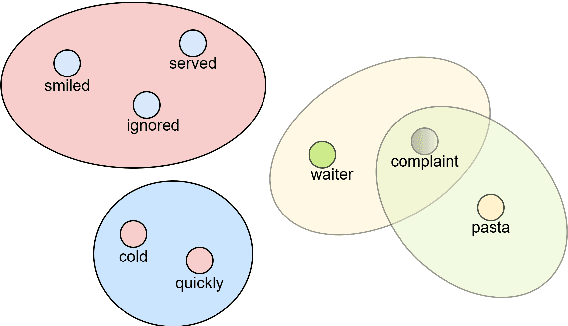
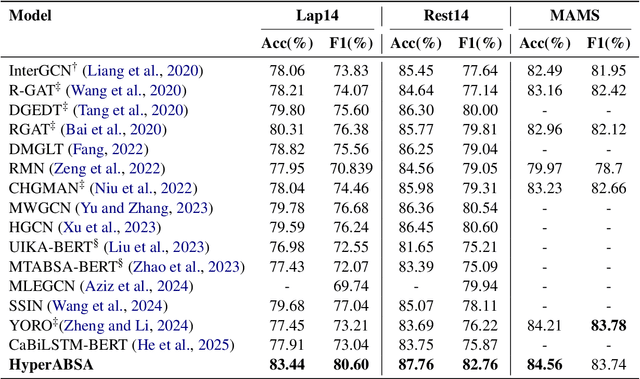
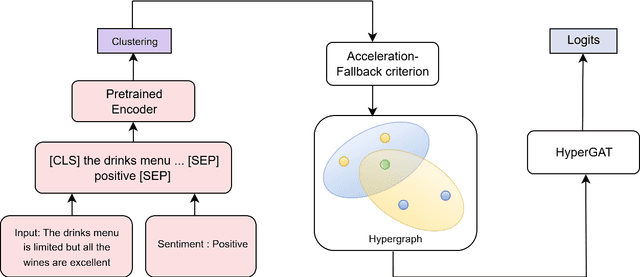
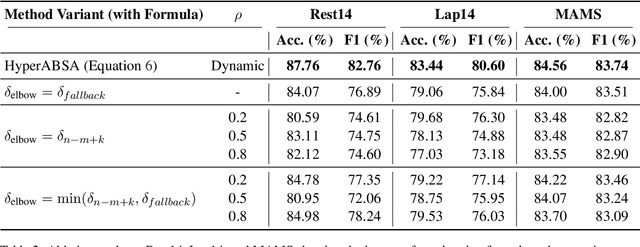
Aspect-Based Sentiment Analysis (ABSA) predicts sentiment polarity for specific aspect terms, a task made difficult by conflicting sentiments across aspects and the sparse context of short texts. Prior graph-based approaches model only pairwise dependencies, forcing them to construct multiple graphs for different relational views. These introduce redundancy, parameter overhead, and error propagation during fusion, limiting robustness in short-text, low-resource settings. We present HyperABSA, a dynamic hypergraph framework that induces aspect-opinion structures through sample-specific hierarchical clustering. To construct these hyperedges, we introduce a novel acceleration-fallback cutoff for hierarchical clustering, which adaptively determines the level of granularity. Experiments on three benchmarks (Lap14, Rest14, MAMS) show consistent improvements over strong graph baselines, with substantial gains when paired with RoBERTa backbones. These results position dynamic hypergraph construction as an efficient, powerful alternative for ABSA, with potential extensions to other short-text NLP tasks.