 Add to Chrome
 Add to Firefox
 Add to Edge
When Summaries Distort Decisions: Information Fidelity in LLM-Compressed Financial Analysis
Jun 28, 2026
Financial decision-makers face more information than they can directly inspect, making context compression necessary. Yet when large language models (LLMs) compress financial source material, they can alter the investment judgment supported by the original source. We frame this problem as information fidelity: compression loses fidelity when it changes the decision induced by the source. In agentic systems, such losses may recur across intermediate steps and amplify throughout the decision process. Across financial filings and earnings-call transcripts, we find that LLM-based compression can produce fluent and factually plausible compressed contexts that nevertheless alter downstream decisions. We analyze two diagnostic patterns associated with fidelity loss: decontextualization, where salient evidence is retained but separated from the caveats and contextual qualifiers needed for correct interpretation, and model dependency, where different compressors expose different views of the same source. We then propose Agentic Context Compression, which generates multiple candidate compressions and audits their disagreements against the original source. Our results suggest that financial compression should be evaluated not only by efficiency or factuality, but also by its ability to preserve decision-relevant context.

ReFEree: Reference-Free and Fine-Grained Method for Evaluating Factual Consistency in Real-World Code Summarization
Apr 12, 2026As Large Language Models (LLMs) have become capable of generating long and descriptive code summaries, accurate and reliable evaluation of factual consistency has become a critical challenge. However, previous evaluation methods are primarily designed for short summaries of isolated code snippets. Consequently, they struggle to provide fine-grained evaluation of multi-sentence functionalities and fail to accurately assess dependency context commonly found in real-world code summaries. To address this, we propose ReFEree, a reference-free and fine-grained method for evaluating factual consistency in real-world code summaries. We define factual inconsistency criteria specific to code summaries and evaluate them at the segment level using these criteria along with dependency information. These segment-level results are then aggregated into a fine-grained score. We construct a code summarization benchmark with human-annotated factual consistency labels. The evaluation results demonstrate that ReFEree achieves the highest correlation with human judgment among 13 baselines, improving 15-18% over the previous state-of-the-art. Our code and data are available at https://github.com/bsy99615/ReFEree.git.
Q-FAKER: Query-free Hard Black-box Attack via Controlled Generation
Apr 18, 2025
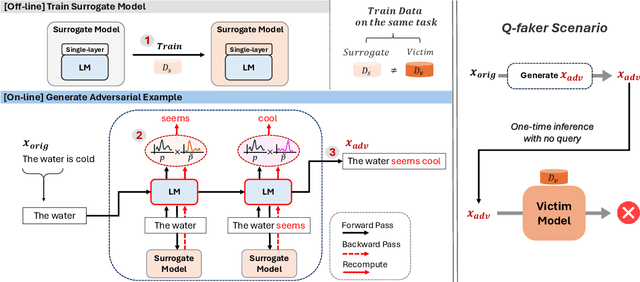

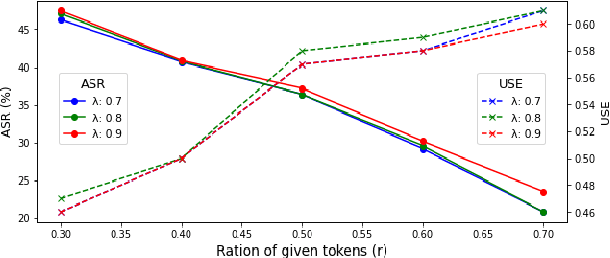
Many adversarial attack approaches are proposed to verify the vulnerability of language models. However, they require numerous queries and the information on the target model. Even black-box attack methods also require the target model's output information. They are not applicable in real-world scenarios, as in hard black-box settings where the target model is closed and inaccessible. Even the recently proposed hard black-box attacks still require many queries and demand extremely high costs for training adversarial generators. To address these challenges, we propose Q-faker (Query-free Hard Black-box Attacker), a novel and efficient method that generates adversarial examples without accessing the target model. To avoid accessing the target model, we use a surrogate model instead. The surrogate model generates adversarial sentences for a target-agnostic attack. During this process, we leverage controlled generation techniques. We evaluate our proposed method on eight datasets. Experimental results demonstrate our method's effectiveness including high transferability and the high quality of the generated adversarial examples, and prove its practical in hard black-box settings.