 Add to Chrome
 Add to Firefox
 Add to Edge
Computational Imaging Priors for Wireless Capsule Endoscopy: Monte Carlo-Guided Hemoglobin Mapping for Rare-Anomaly Detection
May 14, 2026
Background. RGB-trained capsule-endoscopy classifiers underperform on small-vessel vascular findings by conflating hemoglobin contrast with bile and illumination falloff. Thus, here we test whether a Monte Carlo-inspired analytic model can compute hemoglobin from RGB signal built upon extracted classifier. Methods. On Kvasir-Capsule (47,238 frames, video-level 70/15/15 split, 11 evaluable classes) we evaluate two software-only configurations against RGB-only EfficientNet-B0 across 6 seeds: (i) a prior P_blood = sigma(alpha * (H_norm - 0.5)) * Phi(r) fused as 2 zero-init auxiliary channels; (ii) a distillation head training a 3-channel RGB backbone to predict P_blood. Significance: paired DeLong, McNemar, bootstrap CIs with Bonferroni correction. Results. Across 6 seeds (n=6,423), the analytic prior provides a small but direction-consistent macro-AUC improvement: RGB-only 0.760 +/- 0.027, input-fusion 0.783 +/- 0.024 (paired Delta = +0.023, sign-positive on 5/6 seeds), distillation 0.773 +/- 0.028. The largest robust per-class lift is on Lymphangiectasia, where AUC rises from RGB 0.238 +/- 0.057 to input-fusion 0.337 +/- 0.019, sign-consistent across all 6 seeds. On rare focal-vascular classes (Angiectasia, Blood - fresh) the prior's per-seed effects are bimodal: seed=42 reaches Angiectasia AUC 0.528 -> 0.916, but the cross-seed mean is 0.646 -> 0.608 with sigma_PI = 0.23 - reported as a high-variance per-seed exemplar. Conclusion. A Monte Carlo-inspired analytic prior provides a small, direction-consistent macro-AUC improvement on Kvasir-Capsule across 6 seeds with the largest robust per-class lift on Lymphangiectasia; the distillation variant runs on plain 3-channel RGB and yields a free interpretability heatmap.

Designing Any Imaging System from Natural Language: Agent-Constrained Composition over a Finite Primitive Basis
Mar 26, 2026Designing a computational imaging system -- selecting operators, setting parameters, validating consistency -- requires weeks of specialist effort per modality, creating an expertise bottleneck that excludes the broader scientific community from prototyping imaging instruments. We introduce spec.md, a structured specification format, and three autonomous agents -- Plan, Judge, and Execute -- that translate a one-sentence natural-language description into a validated forward model with bounded reconstruction error. A design-to-real error theorem decomposes total reconstruction error into five independently bounded terms, each linked to a corrective action. On 6 real-data modalities spanning all 5 carrier families, the automated pipeline matches expert-library quality (98.1 +/- 4.2%). Ten novel designs -- composing primitives into chains from 3D to 5D -- demonstrate compositional reach beyond any single-modality tool.
A Judge Agent Closes the Reliability Gap in AI-Generated Scientific Simulation
Mar 26, 2026Large language models can generate scientific simulation code, but the generated code silently fails on most non-textbook problems. We show that classical mathematical validation -- well-posedness, convergence, and error certification -- can be fully automated by a Judge Agent, reducing the silent-failure rate from 42% to 1.5% across 134 test cases spanning 12 scientific domains. The headline result comes from a prospective benchmark: 72 blinded tasks submitted by 12 independent scientists yield an 89% success rate (95% CI: [80%, 95%]) with automated error bounds, versus 53% without the Judge. On clinical CT (the only powered experiment, n = 200), the pipeline reaches 99% of expert quality. The residual 1.5% concentrates at bifurcation points where certifiability breaks down. We formalize this boundary through the simulability class S and introduce spec.md, a structured specification format that makes any scientific computation problem machine-readable and solver-independent. Code, data, and all 72 benchmark tasks are publicly archived.
Eleven Primitives and Three Gates: The Universal Structure of Computational Imaging
Mar 13, 2026Computational imaging systems -- from coded-aperture cameras to cryo-electron microscopes -- span five carrier families yet share a hidden structural simplicity. We prove that every imaging forward model decomposes into a directed acyclic graph over exactly 11 physically typed primitives (Finite Primitive Basis Theorem) -- a sufficient and minimal basis that provides a compositional language for designing any imaging modality. We further prove that every reconstruction failure has exactly three independent root causes: information deficiency, carrier noise, and operator mismatch (Triad Decomposition). The three gates map to the system lifecycle: Gates 1 and 2 guide design (sampling geometry, carrier selection); Gate 3 governs deployment-stage calibration and drift correction. Validation across 12 modalities and all five carrier families confirms both results, with +0.8 to +13.9 dB recovery on deployed instruments. Together, the 11 primitives and 3 gates establish the first universal grammar for designing, diagnosing, and correcting computational imaging systems.
InverseNet: Benchmarking Operator Mismatch and Calibration Across Compressive Imaging Modalities
Mar 04, 2026State-of-the-art EfficientSCI loses 20.58 dB when its assumed forward operator deviates from physical reality in just eight parameters, yet no existing benchmark quantifies operator mismatch, the default condition in deployed compressive imaging systems. We introduce InverseNet, the first cross-modality benchmark for operator mismatch, spanning CASSI, CACTI, and single-pixel cameras. Evaluating 12 methods under a four-scenario protocol (ideal, mismatched, oracle-corrected, blind calibration) across 27 simulated scenes and 9 real hardware captures, we find: (1) deep learning methods lose 10-21 dB under mismatch, eliminating their advantage over classical baselines; (2) performance and robustness are inversely correlated across modalities (Spearman r_s = -0.71, p < 0.01); (3) mask-oblivious architectures recover 0% of mismatch losses regardless of calibration quality, while operator-conditioned methods recover 41-90%; (4) blind grid-search calibration recovers 85-100% of the oracle bound without ground truth. Real hardware experiments confirm that simulation trends transfer to physical data. Code will be released upon acceptance.
The Finite Primitive Basis Theorem for Computational Imaging: Formal Foundations of the OperatorGraph Representation
Feb 24, 2026Computational imaging forward models, from coded aperture spectral cameras to MRI scanners, are traditionally implemented as monolithic, modality-specific codes. We prove that every forward model in a broad, precisely defined operator class Cimg (encompassing clinical, scientific, and industrial imaging modalities, both linear and nonlinear) admits an epsilon-approximate representation as a typed directed acyclic graph (DAG) whose nodes are drawn from a library of exactly 11 canonical primitives: Propagate, Modulate, Project, Encode, Convolve, Accumulate, Detect, Sample, Disperse, Scatter, and Transform. We call this the Finite Primitive Basis Theorem. The proof is constructive: we provide an algorithm that, given any H in Cimg, produces a DAG G with relative operator error at most epsilon and graph complexity within prescribed bounds. We further prove that the library is minimal: removing any single primitive causes at least one modality to lose its epsilon-approximate representation. A systematic analysis of nonlinearities in imaging physics shows they fall into two structural categories: pointwise scalar functions (handled by Transform) and self-consistent iterations (unrolled into existing linear primitives). Empirical validation on 31 linear modalities confirms eimg below 0.01 with at most 5 nodes and depth 5, and we provide constructive DAG decompositions for 9 additional nonlinear modalities. These results establish mathematical foundations for the Physics World Model (PWM) framework.
Adaptive Deep PnP Algorithm for Video Snapshot Compressive Imaging
Jan 28, 2022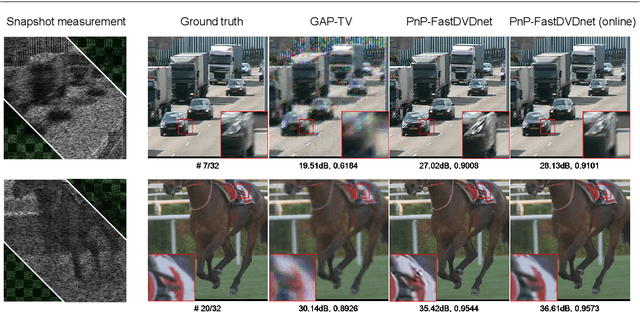
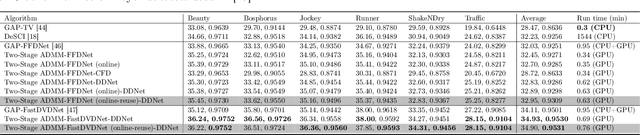
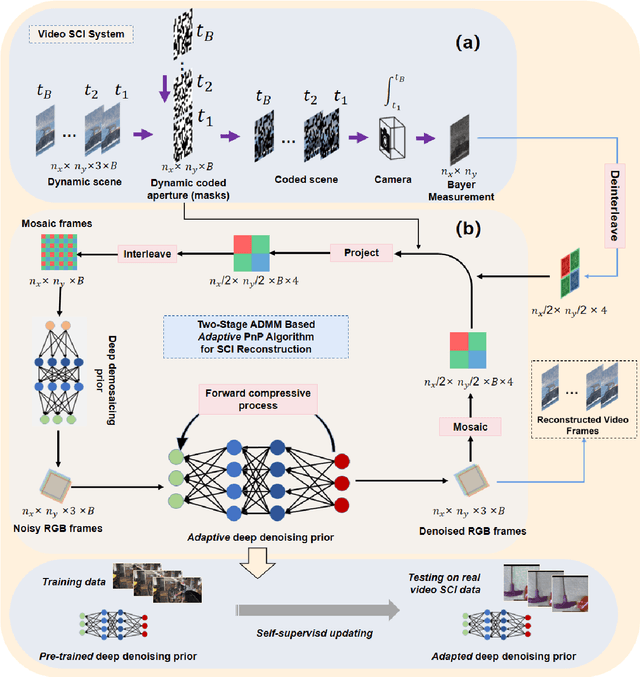
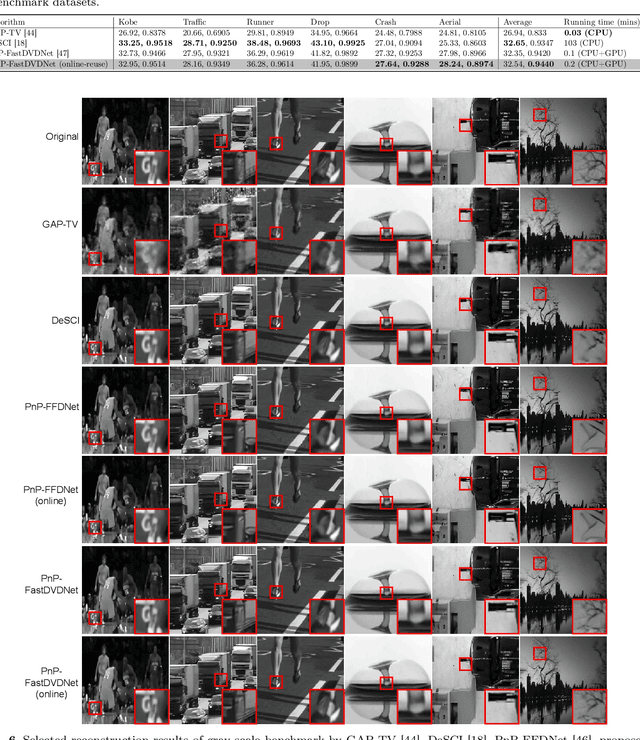
Video Snapshot compressive imaging (SCI) is a promising technique to capture high-speed videos, which transforms the imaging speed from the detector to mask modulating and only needs a single measurement to capture multiple frames. The algorithm to reconstruct high-speed frames from the measurement plays a vital role in SCI. In this paper, we consider the promising reconstruction algorithm framework, namely plug-and-play (PnP), which is flexible to the encoding process comparing with other deep learning networks. One drawback of existing PnP algorithms is that they use a pre-trained denoising network as a plugged prior while the training data of the network might be different from the task in real applications. Towards this end, in this work, we propose the online PnP algorithm which can adaptively update the network's parameters within the PnP iteration; this makes the denoising network more applicable to the desired data in the SCI reconstruction. Furthermore, for color video imaging, RGB frames need to be recovered from Bayer pattern or named demosaicing in the camera pipeline. To address this challenge, we design a two-stage reconstruction framework to optimize these two coupled ill-posed problems and introduce a deep demosaicing prior specifically for video demosaicing which does not have much past works instead of using single image demosaicing networks. Extensive results on both simulation and real datasets verify the superiority of our adaptive deep PnP algorithm.
Ensemble learning priors unfolding for scalable Snapshot Compressive Sensing
Jan 25, 2022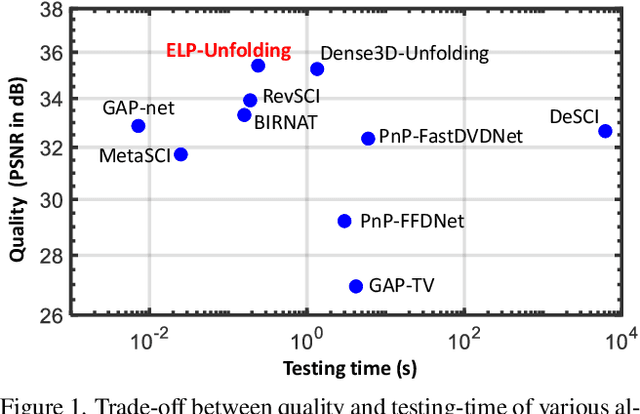
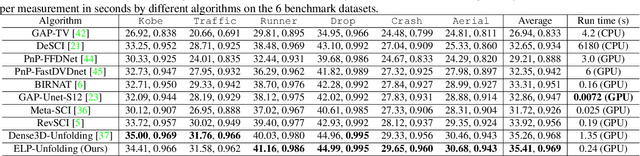
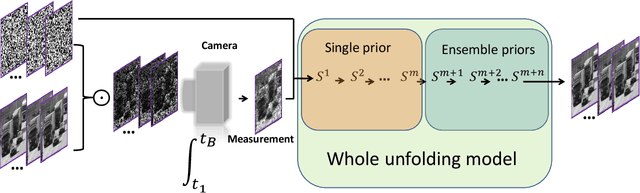
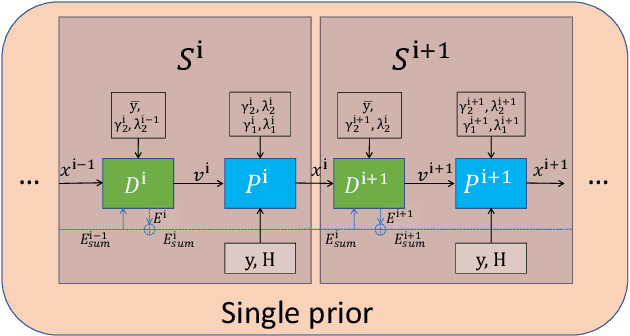
Snapshot compressive imaging (SCI) can record the 3D information by a 2D measurement and from this 2D measurement to reconstruct the original 3D information by reconstruction algorithm. As we can see, the reconstruction algorithm plays a vital role in SCI. Recently, deep learning algorithm show its outstanding ability, outperforming the traditional algorithm. Therefore, to improve deep learning algorithm reconstruction accuracy is an inevitable topic for SCI. Besides, deep learning algorithms are usually limited by scalability, and a well trained model in general can not be applied to new systems if lacking the new training process. To address these problems, we develop the ensemble learning priors to further improve the reconstruction accuracy and propose the scalable learning to empower deep learning the scalability just like the traditional algorithm. What's more, our algorithm has achieved the state-of-the-art results, outperforming existing algorithms. Extensive results on both simulation and real datasets demonstrate the superiority of our proposed algorithm. The code and models will be released to the public.