 Add to Chrome
 Add to Firefox
 Add to Edge
Knowledge-Centric Self-Improvement
Jul 21, 2026
Self-improving AI systems typically treat the agent as the object that improves, by optimizing prompts, workflows, harnesses, or even the agent's own code. This agent-centric view can make improvements expensive to maintain and difficult to transfer, because gains become tied to a particular agent design, task distribution, or adaptation run. We study a complementary paradigm: knowledge-centric self-improvement, in which agents remain generic and disposable while the persistent object is a curated knowledge base that agents can leverage for future tasks. We conduct controlled case studies to operationalize this idea via a simple protocol. Agents attempt one task, then contribute evidence-grounded insights to a shared knowledge base via task-level and cross-task forums, followed by knowledge distillation. Because self-improvement is contained in the knowledge rather than the agent, improvement can be more inspectable, transferable, and portable. Across abstract reasoning, coding, and terminal benchmarks, this protocol improves solve rates while reducing dollar cost relative to agent-centric baselines. The resulting distilled knowledge also transfers to held-out tasks and across LLM families, indicating that the improvement is not merely an LLM- or run-specific behavior. These results support a new view of self-improving agentic systems: progress can be driven primarily by the curated persistent knowledge. Code is available at https://github.com/recursive-knowledge/KSI.

Training Generalizable Collaborative Agents via Strategic Risk Aversion
Feb 25, 2026Many emerging agentic paradigms require agents to collaborate with one another (or people) to achieve shared goals. Unfortunately, existing approaches to learning policies for such collaborative problems produce brittle solutions that fail when paired with new partners. We attribute these failures to a combination of free-riding during training and a lack of strategic robustness. To address these problems, we study the concept of strategic risk aversion and interpret it as a principled inductive bias for generalizable cooperation with unseen partners. While strategically risk-averse players are robust to deviations in their partner's behavior by design, we show that, in collaborative games, they also (1) can have better equilibrium outcomes than those at classical game-theoretic concepts like Nash, and (2) exhibit less or no free-riding. Inspired by these insights, we develop a multi-agent reinforcement learning (MARL) algorithm that integrates strategic risk aversion into standard policy optimization methods. Our empirical results across collaborative benchmarks (including an LLM collaboration task) validate our theory and demonstrate that our approach consistently achieves reliable collaboration with heterogeneous and previously unseen partners across collaborative tasks.
Distributionally Robust Cooperative Multi-Agent Reinforcement Learning via Robust Value Factorization
Feb 11, 2026Cooperative multi-agent reinforcement learning (MARL) commonly adopts centralized training with decentralized execution, where value-factorization methods enforce the individual-global-maximum (IGM) principle so that decentralized greedy actions recover the team-optimal joint action. However, the reliability of this recipe in real-world settings remains unreliable due to environmental uncertainties arising from the sim-to-real gap, model mismatch, and system noise. We address this gap by introducing Distributionally robust IGM (DrIGM), a principle that requires each agent's robust greedy action to align with the robust team-optimal joint action. We show that DrIGM holds for a novel definition of robust individual action values, which is compatible with decentralized greedy execution and yields a provable robustness guarantee for the whole system. Building on this foundation, we derive DrIGM-compliant robust variants of existing value-factorization architectures (e.g., VDN/QMIX/QTRAN) that (i) train on robust Q-targets, (ii) preserve scalability, and (iii) integrate seamlessly with existing codebases without bespoke per-agent reward shaping. Empirically, on high-fidelity SustainGym simulators and a StarCraft game environment, our methods consistently improve out-of-distribution performance. Code and data are available at https://github.com/crqu/robust-coMARL.
Understanding Agent Scaling in LLM-Based Multi-Agent Systems via Diversity
Feb 03, 2026LLM-based multi-agent systems (MAS) have emerged as a promising approach to tackle complex tasks that are difficult for individual LLMs. A natural strategy is to scale performance by increasing the number of agents; however, we find that such scaling exhibits strong diminishing returns in homogeneous settings, while introducing heterogeneity (e.g., different models, prompts, or tools) continues to yield substantial gains. This raises a fundamental question: what limits scaling, and why does diversity help? We present an information-theoretic framework showing that MAS performance is bounded by the intrinsic task uncertainty, not by agent count. We derive architecture-agnostic bounds demonstrating that improvements depend on how many effective channels the system accesses. Homogeneous agents saturate early because their outputs are strongly correlated, whereas heterogeneous agents contribute complementary evidence. We further introduce $K^*$, an effective channel count that quantifies the number of effective channels without ground-truth labels. Empirically, we show that heterogeneous configurations consistently outperform homogeneous scaling: 2 diverse agents can match or exceed the performance of 16 homogeneous agents. Our results provide principled guidelines for building efficient and robust MAS through diversity-aware design. Code and Dataset are available at the link: https://github.com/SafeRL-Lab/Agent-Scaling.
Hybrid Transfer Reinforcement Learning: Provable Sample Efficiency from Shifted-Dynamics Data
Nov 06, 2024

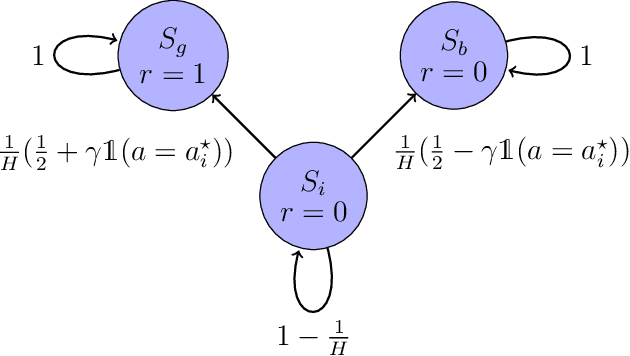

Online Reinforcement learning (RL) typically requires high-stakes online interaction data to learn a policy for a target task. This prompts interest in leveraging historical data to improve sample efficiency. The historical data may come from outdated or related source environments with different dynamics. It remains unclear how to effectively use such data in the target task to provably enhance learning and sample efficiency. To address this, we propose a hybrid transfer RL (HTRL) setting, where an agent learns in a target environment while accessing offline data from a source environment with shifted dynamics. We show that -- without information on the dynamics shift -- general shifted-dynamics data, even with subtle shifts, does not reduce sample complexity in the target environment. However, with prior information on the degree of the dynamics shift, we design HySRL, a transfer algorithm that achieves problem-dependent sample complexity and outperforms pure online RL. Finally, our experimental results demonstrate that HySRL surpasses state-of-the-art online RL baseline.