 Add to Chrome
 Add to Firefox
 Add to Edge
DeaMoE: Efficient MoE Structure for Fast Small-Batch Decoding
Aug 14, 2026
Mixture-of-Experts (MoE) models have been widely adopted in real-time interactive applications such as coding assistants, real-time audio-video interaction systems. To meet the extremely low response latency requirements of these scenarios, practitioners commonly employ small-batch decoding, under which MoE inference becomes memory-bound and is severely bottlenecked by expert weight loading. However, this bottleneck has received limited attention, and existing solutions such as post-training weight compression or fine-grained expert design during pre-training either degrade model accuracy or introduce additional computation and communication overhead. To tackle this issue, we propose DeaMoE, a decoding-efficient MoE architecture, in which the experts are grouped into several departments, and the experts belonging to the same department share most parameters since they come from the same professional field, and additionally each expert contains a few private parameters to reflect its uniqueness. Moreover, we design customized two-stage routing strategy for DeaMoE to avoid redundant loading, under which DeaMoE greatly improves the efficiency during LLM decoding. Compared with vanilla MoE, DeaMoE reduces per-step loaded weights by up to 50.9% and achieves up to 1.33 end-to-end TPOT speedup for the pre-trained 7B model on A40, and up to 2.00x and 1.97x peak speedup for DeepSeek-V3 on A40 and H100 in microbenchmarks.

Seg-Wild: Interactive Segmentation based on 3D Gaussian Splatting for Unconstrained Image Collections
Jul 10, 2025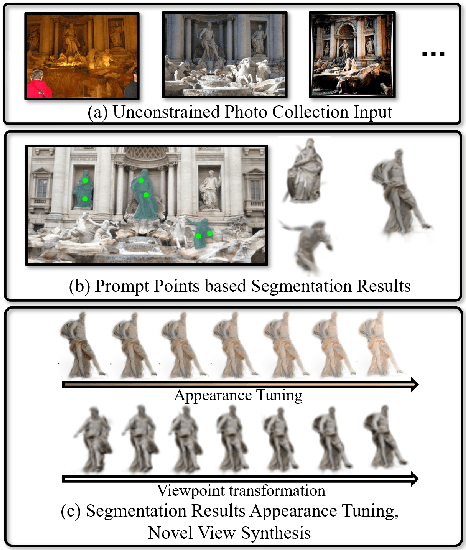
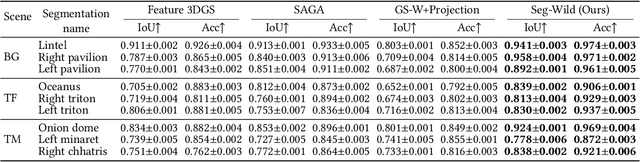
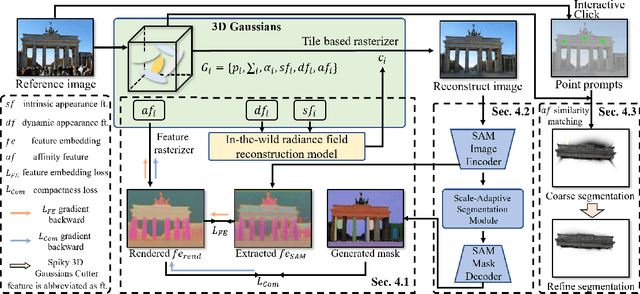
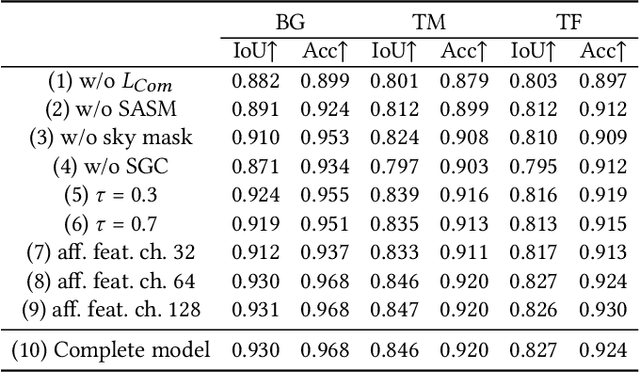
Reconstructing and segmenting scenes from unconstrained photo collections obtained from the Internet is a novel but challenging task. Unconstrained photo collections are easier to get than well-captured photo collections. These unconstrained images suffer from inconsistent lighting and transient occlusions, which makes segmentation challenging. Previous segmentation methods cannot address transient occlusions or accurately restore the scene's lighting conditions. Therefore, we propose Seg-Wild, an interactive segmentation method based on 3D Gaussian Splatting for unconstrained image collections, suitable for in-the-wild scenes. We integrate multi-dimensional feature embeddings for each 3D Gaussian and calculate the feature similarity between the feature embeddings and the segmentation target to achieve interactive segmentation in the 3D scene. Additionally, we introduce the Spiky 3D Gaussian Cutter (SGC) to smooth abnormal 3D Gaussians. We project the 3D Gaussians onto a 2D plane and calculate the ratio of 3D Gaussians that need to be cut using the SAM mask. We also designed a benchmark to evaluate segmentation quality in in-the-wild scenes. Experimental results demonstrate that compared to previous methods, Seg-Wild achieves better segmentation results and reconstruction quality. Our code will be available at https://github.com/Sugar0725/Seg-Wild.