 Add to Chrome
 Add to Firefox
 Add to Edge
TCBiRRT: Rapid Motion Planning for Tightly Coupled Dual-arm Space Manipulator Using Task-space Random Expansion
May 26, 2026
Planning the motion path for a tightly coupled dual-arm space manipulator under closed-chain constraints is a fundamental yet challenging problem in on-orbit assembly of large-scale space structures. The closed-chain constraints significantly reduce the feasible configuration space, making it difficult for existing planners to efficiently generate collision-free motions, especially in cluttered environments. To address this issue, this paper proposes a task-space constrained bidirectional rapidly-exploring random tree algorithm, termed TCBiRRT. Unlike conventional methods that operate in the high-dimensional configuration space, the proposed approach performs random sampling and node expansion directly in the task space defined by the manipulated object pose. A task-space node expansion strategy is developed to generate candidate object motions, which are then mapped to continuous joint paths using a path inverse kinematics algorithm. The method is further integrated with a bidirectional RRT framework and a regrasp mechanism to efficiently connect two random trees. Extensive simulations are conducted in representative on-orbit assembly scenarios with varying levels of environmental complexity. The results demonstrate that TCBiRRT achieves significantly higher success rates and orders-of-magnitude improvements in planning time compared to state-of-the-art planners. The proposed method provides an efficient and robust solution for motion planning of tightly coupled dual-arm space manipulators.

Local Path Optimization in The Latent Space Using Learned Distance Gradient
Dec 30, 2025Constrained motion planning is a common but challenging problem in robotic manipulation. In recent years, data-driven constrained motion planning algorithms have shown impressive planning speed and success rate. Among them, the latent motion method based on manifold approximation is the most efficient planning algorithm. Due to errors in manifold approximation and the difficulty in accurately identifying collision conflicts within the latent space, time-consuming path validity checks and path replanning are required. In this paper, we propose a method that trains a neural network to predict the minimum distance between the robot and obstacles using latent vectors as inputs. The learned distance gradient is then used to calculate the direction of movement in the latent space to move the robot away from obstacles. Based on this, a local path optimization algorithm in the latent space is proposed, and it is integrated with the path validity checking process to reduce the time of replanning. The proposed method is compared with state-of-the-art algorithms in multiple planning scenarios, demonstrating the fastest planning speed
* This paper has been published in IROS 2025
Multiple Peg-in-Hole Assembly of Tightly Coupled Multi-manipulator Using Learning-based Visual Servo
Jul 15, 2024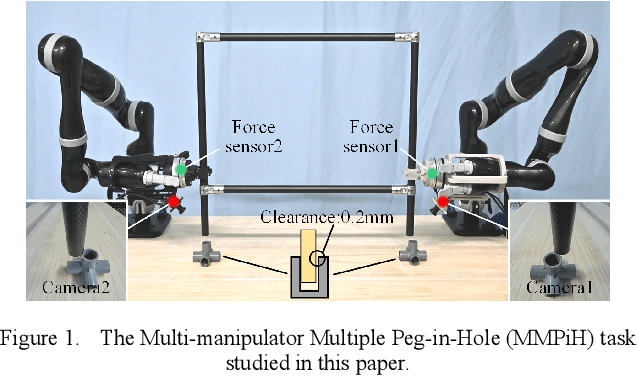
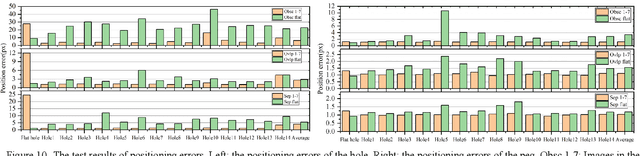

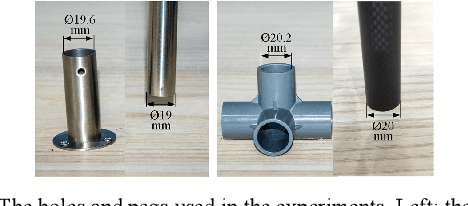
Multiple peg-in-hole assembly is one of the fundamental tasks in robotic assembly. In the multiple peg-in-hole task for large-sized parts, it is challenging for a single manipulator to simultaneously align multiple distant pegs and holes, necessitating tightly coupled multi-manipulator systems. For such Multi-manipulator Multiple Peg-in-Hole (MMPiH) tasks, we proposes a collaborative visual servo control framework that uses only the monocular in-hand cameras of each manipulator to reduce positioning errors. Initially, we train a state classification neural network and a positioning neural network. The former is used to divide the states of peg and hole in the image into three categories: obscured, separated and overlapped, while the latter determines the position of the peg and hole in the image. Based on these findings, we propose a method to integrate the visual features of multiple manipulators using virtual forces, which can naturally combine with the cooperative controller of the multi-manipulator system. To generalize our approach to holes of different appearances, we varied the appearance of the holes during the dataset generation process. The results confirm that by considering the appearance of the holes, classification accuracy and positioning precision can be improved. Finally, the results show that our method achieves an 85% success rate in dual-manipulator dual peg-in-hole tasks with a clearance of 0.2 mm.