 Add to Chrome
 Add to Firefox
 Add to Edge
An Ontology-driven Dynamic Knowledge Base for Uninhabited Ground Vehicles
Feb 11, 2026
In this paper, the concept of Dynamic Contextual Mission Data (DCMD) is introduced to develop an ontology-driven dynamic knowledge base for Uninhabited Ground Vehicles (UGVs) at the tactical edge. The dynamic knowledge base with DCMD is added to the UGVs to: support enhanced situation awareness; improve autonomous decision making; and facilitate agility within complex and dynamic environments. As UGVs are heavily reliant on the a priori information added pre-mission, unexpected occurrences during a mission can cause identification ambiguities and require increased levels of user input. Updating this a priori information with contextual information can help UGVs realise their full potential. To address this, the dynamic knowledge base was designed using an ontology-driven representation, supported by near real-time information acquisition and analysis, to provide in-mission on-platform DCMD updates. This was implemented on a team of four UGVs that executed a laboratory based surveillance mission. The results showed that the ontology-driven dynamic representation of the UGV operational environment was machine actionable, producing contextual information to support a successful and timely mission, and contributed directly to the situation awareness.
* 10 pages, 11 figures, 2025 Australasian Conference on Robotics and Automation (ACRA 2025)

Graph-based Integrated Gradients for Explaining Graph Neural Networks
Sep 09, 2025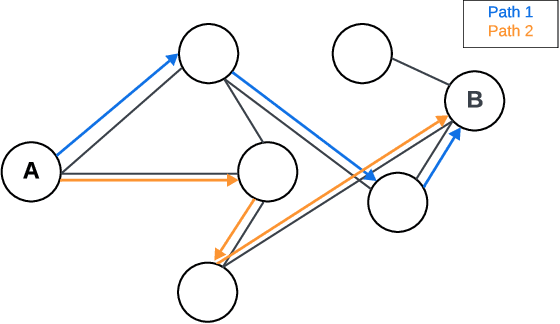
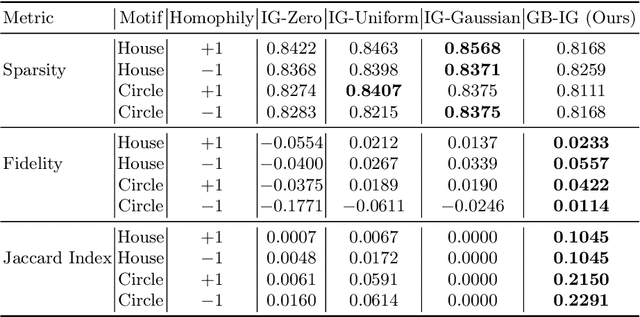

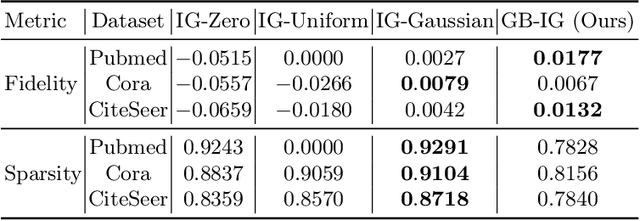
Integrated Gradients (IG) is a common explainability technique to address the black-box problem of neural networks. Integrated gradients assumes continuous data. Graphs are discrete structures making IG ill-suited to graphs. In this work, we introduce graph-based integrated gradients (GB-IG); an extension of IG to graphs. We demonstrate on four synthetic datasets that GB-IG accurately identifies crucial structural components of the graph used in classification tasks. We further demonstrate on three prevalent real-world graph datasets that GB-IG outperforms IG in highlighting important features for node classification tasks.
Algebraic Adversarial Attacks on Explainability Models
Mar 16, 2025Classical adversarial attacks are phrased as a constrained optimisation problem. Despite the efficacy of a constrained optimisation approach to adversarial attacks, one cannot trace how an adversarial point was generated. In this work, we propose an algebraic approach to adversarial attacks and study the conditions under which one can generate adversarial examples for post-hoc explainability models. Phrasing neural networks in the framework of geometric deep learning, algebraic adversarial attacks are constructed through analysis of the symmetry groups of neural networks. Algebraic adversarial examples provide a mathematically tractable approach to adversarial examples. We validate our approach of algebraic adversarial examples on two well-known and one real-world dataset.
Tangentially Aligned Integrated Gradients for User-Friendly Explanations
Mar 11, 2025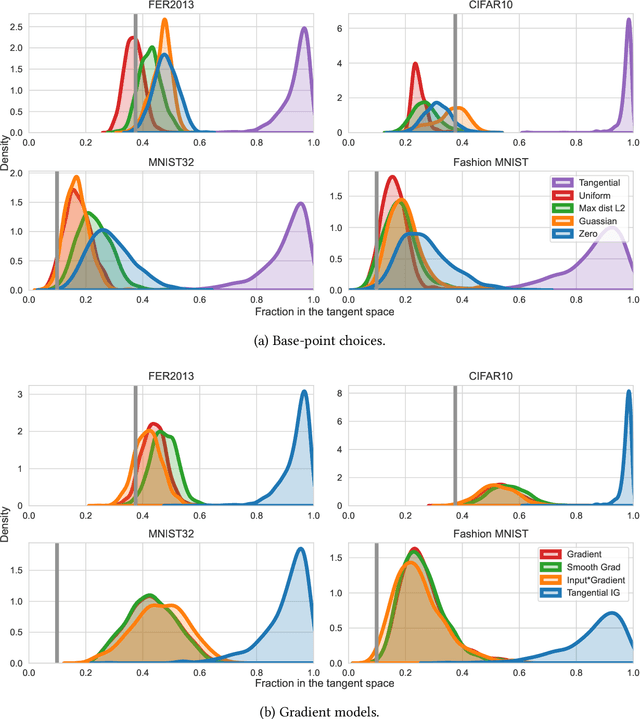
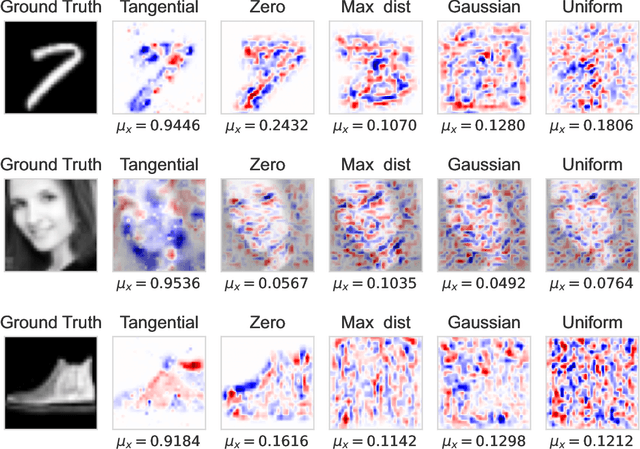
Integrated gradients is prevalent within machine learning to address the black-box problem of neural networks. The explanations given by integrated gradients depend on a choice of base-point. The choice of base-point is not a priori obvious and can lead to drastically different explanations. There is a longstanding hypothesis that data lies on a low dimensional Riemannian manifold. The quality of explanations on a manifold can be measured by the extent to which an explanation for a point lies in its tangent space. In this work, we propose that the base-point should be chosen such that it maximises the tangential alignment of the explanation. We formalise the notion of tangential alignment and provide theoretical conditions under which a base-point choice will provide explanations lying in the tangent space. We demonstrate how to approximate the optimal base-point on several well-known image classification datasets. Furthermore, we compare the optimal base-point choice with common base-points and three gradient explainability models.
Algebraic Adversarial Attacks on Integrated Gradients
Jul 23, 2024Adversarial attacks on explainability models have drastic consequences when explanations are used to understand the reasoning of neural networks in safety critical systems. Path methods are one such class of attribution methods susceptible to adversarial attacks. Adversarial learning is typically phrased as a constrained optimisation problem. In this work, we propose algebraic adversarial examples and study the conditions under which one can generate adversarial examples for integrated gradients. Algebraic adversarial examples provide a mathematically tractable approach to adversarial examples.
Probabilistic Lipschitzness and the Stable Rank for Comparing Explanation Models
Mar 08, 2024
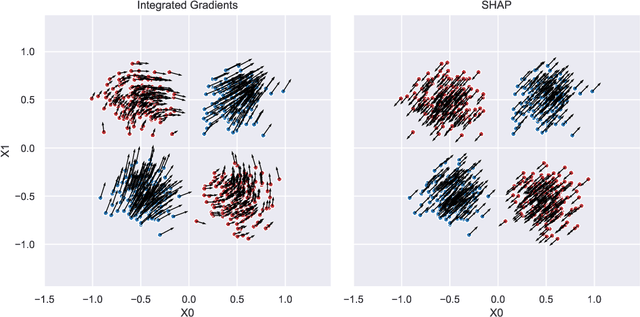
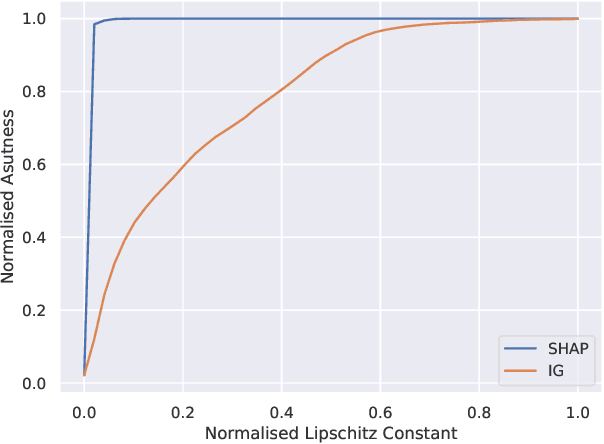
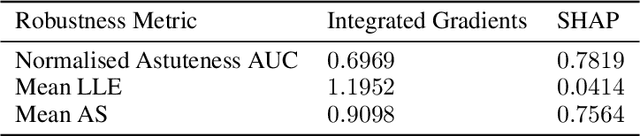
Explainability models are now prevalent within machine learning to address the black-box nature of neural networks. The question now is which explainability model is most effective. Probabilistic Lipschitzness has demonstrated that the smoothness of a neural network is fundamentally linked to the quality of post hoc explanations. In this work, we prove theoretical lower bounds on the probabilistic Lipschitzness of Integrated Gradients, LIME and SmoothGrad. We propose a novel metric using probabilistic Lipschitzness, normalised astuteness, to compare the robustness of explainability models. Further, we prove a link between the local Lipschitz constant of a neural network and its stable rank. We then demonstrate that the stable rank of a neural network provides a heuristic for the robustness of explainability models.
A Testbed for Automating and Analysing Mobile Devices and their Applications
Sep 15, 2023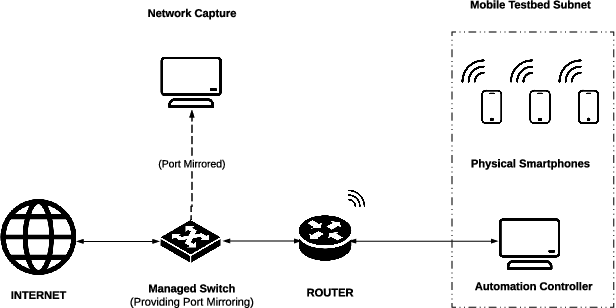
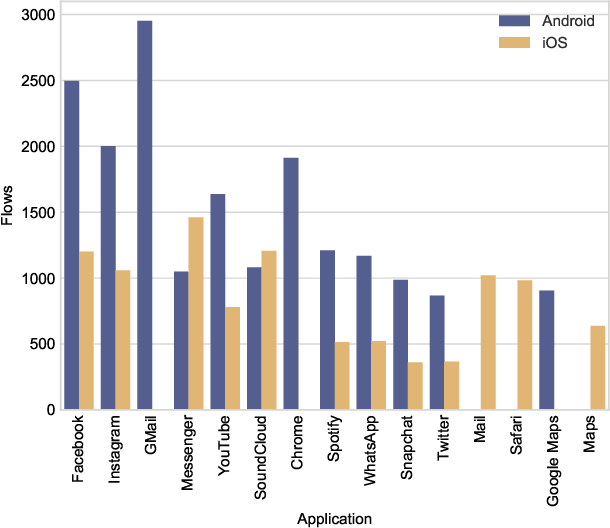
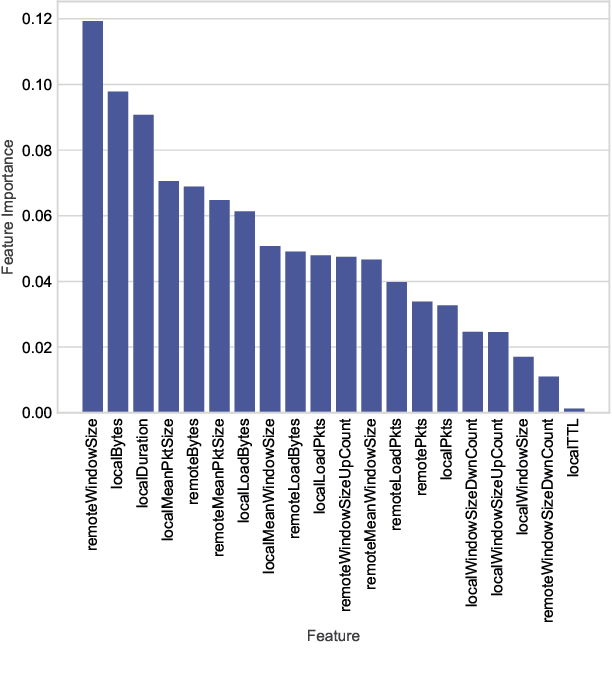
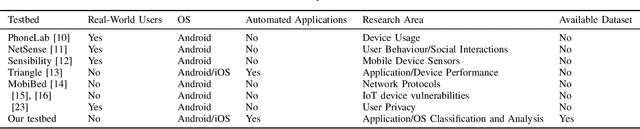
The need for improved network situational awareness has been highlighted by the growing complexity and severity of cyber-attacks. Mobile phones pose a significant risk to network situational awareness due to their dynamic behaviour and lack of visibility on a network. Machine learning techniques enhance situational awareness by providing administrators insight into the devices and activities which form their network. Developing machine learning techniques for situational awareness requires a testbed to generate and label network traffic. Current testbeds, however, are unable to automate the generation and labelling of realistic network traffic. To address this, we describe a testbed which automates applications on mobile devices to generate and label realistic traffic. From this testbed, two labelled datasets of network traffic have been created. We provide an analysis of the testbed automation reliability and benchmark the datasets for the task of application classification.