 Add to Chrome
 Add to Firefox
 Add to Edge
Algebraic Adversarial Attacks on Explainability Models
Mar 16, 2025
Classical adversarial attacks are phrased as a constrained optimisation problem. Despite the efficacy of a constrained optimisation approach to adversarial attacks, one cannot trace how an adversarial point was generated. In this work, we propose an algebraic approach to adversarial attacks and study the conditions under which one can generate adversarial examples for post-hoc explainability models. Phrasing neural networks in the framework of geometric deep learning, algebraic adversarial attacks are constructed through analysis of the symmetry groups of neural networks. Algebraic adversarial examples provide a mathematically tractable approach to adversarial examples. We validate our approach of algebraic adversarial examples on two well-known and one real-world dataset.

Tangentially Aligned Integrated Gradients for User-Friendly Explanations
Mar 11, 2025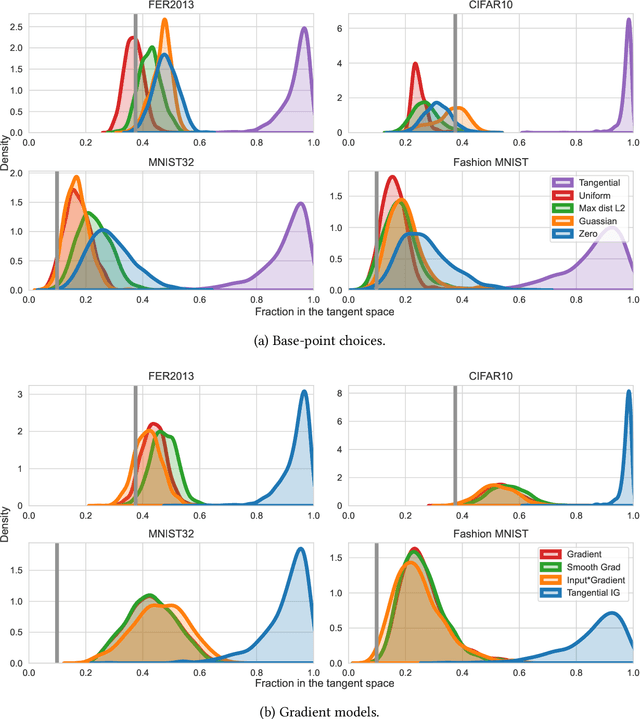
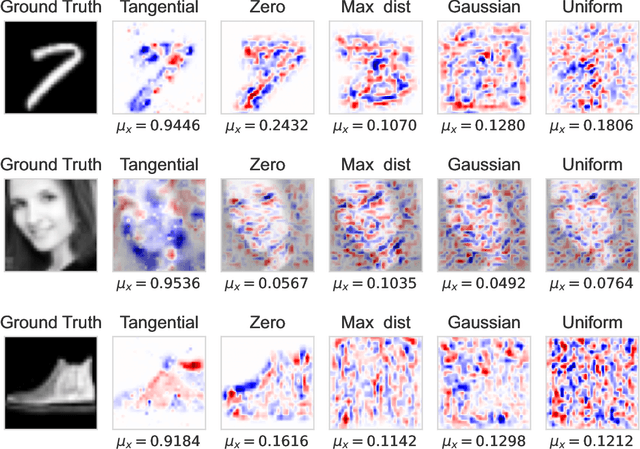
Integrated gradients is prevalent within machine learning to address the black-box problem of neural networks. The explanations given by integrated gradients depend on a choice of base-point. The choice of base-point is not a priori obvious and can lead to drastically different explanations. There is a longstanding hypothesis that data lies on a low dimensional Riemannian manifold. The quality of explanations on a manifold can be measured by the extent to which an explanation for a point lies in its tangent space. In this work, we propose that the base-point should be chosen such that it maximises the tangential alignment of the explanation. We formalise the notion of tangential alignment and provide theoretical conditions under which a base-point choice will provide explanations lying in the tangent space. We demonstrate how to approximate the optimal base-point on several well-known image classification datasets. Furthermore, we compare the optimal base-point choice with common base-points and three gradient explainability models.
Algebraic Adversarial Attacks on Integrated Gradients
Jul 23, 2024Adversarial attacks on explainability models have drastic consequences when explanations are used to understand the reasoning of neural networks in safety critical systems. Path methods are one such class of attribution methods susceptible to adversarial attacks. Adversarial learning is typically phrased as a constrained optimisation problem. In this work, we propose algebraic adversarial examples and study the conditions under which one can generate adversarial examples for integrated gradients. Algebraic adversarial examples provide a mathematically tractable approach to adversarial examples.