 Add to Chrome
 Add to Firefox
 Add to Edge
Constraint-Aware Generative Re-ranking for Multi-Objective Optimization in Advertising Feeds
Mar 04, 2026
Optimizing reranking in advertising feeds is a constrained combinatorial problem, requiring simultaneous maximization of platform revenue and preservation of user experience. Recent generative ranking methods enable listwise optimization via autoregressive decoding, but their deployment is hindered by high inference latency and limited constraint handling. We propose a constraint-aware generative reranking framework that transforms constrained optimization into bounded neural decoding. Unlike prior approaches that separate generator and evaluator models, our framework unifies sequence generation and reward estimation into a single network. We further introduce constraint-aware reward pruning, integrating constraint satisfaction directly into decoding to efficiently generate optimal sequences. Experiments on large-scale industrial feeds and online A/B tests show that our method improves revenue and user engagement while meeting strict latency requirements, providing an efficient neural solution for constrained listwise optimization.

Modeling Communication to Coordinate Perspectives in Cooperation
Jun 03, 2021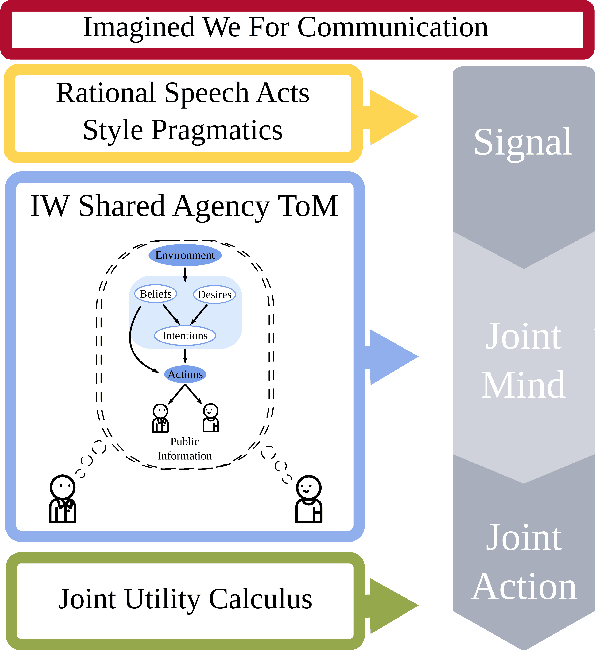
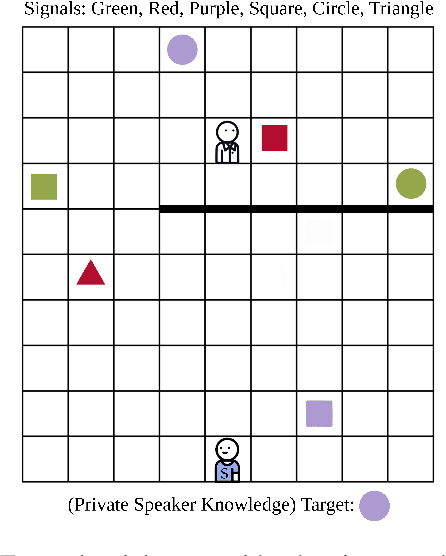
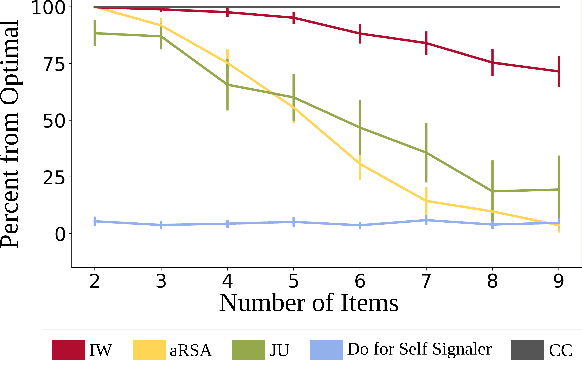
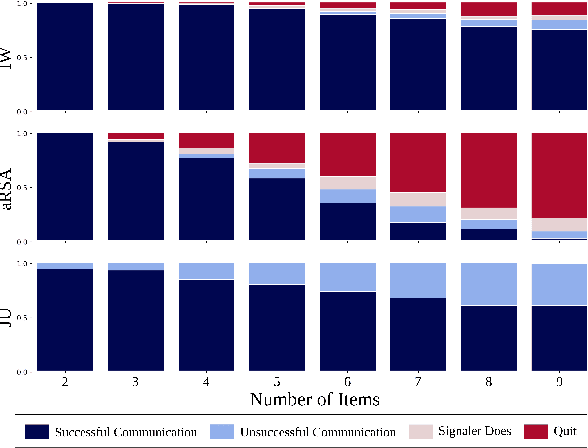
Communication is highly overloaded. Despite this, even young children are good at leveraging context to understand ambiguous signals. We propose a computational account of overloaded signaling from a shared agency perspective which we call the Imagined We for Communication. Under this framework, communication helps cooperators coordinate their perspectives, allowing them to act together to achieve shared goals. We assume agents are rational cooperators, which puts constraints on how signals can be sent and interpreted. We implement this model in a set of simulations demonstrating this model's success under increasing ambiguity as well as increasing layers of reasoning. Our model is capable of improving performance with deeper recursive reasoning; however, it outperforms comparison baselines at even the shallowest level, highlighting how shared knowledge and cooperative logic can do much of the heavy-lifting in language.