 Add to Chrome
 Add to Firefox
 Add to Edge
Gromov-Wasserstein Methods for Multi-View Relational Embedding and Clustering
Apr 26, 2026
Learning low-dimensional representations from multi-view relational data is challenging when underlying geometries differ across views. We propose Bary-GWMDS, a Gromov-Wasserstein-based method that operates directly on distance matrices to learn a consensus embedding preserving shared relational structure. By leveraging intrinsic distances, the approach naturally handles nonlinear distortions across views. We also introduce Mean-GWMDS-C, a clustering-oriented formulation that averages distance matrices and learns reduced-support representations via a consensus Gromov-Wasserstein transport. Experiments on synthetic and real-world datasets show that the proposed framework yields stable and geometrically meaningful embeddings.

Structure-Preserving Multi-View Embedding Using Gromov-Wasserstein Optimal Transport
Apr 03, 2026Multi-view data analysis seeks to integrate multiple representations of the same samples in order to recover a coherent low-dimensional structure. Classical approaches often rely on feature concatenation or explicit alignment assumptions, which become restrictive under heterogeneous geometries or nonlinear distortions. In this work, we propose two geometry-aware multi-view embedding strategies grounded in Gromov-Wasserstein (GW) optimal transport. The first, termed Mean-GWMDS, aggregates view-specific relational information by averaging distance matrices and applying GW-based multidimensional scaling to obtain a representative embedding. The second strategy, referred to as Multi-GWMDS, adopts a selection-based paradigm in which multiple geometry-consistent candidate embeddings are generated via GW-based alignment and a representative embedding is selected. Experiments on synthetic manifolds and real-world datasets show that the proposed methods effectively preserve intrinsic relational structure across views. These results highlight GW-based approaches as a flexible and principled framework for multi-view representation learning.
Machine Learning for Spectrum Sharing: A Survey
Nov 28, 2024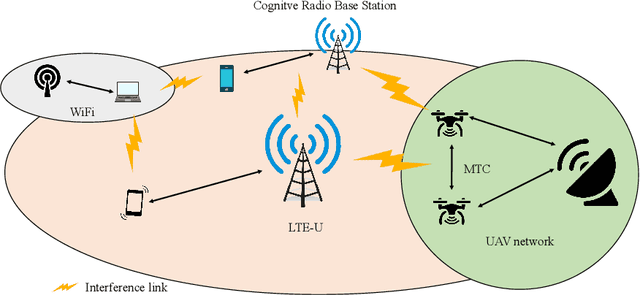
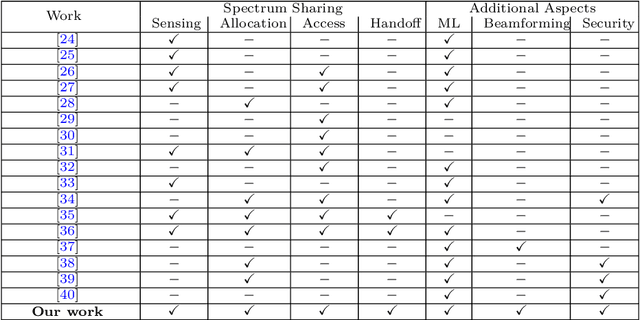
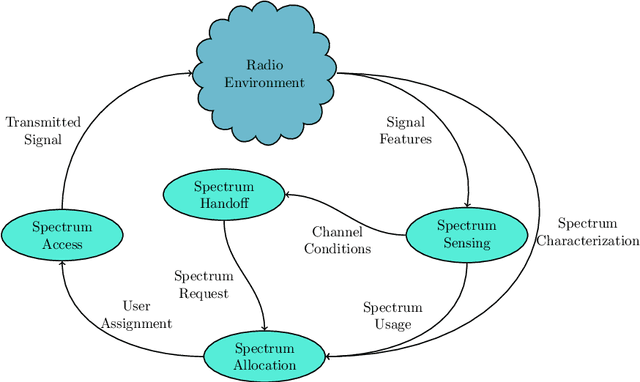
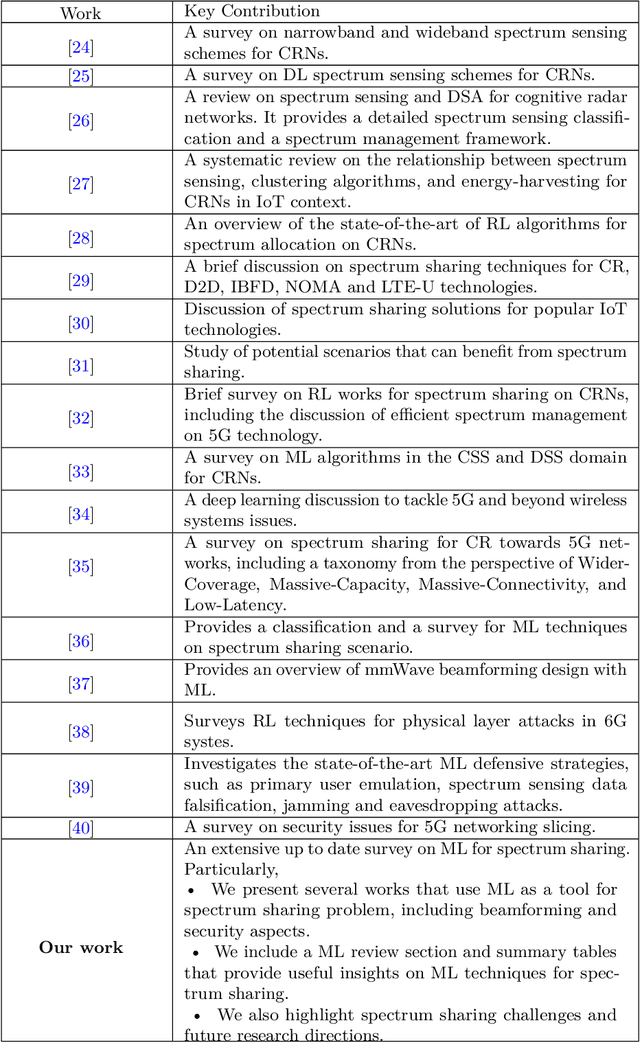
The 5th generation (5G) of wireless systems is being deployed with the aim to provide many sets of wireless communication services, such as low data rates for a massive amount of devices, broadband, low latency, and industrial wireless access. Such an aim is even more complex in the next generation wireless systems (6G) where wireless connectivity is expected to serve any connected intelligent unit, such as software robots and humans interacting in the metaverse, autonomous vehicles, drones, trains, or smart sensors monitoring cities, buildings, and the environment. Because of the wireless devices will be orders of magnitude denser than in 5G cellular systems, and because of their complex quality of service requirements, the access to the wireless spectrum will have to be appropriately shared to avoid congestion, poor quality of service, or unsatisfactory communication delays. Spectrum sharing methods have been the objective of intense study through model-based approaches, such as optimization or game theories. However, these methods may fail when facing the complexity of the communication environments in 5G, 6G, and beyond. Recently, there has been significant interest in the application and development of data-driven methods, namely machine learning methods, to handle the complex operation of spectrum sharing. In this survey, we provide a complete overview of the state-of-theart of machine learning for spectrum sharing. First, we map the most prominent methods that we encounter in spectrum sharing. Then, we show how these machine learning methods are applied to the numerous dimensions and sub-problems of spectrum sharing, such as spectrum sensing, spectrum allocation, spectrum access, and spectrum handoff. We also highlight several open questions and future trends.
* Published at NOW Foundations and Trends in Networking