 Add to Chrome
 Add to Firefox
 Add to Edge
RIS-Empowered OTFS Modulation With Faster-than-Nyquist Signaling in High-Mobility Wireless Communications
Dec 23, 2025
High-mobility wireless communication systems suffer from severe Doppler spread and multi-path delay, which degrade the reliability and spectral efficiency of conventional modulation schemes. Orthogonal time frequency space (OTFS) modulation offers strong robustness in such environments by representing symbols in the delay-Doppler (DD) domain, while faster-than-Nyquist (FTN) signaling can further enhance spectral efficiency through intentional symbol packing. Meanwhile, reconfigurable intelligent surfaces (RIS) provide a promising means to improve link quality via passive beamforming. Motivated by these advantages, we propose a novel RIS-empowered OTFS modulation with FTN signaling (RIS-OTFS-FTN) scheme. First, we establish a unified DD-domain input-output relationship that jointly accounts for RIS passive beamforming, FTN-induced inter-symbol interference, and DD-domain channel characteristics. Based on this model, we provide comprehensive analytical performance for the frame error rate, spectral efficiency, and peak-to-average power ratio (PAPR), etc. Furthermore, a practical RIS phase adjustment strategy with quantized phase selection is designed to maximize the effective channel gain. Extensive Monte Carlo simulations under a standardized extended vehicular A (EVA) channel model validate the theoretical results and provide key insights into the trade-offs among spectral efficiency, PAPR, input back-off (IBO), and error performance, with some interesting insights.The proposed RIS-OTFS-FTN scheme demonstrates notable performance gains in both reliability and spectral efficiency, offering a viable solution for future high-mobility and spectrum-constrained wireless systems.

What Roles can Spatial Modulation and Space Shift Keying Play in LEO Satellite-Assisted Communication?
Sep 26, 2024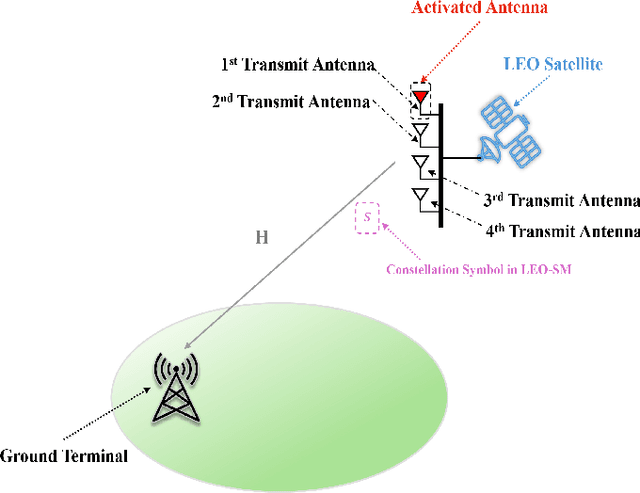
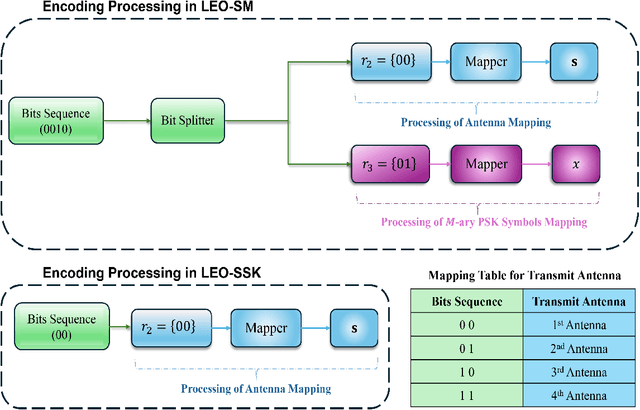
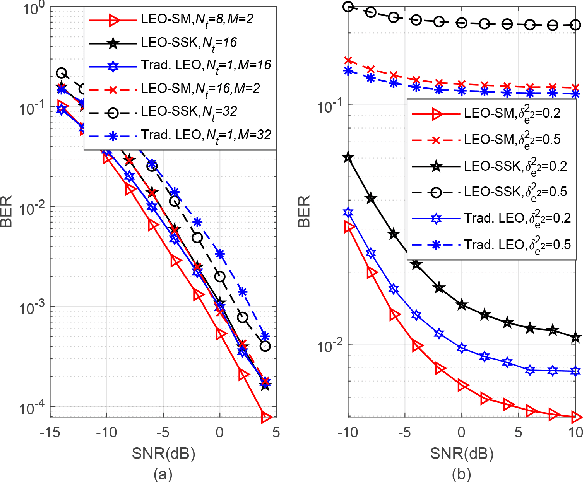
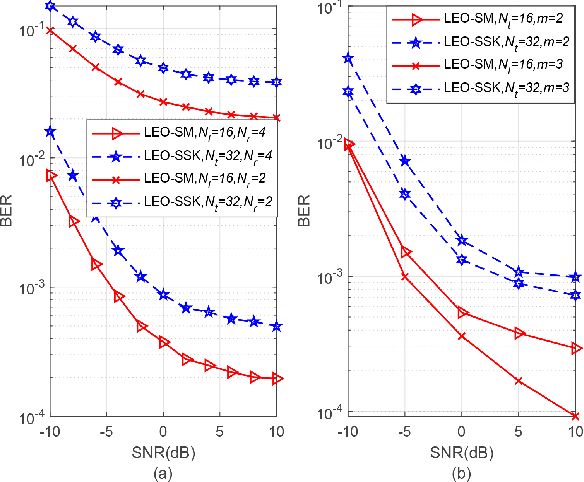
In recent years, the rapid evolution of satellite communications play a pivotal role in addressing the ever-increasing demand for global connectivity, among which the Low Earth Orbit (LEO) satellites attract a great amount of attention due to their low latency and high data throughput capabilities. Based on this, we explore spatial modulation (SM) and space shift keying (SSK) designs as pivotal techniques to enhance spectral efficiency (SE) and bit-error rate (BER) performance in the LEO satellite-assisted multiple-input multiple-output (MIMO) systems. The various performance analysis of these designs are presented in this paper, revealing insightful findings and conclusions through analytical methods and Monte Carlo simulations with perfect and imperfect channel state information (CSI) estimation. The results provide a comprehensive analysis of the merits and trade-offs associated with the investigated schemes, particularly in terms of BER, computational complexity, and SE. This analysis underscores the potential of both schemes as viable candidates for future 6G LEO satellite-assisted wireless communication systems.