 Add to Chrome
 Add to Firefox
 Add to Edge
MemoryLake on MemoryArena: A Matched Study of Agent Memory Backends
Aug 14, 2026
Most agent-memory benchmarks test post-hoc recall, whereas MemoryArena evaluates whether memory supports interdependent, multi-session task completion. We compare MemoryLake, a structured multi-track memory backend, with Mem0, text-embedding-3-small vector RAG, and a long-context control across all five MemoryArena domains. The systems share the same agent framework, requested gpt-5-mini model alias, task samples, and scoring code; the memory integration is the intentionally changed component. Because each backend bundles write, retrieval, consolidation, budgeting, and prompt-assembly choices, the study is a matched system-level comparison, not a representation-only ablation or a cost-matched experiment. On the shared evaluation sets, MemoryLake has the highest observed success rate (SR) in mathematics (9/40), physics (12/20), and progressive retrieval (4/20). Every system has zero SR in travel planning, and web shopping yields a single bundle-level success (long context, 1/150); MemoryLake ranks third on both the travel soft process score and shopping step match. Following MemoryArena's suite-level convention, a post-hoc equal-weight average over the five SRs is 20.5% for MemoryLake versus 13.6% for the best comparator. These are point estimates: sample sizes are modest, confidence intervals overlap, and we do not report paired significance tests. A separate MemoryLake-only run over all 221 progressive queries yields a failure-counted SR of 26.7% (59/221) and is not a baseline comparison. The results support a workload-dependent view of memory backends and an observed lead among the four evaluated systems on the shared sets; they do not establish benchmark-wide state of the art or a causal advantage of representation structure.

HighAir: A Hierarchical Graph Neural Network-Based Air Quality Forecasting Method
Jan 12, 2021
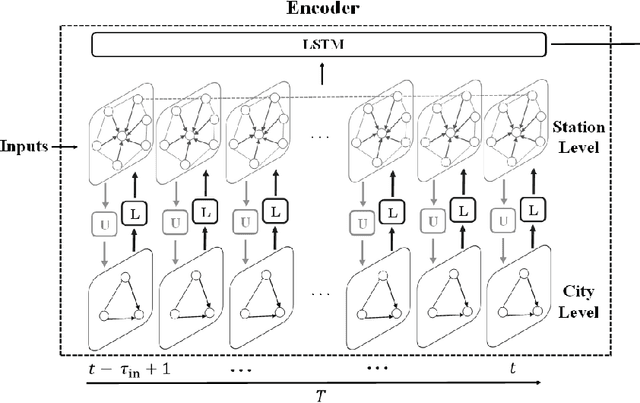
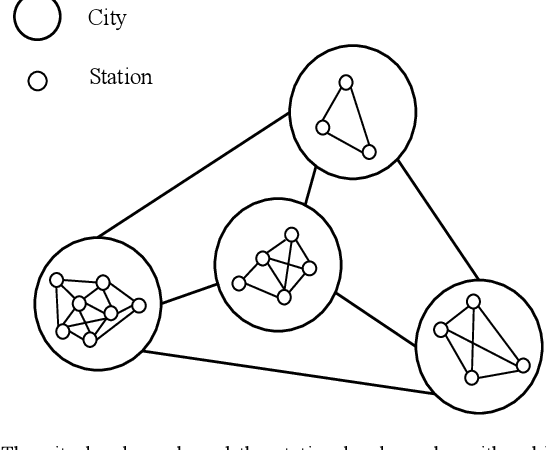
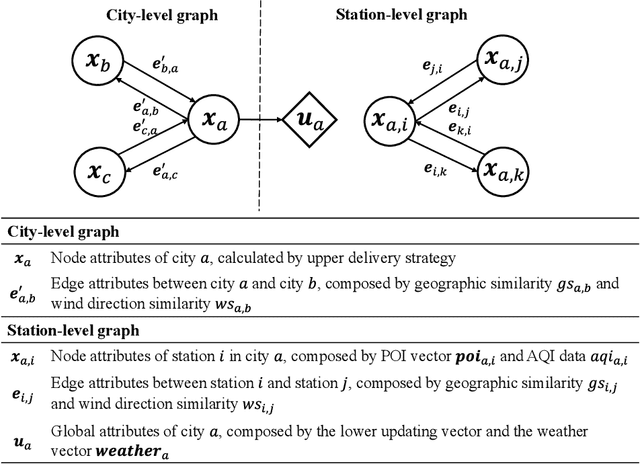
Accurately forecasting air quality is critical to protecting general public from lung and heart diseases. This is a challenging task due to the complicated interactions among distinct pollution sources and various other influencing factors. Existing air quality forecasting methods cannot effectively model the diffusion processes of air pollutants between cities and monitoring stations, which may suddenly deteriorate the air quality of a region. In this paper, we propose HighAir, i.e., a hierarchical graph neural network-based air quality forecasting method, which adopts an encoder-decoder architecture and considers complex air quality influencing factors, e.g., weather and land usage. Specifically, we construct a city-level graph and station-level graphs from a hierarchical perspective, which can consider city-level and station-level patterns, respectively. We design two strategies, i.e., upper delivery and lower updating, to implement the inter-level interactions, and introduce message passing mechanism to implement the intra-level interactions. We dynamically adjust edge weights based on wind direction to model the correlations between dynamic factors and air quality. We compare HighAir with the state-of-the-art air quality forecasting methods on the dataset of Yangtze River Delta city group, which covers 10 major cities within 61,500 km2. The experimental results show that HighAir significantly outperforms other methods.