 Add to Chrome
 Add to Firefox
 Add to Edge
Echo: Learning from Experience Data via User-Driven Refinement
May 21, 2026
Static "human data" faces inherent limitations: it is expensive to scale and bounded by the knowledge of its creators. Continuous learning from "experience data" - interactions between agents and their environments - promises to transcend these barriers. Today, the widespread deployment of AI agents grants us low-cost access to massive streams of such real-world experience. However, raw interaction logs are inherently noisy, filled with trial-and-error and low information density, rendering them inefficient for direct model training. We introduce Echo, a generalized framework designed to operationalize the transition from raw experience to learnable knowledge, effectively "echoing" environmental feedback back into the training loop for model optimization. In today's agent ecosystem, user refinement serves as a primary source of such feedback: driven by responsibility for the outcome, users rigorously transform flawed agent proposals into verified solutions. These user-driven refinement sequences inherently distill agents' crude attempts into high-quality training signals. Echo systematically harvests these signals to continuously align the agent with real-world needs. Large-scale validation in a production code completion environment confirms that Echo effectively harnesses this pipeline, breaking the static performance ceiling by increasing the acceptance rate from 25.7% to 35.7%.

GraphSB: Boosting Imbalanced Node Classification on Graphs through Structural Balance
Nov 13, 2025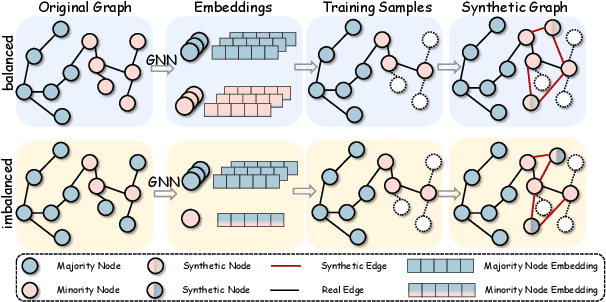

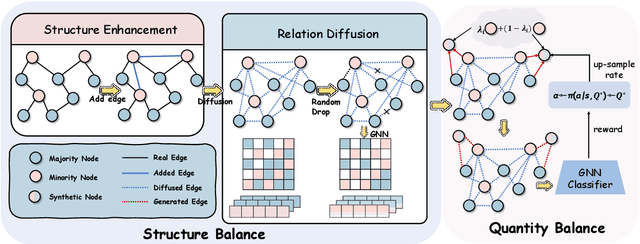
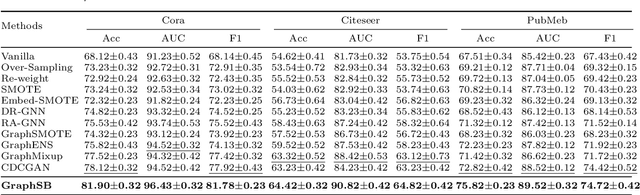
Imbalanced node classification is a critical challenge in graph learning, where most existing methods typically utilize Graph Neural Networks (GNNs) to learn node representations. These methods can be broadly categorized into the data-level and the algorithm-level. The former aims to synthesize minority-class nodes to mitigate quantity imbalance, while the latter tries to optimize the learning process to highlight minority classes. However, neither category addresses the inherently imbalanced graph structure, which is a fundamental factor that incurs majority-class dominance and minority-class assimilation in GNNs. Our theoretical analysis further supports this critical insight. Therefore, we propose GraphSB (Graph Structural Balance), a novel framework that incorporates Structural Balance as a key strategy to address the underlying imbalanced graph structure before node synthesis. Structural Balance performs a two-stage structure optimization: Structure Enhancement that adaptively builds similarity-based edges to strengthen connectivity of minority-class nodes, and Relation Diffusion that captures higher-order dependencies while amplifying signals from minority classes. Thus, GraphSB balances structural distribution before node synthesis, enabling more effective learning in GNNs. Extensive experiments demonstrate that GraphSB significantly outperforms the state-of-the-art methods. More importantly, the proposed Structural Balance can be seamlessly integrated into state-of-the-art methods as a simple plug-and-play module, increasing their accuracy by an average of 3.67\%.