 Add to Chrome
 Add to Firefox
 Add to Edge
ProPRL: Property-Aware Prerequisite Relation Learning in Educational Knowledge Graphs
Aug 04, 2026
Prerequisite relation learning is central to adaptive instruction, yet existing methods often formulate it as conventional link prediction, limiting their ability to adaptively integrate complementary educational evidence for individual candidate pairs and to discourage contradictory reverse predictions. We propose ProPRL, a Property-aware Prerequisite Relation Learning framework. ProPRL first learns complementary concept representations from a concept-resource hypergraph and a directed learning-behavior graph, where direction-preserving personalized propagation aggregates multi-hop behavioral evidence. It then employs a Pair-conditioned Gate to adaptively weight and fuse the two views for each candidate ordered concept pair. Finally, an \textit{Irreversibility Constraint} introduces an anti-symmetry regularizer that penalizes simultaneously high confidence in both directions of the same concept pair. Experiments on multiple real-world educational datasets show that ProPRL achieves state-of-the-art performance on prerequisite relation learning.

Efficient Multi-view Clustering via Unified and Discrete Bipartite Graph Learning
Sep 09, 2022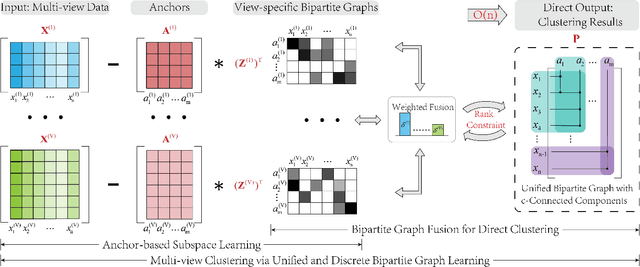
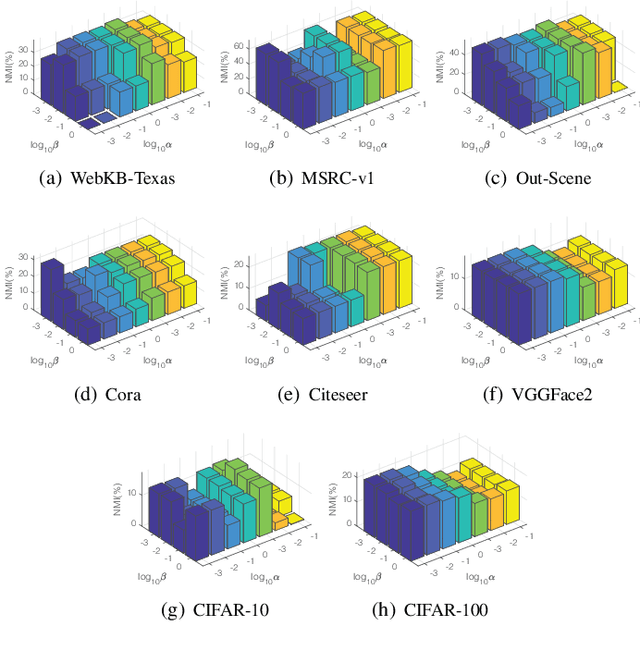
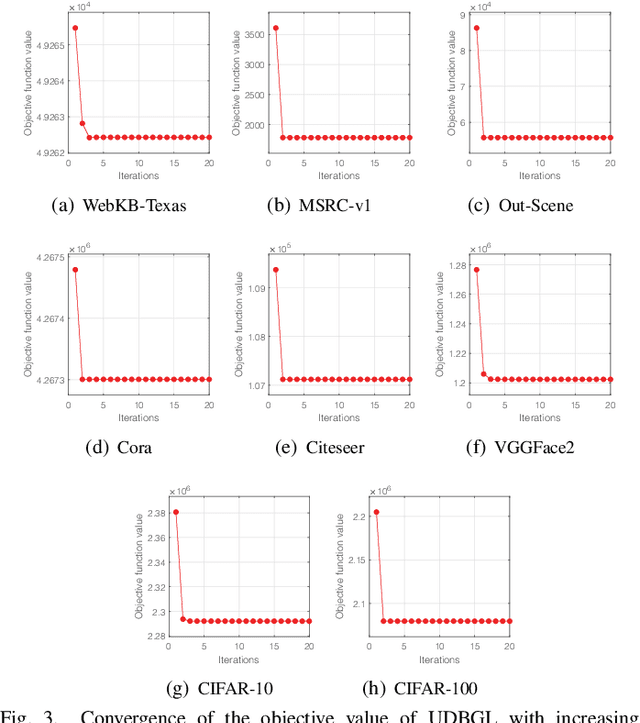
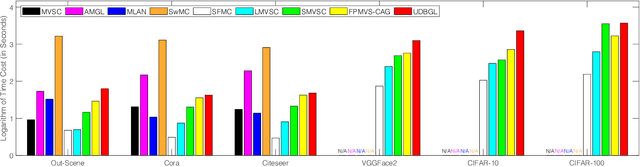
Although previous graph-based multi-view clustering algorithms have gained significant progress, most of them are still faced with three limitations. First, they often suffer from high computational complexity, which restricts their applications in large-scale scenarios. Second, they usually perform graph learning either at the single-view level or at the view-consensus level, but often neglect the possibility of the joint learning of single-view and consensus graphs. Third, many of them rely on the $k$-means for discretization of the spectral embeddings, which lack the ability to directly learn the graph with discrete cluster structure. In light of this, this paper presents an efficient multi-view clustering approach via unified and discrete bipartite graph learning (UDBGL). Specifically, the anchor-based subspace learning is incorporated to learn the view-specific bipartite graphs from multiple views, upon which the bipartite graph fusion is leveraged to learn a view-consensus bipartite graph with adaptive weight learning. Further, the Laplacian rank constraint is imposed to ensure that the fused bipartite graph has discrete cluster structures (with a specific number of connected components). By simultaneously formulating the view-specific bipartite graph learning, the view-consensus bipartite graph learning, and the discrete cluster structure learning into a unified objective function, an efficient minimization algorithm is then designed to tackle this optimization problem and directly achieve a discrete clustering solution without requiring additional partitioning, which notably has linear time complexity in data size. Experiments on a variety of multi-view datasets demonstrate the robustness and efficiency of our UDBGL approach.