 Add to Chrome
 Add to Firefox
 Add to Edge
Parser agreement and disagreement in L2 Korean UD: Implications for human-in-the-loop annotation
May 07, 2026
We propose a simplified human-in-the-loop workflow for second language (L2) Korean morphosyntactic annotation by leveraging agreement between two domain-adapted parsers. We first evaluate whether parser agreement can serve as a proxy for annotation correctness by comparing it with independent human judgments. The results show strong correspondence between parser and human judgments, supporting the feasibility of semi-automatic L2-Korean UD annotation. Further analysis demonstrates that parser disagreements cluster in linguistically predictable domains such as grammatical-relation distinctions and clause-boundary ambiguity. While many disagreement cases are tractable for iterative model refinement, others reflect deeper representational challenges inherent in parsing and tagging L2-Korean corpora.

UD-KSL Treebank v1.3: A semi-automated framework for aligning XPOS-extracted units with UPOS tags
Jun 11, 2025
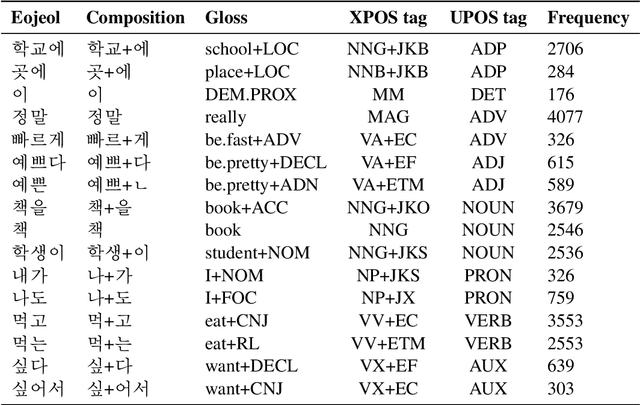


The present study extends recent work on Universal Dependencies annotations for second-language (L2) Korean by introducing a semi-automated framework that identifies morphosyntactic constructions from XPOS sequences and aligns those constructions with corresponding UPOS categories. We also broaden the existing L2-Korean corpus by annotating 2,998 new sentences from argumentative essays. To evaluate the impact of XPOS-UPOS alignments, we fine-tune L2-Korean morphosyntactic analysis models on datasets both with and without these alignments, using two NLP toolkits. Our results indicate that the aligned dataset not only improves consistency across annotation layers but also enhances morphosyntactic tagging and dependency-parsing accuracy, particularly in cases of limited annotated data.
Second language Korean Universal Dependency treebank v1.2: Focus on data augmentation and annotation scheme refinement
Mar 18, 2025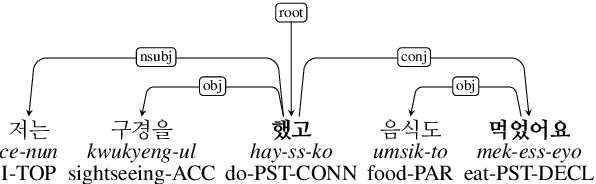
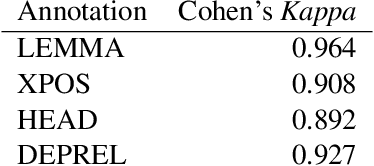
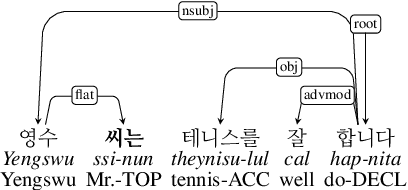

We expand the second language (L2) Korean Universal Dependencies (UD) treebank with 5,454 manually annotated sentences. The annotation guidelines are also revised to better align with the UD framework. Using this enhanced treebank, we fine-tune three Korean language models and evaluate their performance on in-domain and out-of-domain L2-Korean datasets. The results show that fine-tuning significantly improves their performance across various metrics, thus highlighting the importance of using well-tailored L2 datasets for fine-tuning first-language-based, general-purpose language models for the morphosyntactic analysis of L2 data.