 Add to Chrome
 Add to Firefox
 Add to Edge
Model Predictive Current Control with Harmonic Correction for Single-Phase AC-DC EV Charging
Jun 29, 2026
The increasing integration of Electric Vehicles (EVs) has imposed a growing harmonic challenge on the power grid. For AC/DC Power Factor Correction (PFC) in single-phase On-Board Chargers (OBCs), Model Predictive Current Control (MPCC) improves the current quality by predicting and tracking the inductor current. However, finite control set MPCC selects switching states, resulting in discrete control actions and a limited optimisation space. Moreover, the MPCC cost function based on instantaneous current tracking error has limited capability to compensate for low-order harmonic disturbances induced by dead time, control delay, and model parameter mismatch. This paper proposes a duty cycle predictive MPCC incorporating a real-time harmonic estimation reference. The proposed method dynamically estimates the low-order harmonic components of the input current and corrects the MPCC reference current, enabling continuous duty cycle control and targeted suppression of dominant low-order harmonics. Simulation results on a single-phase OBC demonstrate that the proposed duty cycle predictive MPCC reduces the steady-state current THD_i from 11.47% to 6.10% compared with the switching state predictive MPCC. With the harmonic reference, the THD_i is further reduced to 2.85%.

Multimodal Difference Learning for Sequential Recommendation
Dec 11, 2024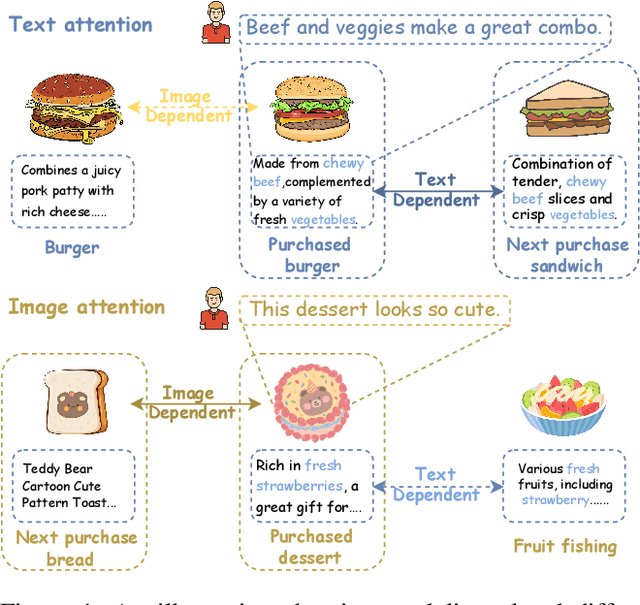
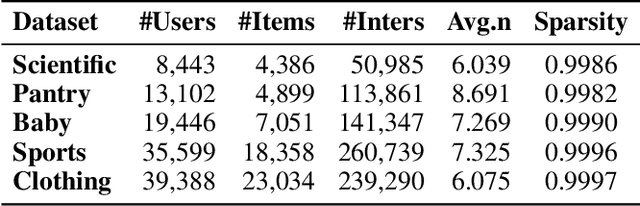
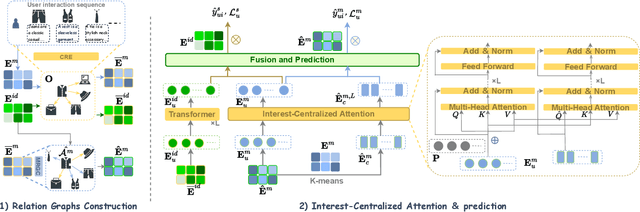
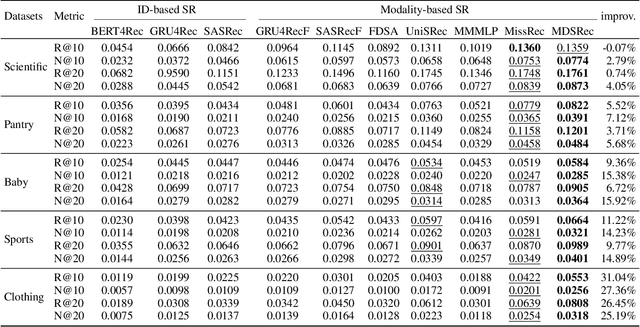
Sequential recommendations have drawn significant attention in modeling the user's historical behaviors to predict the next item. With the booming development of multimodal data (e.g., image, text) on internet platforms, sequential recommendation also benefits from the incorporation of multimodal data. Most methods introduce modal features of items as side information and simply concatenates them to learn unified user interests. Nevertheless, these methods encounter the limitation in modeling multimodal differences. We argue that user interests and item relationships vary across different modalities. To address this problem, we propose a novel Multimodal Difference Learning framework for Sequential Recommendation, MDSRec for brevity. Specifically, we first explore the differences in item relationships by constructing modal-aware item relation graphs with behavior signal to enhance item representations. Then, to capture the differences in user interests across modalities, we design a interest-centralized attention mechanism to independently model user sequence representations in different modalities. Finally, we fuse the user embeddings from multiple modalities to achieve accurate item recommendation. Experimental results on five real-world datasets demonstrate the superiority of MDSRec over state-of-the-art baselines and the efficacy of multimodal difference learning.